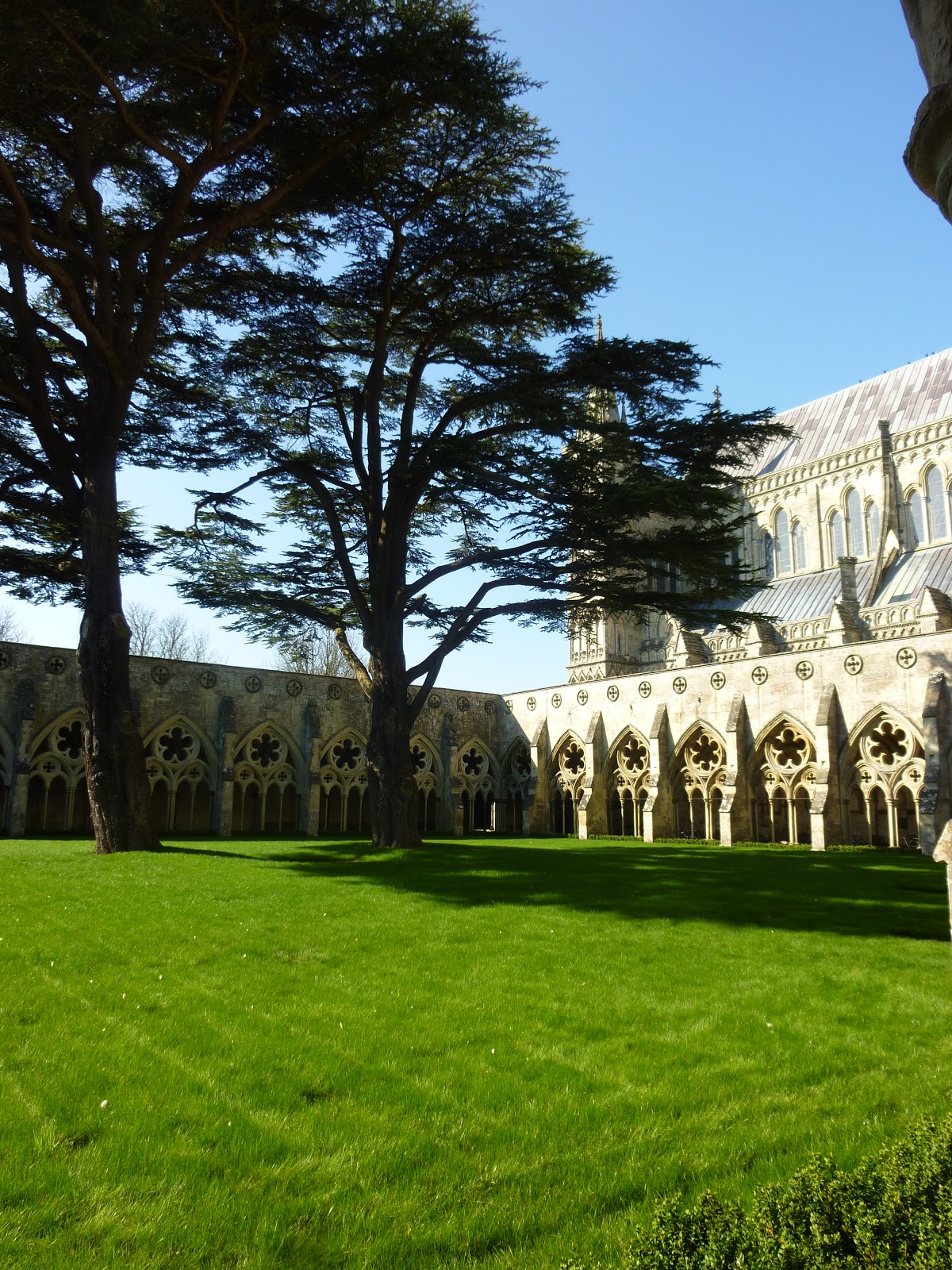
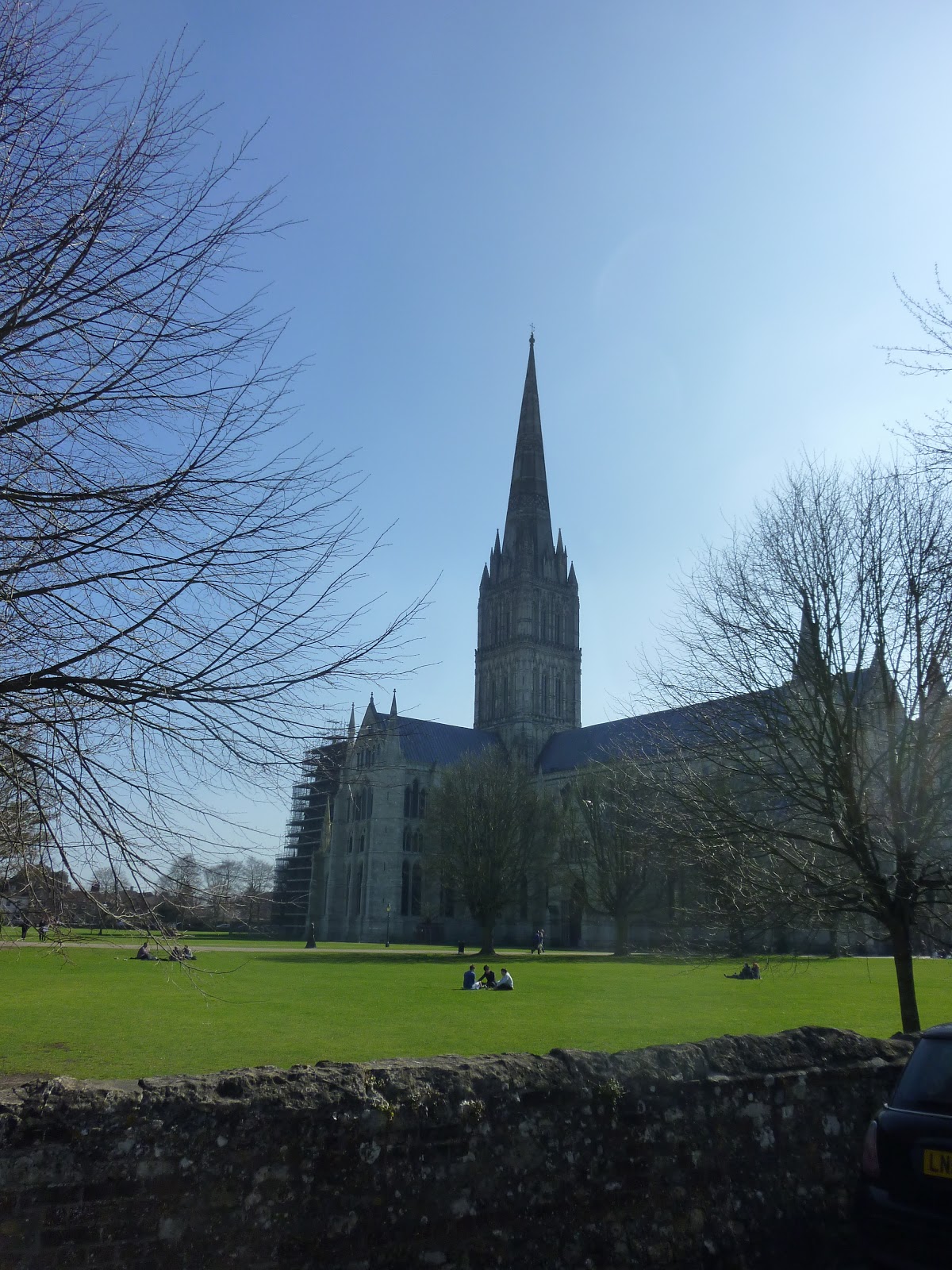
In my last week at Wessex Film and Sound Archive (WFSA) me and Zoe Viney had a research trip to Salisbury. We timed it perfectly, picking the sunniest day of the week to go! I hadn't been to Salisbury before and Zoe hadn't been in years so we did a bit of exploring whilst we were there.
The reason for your visit was to try and gather more information on Eda Moore, an amateur filmmaker from Salisbury whose films are held in WFSA. I love her films as they cover a wide date range, from the 1930s through to the 1970s/1980s and cover a wide range of subjects. The films which we catalogued though were all about Salisbury. This was because the project 'Revitalising the Regions' is all about films from Hampshire and the surroundings regions, including Dorset. Her films about Salisbury show local events, carnivals, parades, processions etc such as the clip shown below.
She also filmed her travels, including many visits back to South Africa. Unfortunately due to the nature of the project I was employed on, I couldn't really justify spending time sitting watching all of these but I did have a peak at a few of them and wish I'd had time to watch them all!
Eda Moore herself, though, was proving a good deal more elusive than her films. We couldn't find out much biographical information about her at all. So, a trip to Salisbury was called for - oh the hardships of being a film cataloguer/researcher! The first stop was at Salisbury Local Reference Library where we found lots of useful information, mostly through an obituary for her we found on the microfilm for the Salisbury Journal. We found the obituary because Zoe had found out her date of death through Ancestry - I'm ashamed to admit that it hadn't occurred to me to use something like Ancestry, some archivist eh!?
Our next port of call was Salisbury & South Wiltshire Museum, whom I had been in touch with via e-mail. They had informed us they had a box of archive material about Eda Moore's father, Francis John Moore, who had been Mayor of Salisbury 1953/1954. They suggested we might want to look through the material as it included a large book compiled of press cuttings. Another confession - I totally forgot to get in touch and set up an appointment so we just popped in when we were there. Terrible I know, just dropping in like that, but thankfully the staff there were super friendly and helpful! We had a walk round the museum (which I'd highly recommend) sat outside Salisbury Cathedral for lunch and then got to look through the material. It proved very illuminating and gave us lots of useful information - my favourite nugget was a page written by Eda Moore herself where she talks about carrying her Bolex around in her handbag with her. I love it! I have this image now of this very genteel lady, going to official events at the invite of her father the Mayor, all the while having her camera in her bag so she could film!
Whilst in Salisbury we also fitted in a visit to the Cathedral which was absolutely beautiful, both inside and out. My photos, as usual, don't do it justice. It was so satisfying to be able to fill in some gaps in the story of Eda Moore before finishing up at WFSA. I'm going to miss my colleagues, and the films of course!, but I know I can keep checking out the WFSA Flickr to see what's new.
Showing posts with label Wessex Film and Sound Archive. Show all posts
Sunday, 27 March 2011
Tuesday, 22 March 2011
Today was the first day of my last week at Wessex Film and Sound Archive(WFSA) before I move on to pastures new (more of that in a later post once I start the new job!). My post at WFSA was only a six month post and I'll be leaving it four weeks early but having completed all the work I was scheduled to do, in addition to all the extra work me and Zoe Viney have done on promoting and project and the Archive.
What have I learned?
- Cataloguing films isn't different from cataloguing paper documents in terms of the description of the material i.e. keep it descriptive, don't use words the general public couldn't understand (unless you also provide a glossary), include as much contextual information as possible given time and availability of information constraints, include all the ISAD(G) elements
- Knowledge of the variety of film and audio formats and knowledge of how to identify and differentiate between them
- I've learned more of the quirks and functions of CALM as I've continued using that at WFSA
- The wonders of Excel! - it is fantastic for keeping and managing timetables and deadlines. I can now use an Excel spreadsheet, and create one, with a lot more confidence - thanks Zoe!
- I have been working on a Mac so have greatly increased my knowledge of using that, including simple things like learning how to take screenshots
- I've installed and used DROID - Digital Record Object IDentification
- I've learned how to edit film clips using Quicktime
- Experience of using an 8mm projector
- Plenty of experience now of using a Steenbeck - which I love!
- Splicing film, adding leader tape
- An awareness of the various ways and places in which archive film can be utilised, such as the Little Black Dress exhibition in Portsmouth
- More experience of carrying out research - into film locations and film makers.
- I now have knowledge of Hampshire, Dorset, Isle of Wight - and lots of places which I would now like to visit in person, as opposed to just seeing on film
- Increased experience of the ways in which Twitter and Flickr can be used by Archives to promote specific projects and Archives in general.
Wednesday, 23 February 2011
Fun with statistics
Now, if you'd asked me any time up until this if I could have fun with statistics the answer would have been a very quick and very clear No! However I've since rediscovered the StatCounter account I set up when I started Archives and Auteurs and I am amazed to find myself idly browsing my blog's statistics. The reason I remembered about the account was thinking about the work Flickr I recently set up with Zoe Viney for the Wessex Film and Sound Archive. We couldn't find any way for collecting statistical information through Flickr beyond the basic page views information. I remembered about StatCounter and surprised myself by remembering my user name and password as well. It had still been running even though I haven't been logging in but as I hadn't added my new IP addresses (work and home) to the list of addresses not to count then I think my results might be slightly skewed. So, if anyone else is setting up StatCounter or any similar statistical service then it is always best to block your own computer's IP address so your figures are more accurate, unless your memory is really bad and you want to keep count of your own views of course.
The images I've included below show the breakdown by country of visitors to my blog over the course of last week, then the second one lists in more detail every country that views have come from. you can narrow this down to city as well. Other useful things you can check are which pages are the most popular, which websites people are directed to your site from, how long they stay (this can sometimes be a bit painful), and lots of other useful, or useless, information depending on your point of view/general inclination to nosiness.
What I found most useful was information on how people had found my blog - what terms they had searched for or what website they had come from. This made me think more about the tagging I use on my posts and I have resolved to try and be a bit more thorough in my tagging - treating it more like my actual cataloguing work than I have done in the past.
I haven't started using it yet for the WFSA Flickr account for two reasons, the first being I thought I would try it first with my Flickr account to see if it worked. With StatCounter, and I assume it is similar whatever software you use, you have to input the HTML code in to your profile on Flickr then add the web pages to your statistic software account. I'm find doing this with my own account but I was a bit unsure with the work one - does this give them access to other information on your Flickr account, do they have rights over the statistical data as it is displayed on their account? These questions are things I would rather investigate more fully before using it for workplace statistics - but for now I'll keep enjoying using it for my own web pages.
Tuesday, 22 February 2011
Thoughts on using Flickr for Archives
Since last Friday me and fellow cataloguer Zoe Viney have been avidly following our Flickr statistics (really not as boring as it sounds!) and the publicity we did has had a huge impact on viewing figures. Just using mailing lists such as the Archives NRA list, Hampshire County Council lists, and our Twitter we had over 300 views by the end of the first day (last Friday, 18th February 2011) and as of five minutes ago we have 495 views - pretty good going for five days I would say! Even though I use Twitter every day, check my mailing lists every day and so on, I was still surprised by the high response rate to our postings. I think this illustrates the high value which such social networking tools as Twitter, Facebook and Flickr can have for an archive, especially in these difficult times of cuts and closures.
Our original aim was to create an online exhibition which would promote the project we are working on specifically and the Wessex Film and Sound Archive more generally. This was an additional outcome to the project rather than a core part of it so we had to do it for free, and without using up our cataloguing time. I had used Flickr before when I worked at Stirling University (see their Flickr here) so I knew how easy it was to set up and to upload images to. I had never used it to upload videos before but this isn't any different to uploading photos so doesn't take long at all. What I had thought would take longer was actually making clips from the digital copies of the films. However this was surprisingly straightforward using Quicktime to select then extract a short section of a film. The quality of the images varied hugely depending on whether we were doing screenshots from Quicktime files, DVD copies, or taking photographs of a screen showing a VHS copy with the Quicktime files giving the best quality still shots.
The exhibition is 'A Sense of Place' - let me know what you think of it and feel free to add any additional information or comments to the Flickr site. It is very easy to use Flickr and by using some free publicity, very easy to direct people to your site. However what seems to be a lot harder, well at least I've found it harder, is encouraging people to interact and communicate with the archives through Flickr. Our aim now should be to try to generate more user interaction, maybe by posting stills of places or people we can't identify - that's the next project to get started on!
Another thing - trying to set up an exhibition within Flickr, (we don't have Flickr Pro so can't use Collections, only Sets) was tricky. It was only due to Zoe's persistence with sorting out the links that it works (well, we think it works, let us know what you think). it took a lot of tweaking to get it so that we could create themes then link to a set of images from a particular film. Flickr Pro would help with this as you could create Collections, then Sets within the Collections - if the exhibition and our general use of Flickr proves to be a success then we hope that Flickr Pro is something the Record Office would consider investing in (not that it's a huge investment really, just $25).
I think this clip below shows just how much you can get out of a 1 minute 30 second clip - there is just so much going on at this market and fair! The film is titled 1939 - 1963 Then and Now as the filmmaker Eda Moore spliced together footage of Salisbury (her hometown) across this date range to show what had changed, and what had stayed the same.
AV509/3 - Eda Moore 1939 - 1963 Then and Now
Our original aim was to create an online exhibition which would promote the project we are working on specifically and the Wessex Film and Sound Archive more generally. This was an additional outcome to the project rather than a core part of it so we had to do it for free, and without using up our cataloguing time. I had used Flickr before when I worked at Stirling University (see their Flickr here) so I knew how easy it was to set up and to upload images to. I had never used it to upload videos before but this isn't any different to uploading photos so doesn't take long at all. What I had thought would take longer was actually making clips from the digital copies of the films. However this was surprisingly straightforward using Quicktime to select then extract a short section of a film. The quality of the images varied hugely depending on whether we were doing screenshots from Quicktime files, DVD copies, or taking photographs of a screen showing a VHS copy with the Quicktime files giving the best quality still shots.
The exhibition is 'A Sense of Place' - let me know what you think of it and feel free to add any additional information or comments to the Flickr site. It is very easy to use Flickr and by using some free publicity, very easy to direct people to your site. However what seems to be a lot harder, well at least I've found it harder, is encouraging people to interact and communicate with the archives through Flickr. Our aim now should be to try to generate more user interaction, maybe by posting stills of places or people we can't identify - that's the next project to get started on!
Another thing - trying to set up an exhibition within Flickr, (we don't have Flickr Pro so can't use Collections, only Sets) was tricky. It was only due to Zoe's persistence with sorting out the links that it works (well, we think it works, let us know what you think). it took a lot of tweaking to get it so that we could create themes then link to a set of images from a particular film. Flickr Pro would help with this as you could create Collections, then Sets within the Collections - if the exhibition and our general use of Flickr proves to be a success then we hope that Flickr Pro is something the Record Office would consider investing in (not that it's a huge investment really, just $25).
I think this clip below shows just how much you can get out of a 1 minute 30 second clip - there is just so much going on at this market and fair! The film is titled 1939 - 1963 Then and Now as the filmmaker Eda Moore spliced together footage of Salisbury (her hometown) across this date range to show what had changed, and what had stayed the same.
AV509/3 - Eda Moore 1939 - 1963 Then and Now
Friday, 14 January 2011
Using Wordle for Archives
Yes, I know I'm coming slightly late to the party but I've just discovered the fun of using Wordle for Archive Collections - it's great! At lunchtime today I've been experimenting with entering the text from a number of small film collections (such as the example below). This means that you get an overview of the main subjects, places and names which appear in these films. I haven't worked out yet if there's a way to stop a word from appearing more than once so if anyone knows if there is a way to do this then please let me know. As well as being eye-catching and nice to look at I think Wordle could be very useful, for highlighting the places or subjects which are discussed, or in the case of film archives shown, in a particular collection. It could also give a general overview of the content of an entire archive, a filmmaker, a particular project - anything you want to highlight from your collections really... it's also quite an enjoyable way to while away a hour or so!
The examples below are from the text of my cataloguing for four films by Antony Clover, an amateur filmmaker from Portsmouth.
Monday, 6 December 2010
'Revitalising the Regions' - reflections on my first month working in a film archive
I should change the title to first six weeks as I started writing this post ages ago - as visitors to my blog will know my posts have been far from regular recently! With the move to London and the new job I seem to have got rather behind with my postings. My new job is just what I was looking for as it is a post as a film cataloguer. I knew when I did my Masters in Archives that I was interested in working in a film and sound archive but I think what I hadn’t was expected was just how much I have loved all my jobs since I qualified! I would consider myself a pretty positive person most of the time anyway but I can’t imagine how anyone could get bored with the variety of material you get to work with in an archive.
The Wessex Film and Sound Archive where I now work has its home in the Hampshire Records Office in Winchester. So, I now have a commute from London to Winchester every day – the opposite direction to most people. I really enjoy the commute though, I started writing this on the train one day last week but I often use the journey for an extra wee half hour snooze, or to read my book, or just enjoy the beautiful scenery passing by outside the window.
So, my new job: I am working on a project again, as a film cataloguer, this time on a six month post. I enjoy project work and for me it’s been a great way to start out in the profession, going from projects at Glasgow Caledonian University, to Stirling University and now on to Wessex Film and Sound Archive. Although with the way the cuts in the arts and cultural heritage sector are going I'm starting to get slightly worried about finding another job come next April!
The project I am working on ‘Revitalising the Regions’ is one strand of the larger Screen Heritage UK project, itself based on the Strategy for UK Screen Heritage which states that -
“The public are entitled to access, learn about and enjoy their rich screen heritage wherever they live and wherever the materials are held.”
I am working, along with fellow cataloguer Zoe Viney on cataloguing over 600 films which will then be put on the Screen Heritage UK Union catalogue. Some of the films we’re cataloguing already have some cataloguing information on them, others have very little, and many have nothing except one line of description. We have set fields we have to complete in order for the records to be exported to the Union Search catalogue, which covers information about the format and physical description of the film in addition to date, title, any information about the filmmakers, and of course description of the film itself. In addition to the set fields we are also adding in any additional contextual information to the films which we think could be useful to users.
My only experience of cataloguing films prior to this job was one afternoon, a very interesting afternoon, at the Huntley Film Archive (which I wrote about in an earlier post here). I was slightly apprehensive about beginning then but have found that the cataloguing process works in much the same way as with paper records, in fact, I'm not even sure why I would have thought differently as the main purpose of any cataloguing is to make the records more accessibly, understandable, provide context etc. whatever the format. What I have found difficult is the films which have sound as it's difficult not to write down everything in the commentary, and difficult to concentrate on the visual. Is this just me, that the aural takes over the visual when they are both together? It's made me think more about sound in movies, and about silent films. In a silent film, or one with limited sound, or even with only diagetic sound, the image is central, but maybe I'm not alone that once there is a soundtrack or commentary, it becomes hard to pull back and only concentrate on the visual? I'm really enjoying cataloguing the films as I'm learning so much about Hampshire, its history, landscape, industries, culture and people. I'm hoping to become a bit more regular with my posts again so I'll write more about specific films as I catalogue them.
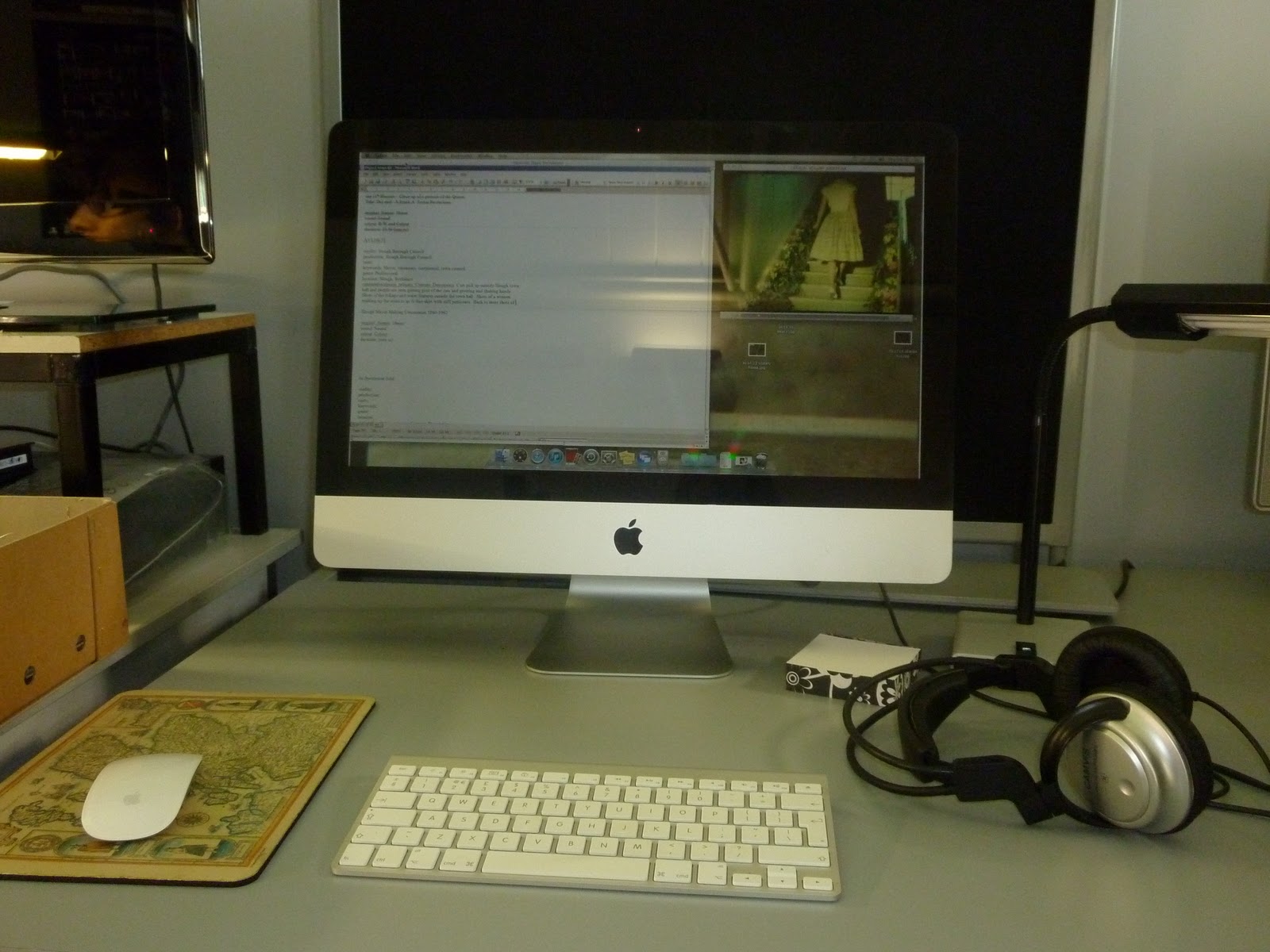
My new workspace - with TV and VHS player to the right.
I also have a mouse mat map of Scotland for when I get homesick
Before I started work Zoe had already set up a Twitter account for us to chart our progress, document our finds, and ask for help if, for example, we can’t identify a particular building in a town, so we’ve both been posting to this on a regular basis. In addition to the Twitter account I’ll continue to write about my work on this blog.
Tuesday, 30 November 2010
Happy St Andrew's Day!
Today is St. Andrew's Day and although I am no longer living in Scotland, indeed perhaps because of it, St. Andrew's Day has made me remember all the things I love about my home country. The mountains, the forests, Glasgow, Fife fishing villages, Skye, the history, the arts and culture, and of course family and friends.
I liked this wee animation on Scotland.org which gives a brief history of the story of St Andrew.
I just posted a photo on my work Twitter as well - via our Twitpic. Zoe, the other film cataloguer I work with, set up the Twitter and we both use it to post stills from the films we're cataloguing. It's useful if we're stuck on identifying a place or building as we can post an image and get help from other people!
The photo I've posted, of the Forth Rail Bridge, is somewhere I'll be seeing soon as we're off back up to Fife at Christmas time.
I'm in the process of writing a longer post about my new job - which I'm really enjoying! - but the dark nights are holding me back as I struggle to get the laptop out and do any work when I get home! I'll get it finished and posted soon though.
I liked this wee animation on Scotland.org which gives a brief history of the story of St Andrew.
I just posted a photo on my work Twitter as well - via our Twitpic. Zoe, the other film cataloguer I work with, set up the Twitter and we both use it to post stills from the films we're cataloguing. It's useful if we're stuck on identifying a place or building as we can post an image and get help from other people!
The photo I've posted, of the Forth Rail Bridge, is somewhere I'll be seeing soon as we're off back up to Fife at Christmas time.
I'm in the process of writing a longer post about my new job - which I'm really enjoying! - but the dark nights are holding me back as I struggle to get the laptop out and do any work when I get home! I'll get it finished and posted soon though.
Subscribe to:
Posts (Atom)