Showing posts with label archivists. Show all posts

Tuesday, 1 May 2012

'A Confederacy of Dunces' - a missing manuscript and a found history

This is the story of a researcher who went searching for a manuscript and discovered the memories he found instead were more valuable - I just loved this when I read it so thought I'd share it!

Cory MacLauchlin has recently published a biography of the writer John Kennedy Toole.  Butterfly in the Typewriter: the Tragic Life of John Kennedy Toole and the Remarkable Story of the Confederacy of Dunces tells the long and sad tale of  John Kennedy Toole and his novel A Confederacy of Dunces. MacLauchlin tells how, after writing the book, Toole corresponded with an editor for two years.  When after this time they still could not agree on the revisions Toole shelved the manuscript.  He didn't write any more novels and after suffering a mental breakdown committed suicide at the age of 31 in 1969.  However the story of the book didn't end there as Toole’s mother found the manuscript and eventually found a supporter for it in the author Walker Percy, who found a publisher.  It went on to win the Pulitzer Prize in 1981.  However the original manuscript which Toole's mother passed on to Walker Percy has never been found.

MacLauchlin states that
"I have been researching and writing about Toole for seven years, digging through archives, interviewing his friends and family, trying to decipher Toole’s character, his fears, his desires, his angels and demons. And I have often contemplated that missing manuscript. "
He tells how he almost thought he had found it when talking to Lynda Martin, the sister of Toole's best friend in High School.  He flies on a plane to go meet her, full of excitement at possibly finding the original manuscript.

The subsequent deflation when he realises it is a copy and not the original is quickly dispelled when Lynda Martin offers to recount her memories of John Kennedy Toole.  I think this bit of the article is a wonderful example of the importance of oral history, of the first-hand record, the completely not-impartial sharing of stories, of life.  Cory MacLauchlin expresses it far more eloquently than me here:
Earlier that morning, I thought I was going to find a rare artefact of literary history, which would help me gain a clearer picture of Toole’s descent towards suicide. But Lynda’s memories were far more profound to me than dissecting how Toole edited his famous novel. Of course, I had to report to my agent and my editor that I had not found the manuscript. But I took heart in what Lynda freely offered me: a vivid portrait of a young aspiring artist, exploring a city filled with unique characters. No documents in the Toole Papers offered such a depiction, a depiction far more valuable than his manuscript.
As he says, of course he would still like to find the original manuscript some day and I don't intend to denigrate the importance of original manuscripts in my re-telling of this story either.  When I thought was so lovely about this story was his surprise at what he did find, at these wonderful memories which won't be around forever and which, unlike the manuscript, could not still be discovered another 30/40 years down the line.. until of course MacLauchlin turned up to find the manuscript and instead ended up filming her oral testimony of John Kennedy Toole.

Wednesday, 1 June 2011

Wednesday Wonders

I thought that, in conjunction with my, still relatively, new job cataloguing the records of the National Union of Women Teachers I would start my first 'series' on this blog.  So, 'Wednesday Wonders' it is!  I still get so excited by some of the things I come across when cataloguing - in fact, all archivists I know do - it's one of the major perks of the job.  The best thing for me now is that I'm sharing an office so not only can I share my finds in blog land I can also share them instantly with real live people!  That's not to belittle sharing things in blogland, far from it, I love reading about the archive work going on in Archives in far off lands and I hope that archivists elsewhere get as much pleasure from reading my blog, and of course, that non-archivists enjoy it too!

This week's Wednesday Wonder was one of those moments when you really do just go 'hey you'll never guess what I've just found' and hope your colleagues share your enthusiasm.  It was the lovely colours of the headed notepaper that first caught my attention.  The green and purple is lovely, and I thought, hmmn, this looks slightly familiar.  Then I looked closer, it was letter headed notepaper from the Women's Social and Political Union!

Letter from Rose Lamartine Yates, ref UWT/D/47/1, © Institute of Education
The WSPU was founded by Emmeline Pankhurst and her three daughters Emmeline, Adela and Christabel Pankhurst.  It was founded in 1903, one year before the NUWT, and they were founded out of frustration with what they saw as a lack of action in terms of obtaining the vote for women.  Their motto 'Deeds, not Words' reflects their stance.  The Women's Library website has a great summary of the WSPU so I won't repeat it all here.

As you can see this letter is a bit later, from 1933.  Rose Lamartine Yates (1875 - 1954) was born in Brixton to French parents.  She studied in the UK and in France.  In 1909 she joined the Wimbledon branch of the WSPU and by 1910 she was the Treasurer and Organising Secretary of the Branch.  In the letter she thanks Ethel Froud (the General Secretary of the NUWT at that time) for inviting her to attend NUWT conference but explains that she was too busy [she was] 'needed here', and was also ill, so she could not make it.  It's really interesting that this letter is dated 1933 as the WSPU ceased to exist in 1919 - maybe Rose Lamartine Yates just had an excess of headed notepaper!  The WSPU were very much about publicising the cause wherever possible and the collection of WSPU items at the Museum of London illustrates this - they have WSPU green and purple tea pots, badges, sashes, and WSPU stockings! 

So thank you for reading, it's been nice to share! Any archivists out there have any favourite finds from their cataloguing work?  What about in other professions? Any unusual finds? 

N.B. For more information on the content of the NUWT Archive you can search the catalogue here.  I also post about the NUWT project on the Institute of Education Library and Archive blog, Newsam News.

Monday, 6 December 2010

'Revitalising the Regions' - reflections on my first month working in a film archive

I should change the title to first six weeks as I started writing this post ages ago - as visitors to my blog will know my posts have been far from regular recently!  With the move to London and the new job I seem to have got rather behind with my postings.   My new job is just what I was looking for as it is a post as a film cataloguer.  I knew when I did my Masters in Archives that I was interested in working in a film and sound archive but I think what I hadn’t was expected was just how much I have loved all my jobs since I qualified! I would consider myself a pretty positive person most of the time anyway but I can’t imagine how anyone could get bored with the variety of material you get to work with in an archive. 

The Wessex Film and Sound Archive where I now work has its home in the Hampshire Records Office in Winchester.  So, I now have a commute from London to Winchester every day – the opposite direction to most people.  I really enjoy the commute though, I started writing this on the train one day last week but I often use the journey for an extra wee half hour snooze, or to read my book, or just enjoy the beautiful scenery passing by outside the window.

So, my new job: I am working on a project again, as a film cataloguer, this time on a six month post.  I enjoy project work and for me it’s been a great way to start out in the profession, going from projects at Glasgow Caledonian University, to Stirling University and now on to Wessex Film and Sound Archive.   Although with the way the cuts in the arts and cultural heritage sector are going I'm starting to get slightly worried about finding another job come next April!  

The project I am working on ‘Revitalising the Regions’ is one strand of the larger Screen Heritage UK project, itself based on the Strategy for UK Screen Heritage which states that -
“The public are entitled to access, learn about and enjoy their rich screen heritage wherever they live and wherever the materials are held.”

I am working, along with fellow cataloguer Zoe Viney on cataloguing over 600 films which will then be put on the Screen Heritage UK Union catalogue.  Some of the films we’re cataloguing already have some cataloguing information on them, others have very little, and many have nothing except one line of description.  We have set fields we have to complete in order for the records to be exported to the Union Search catalogue, which covers information about the format and physical description of the film in addition to date, title, any information about the filmmakers, and of course description of the film itself.  In addition to the set fields we are also adding in any additional contextual information to the films which we think could be useful to users.  

My only experience of cataloguing films prior to this job was one afternoon, a very interesting afternoon, at the Huntley Film Archive (which I wrote about in an earlier post here).  I was slightly apprehensive about beginning then but have found that the cataloguing process works in much the same way as with paper records, in fact, I'm not even sure why I would have thought differently as the main purpose of any cataloguing is to make the records more accessibly, understandable, provide context etc. whatever the format.  What I have found difficult is the films which have sound as it's difficult not to write down everything in the commentary, and difficult to concentrate on the visual.  Is this just me, that the aural takes over the visual when they are both together?  It's made me think more about sound in movies, and about silent films.  In a silent film, or one with limited sound, or even with only diagetic sound, the image is central, but maybe I'm not alone that once there is a soundtrack or commentary, it becomes hard to pull back and only concentrate on the visual?  I'm really enjoying cataloguing the films as I'm learning so much about Hampshire, its history, landscape, industries, culture and people. I'm hoping to become a bit more regular with my posts again so I'll write more about specific films as I catalogue them. 


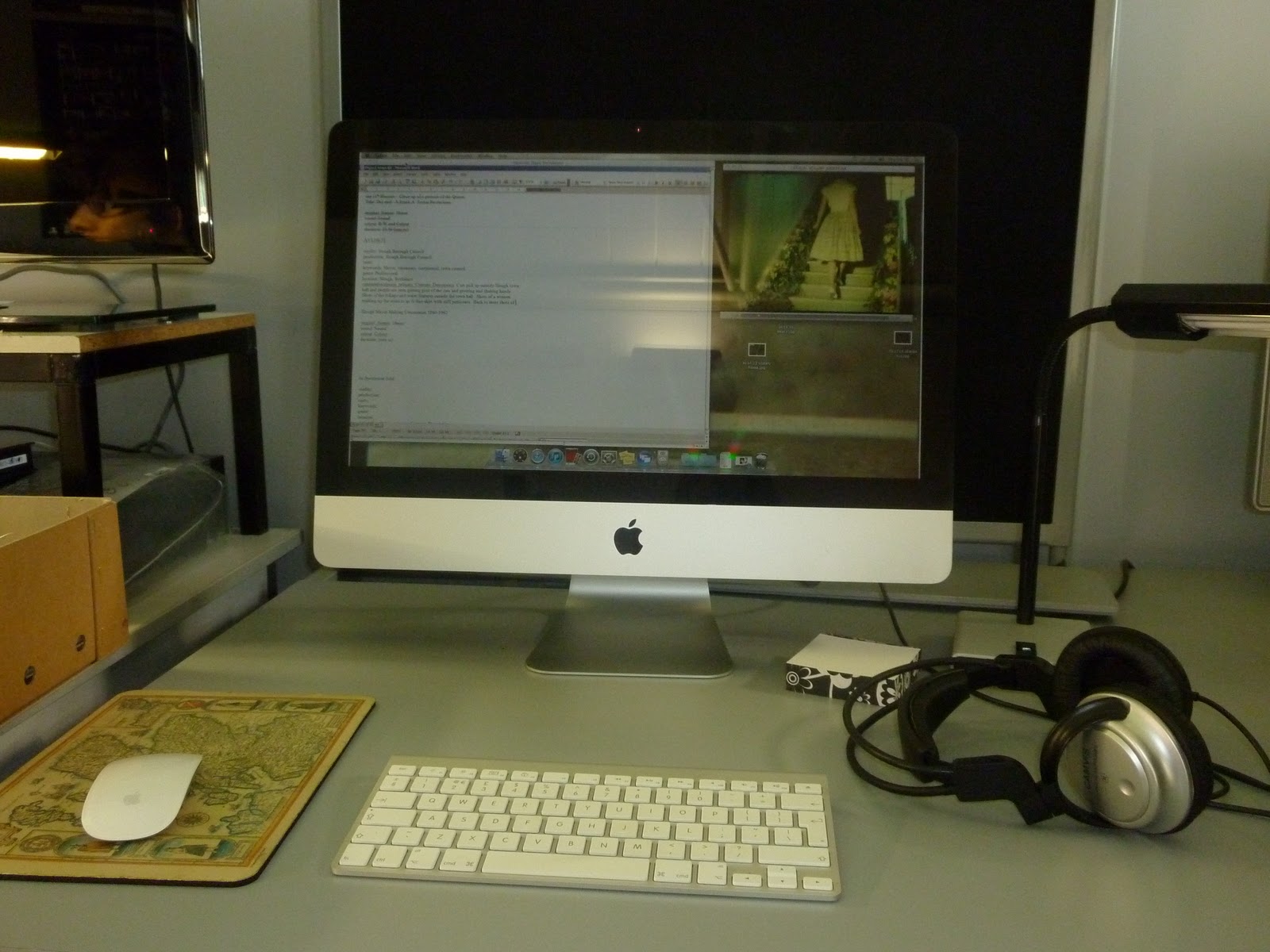
My new workspace - with TV and VHS player to the right.
I also have a mouse mat map of Scotland for when I get homesick

Before I started work Zoe had already set up a Twitter account for us to chart our progress, document our finds, and ask for help if, for example, we can’t identify a particular building in a town, so we’ve both been posting to this on a regular basis.  In addition to the Twitter account I’ll continue to write about my work on this blog. 

Monday, 7 June 2010

Cataloguing - timetables and deadlines

All my plans of getting straight back into posting in May came to naught as I've become increasingly aware of my looming project deadlines. However I now have a very helpful Excel spreadsheet with a full breakdown of everything I want to achieve, set out week by week! Although there's still a huge amount to do before the project finishes at the end of August I now feel that it is all achievable and it makes it so much easier to just get on with the work and not panic. Part of my timetable includes posting on my blog so I thought I would start with a topical (for me) post about my cataloguing.

The thing that's so hard about doing a timetable for cataloguing archival records is that until you open each individual file you don't know how many letters there are, and until you catalogue each letter you don't know how much content there is in it. Letters with lots of interesting content take far longer than say, a greetings card sent simply to say 'Happy New Year'. Quite often the letters with lots of detail about film projects, theatre projects, actors, directors etc also require research into the people and subjects referred to as these will have to be added to the name and subject indexes on the cataloguing system. So I have to remind myself that if some weeks I don't quite meet my targets that's ok as other weeks I can have met them by the Thursday - as long as I get there by the end of August!


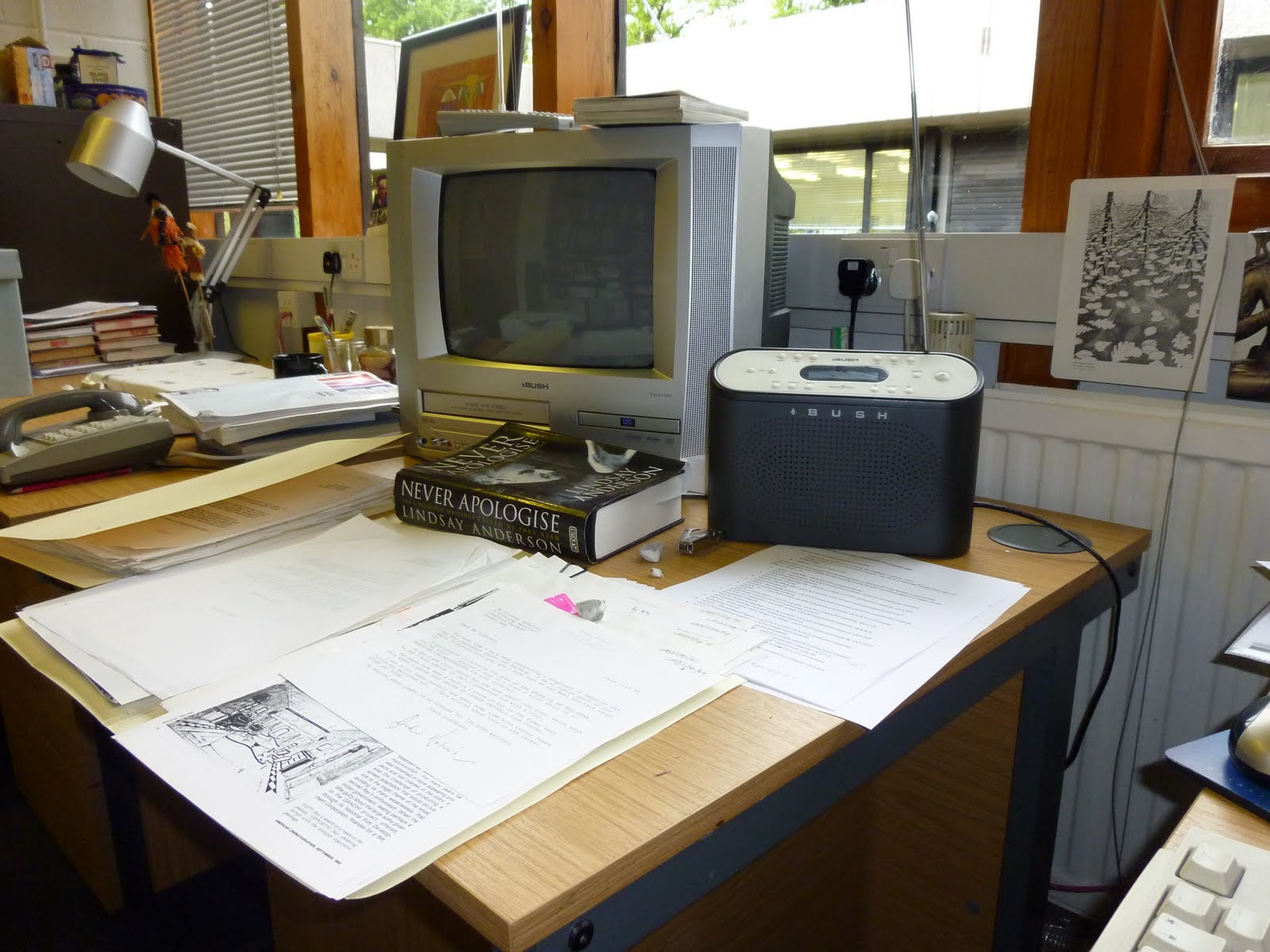
This first photo shows the files I am currently cataloguing - the A-Z correspondence files. I've talked about the fun of cataloguing these before as you never know quite what you're going to find - Friday's cataloguing included letters from Lindsay Anderson to Ridley Scott and this mornings started with a series of letters between Anderson and Dame Maggie Smith re a film version of The Cherry Orchard which was in development for a long time, but which finally fell through. Anderson had long wanted to direct a film of this play by Chekhov, having directed it in the theatre twice. Maggie Smith had agreed to star in it and the plan was to get Dustin Hoffman for the lead male role - if only it had happened!


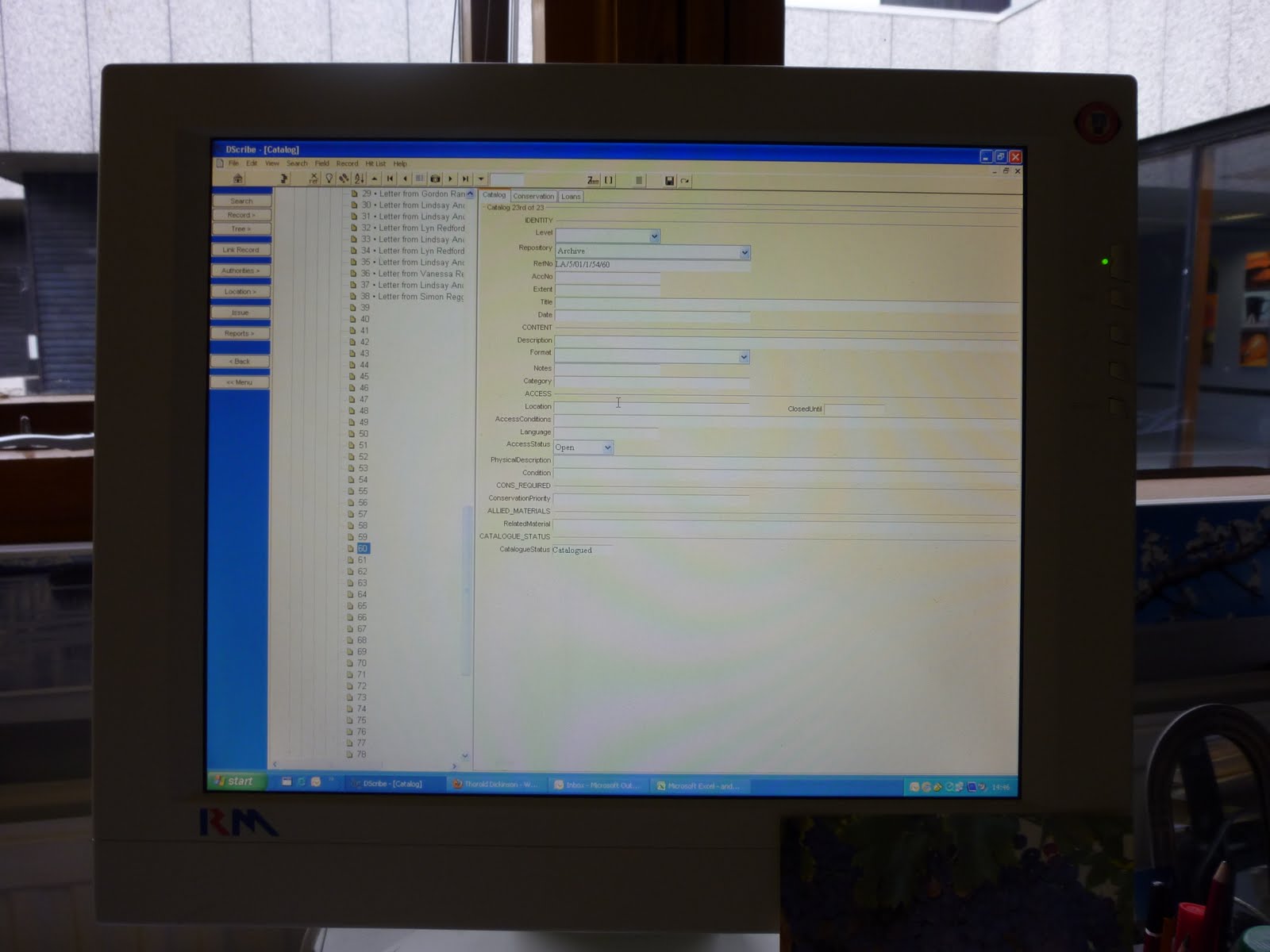
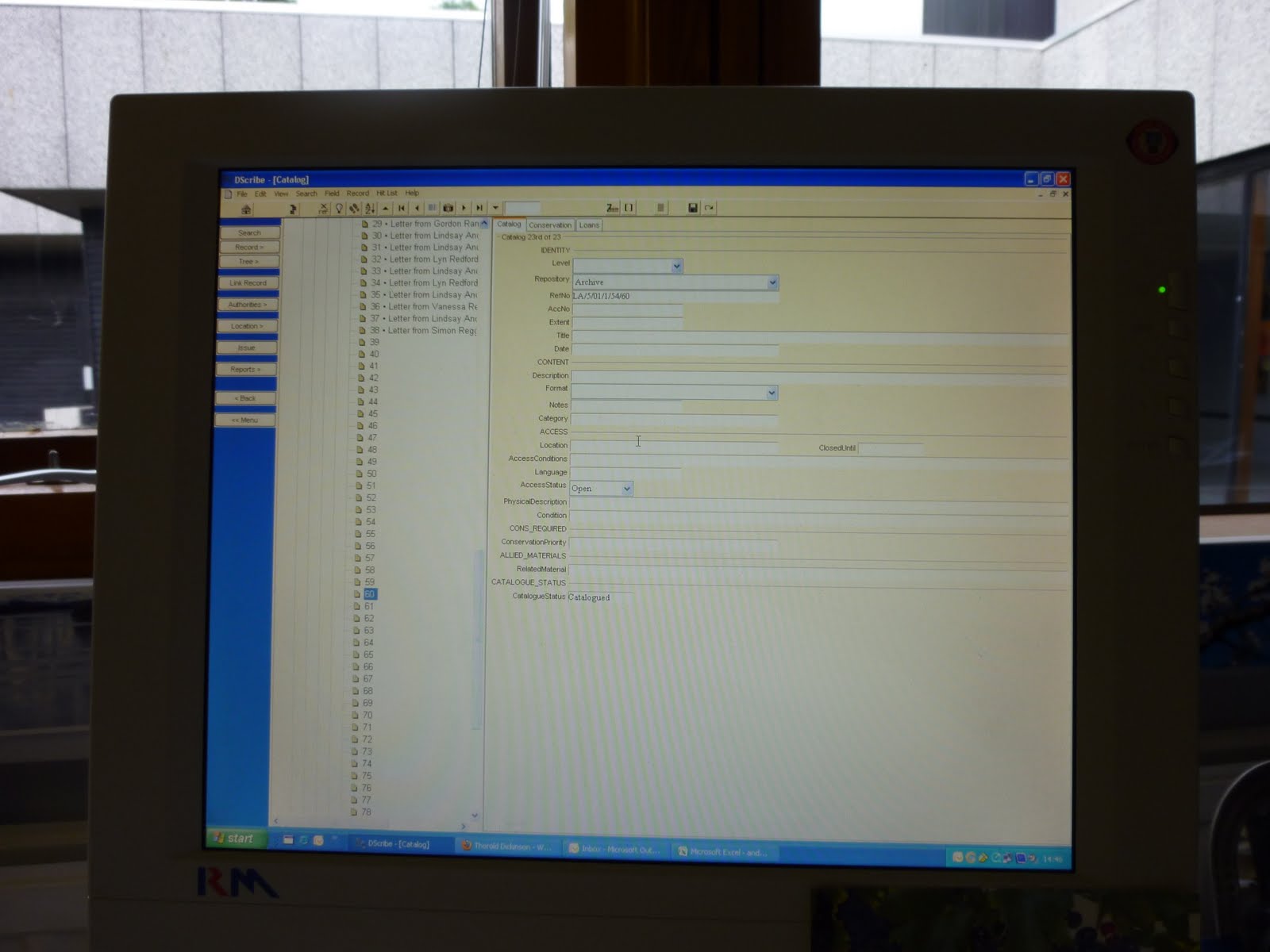
The cataloguing of each file begins by sorting the letters into order alphabetically, then chronologically from earliest to most recent, helpfully all the letters with each correspondent are usually already together. Then it's a case of numbering every letter with a unique identifying code which consists of the collection name, sub-collection, series, sub-series, file and item, for example at the moment I'm doing LA/5/1/1/57/45 with 'LA' identifying the collection, 5 identifying the sub-collection 'working papers', the first 1 is the series 'correspondence files', the second 1 is the sub-series 'correspondence files A-Z', the 57 is the file number and is 'correspondence, S' and 45 is the number of the individual letter from Maggie Smith. After the numbering is done then the folder will be catalogued onto the cataloguing software CALM for Archives - you can see a screenshot in the photo above - this is going to be ingrained on my brain by the end of the project as I've already started dreaming about cataloguing on days when I have a particularly heavy workload!

Once catalogued the folder will be divided up into two or three folders if the amount of letters is too heavy for one folder and these folders are put in new acid-free paper, archival standard boxes. It may not sound too exciting but I love it! The TV in the room is strictly for work-related use by the way! Quite a few of Anderson's films are not available on DVD so it's been really handy to have this TV with a VHS and DVD player built in. Glory! Glory! and The Whales of August are the two which come to mind immediately as being only on VHS (in the UK) so it was necessary to watch them before cataloguing the material relating to them.