Showing posts with label NUWT. Show all posts

Friday, 18 November 2011

Power cuts and paper research

We had a power cut this morning in work - boy does it make you realise how reliant on computers we are! However luckily I had some paper based work I could get on with.  I was searching through 'The Woman Teacher' (the journal of the National Union of Women Teachers) for a report from a women teacher who moved to Italy in 1946/1947.  I found what I was looking for (a blog post on this will follow shortly on the NUWT blog) and I also found lots of other interesting information, particularly relating to film and children.  The NUWT were very concerned with the impact of increased cinema attendance on children and the types of films they were seeing.  They were also quite pioneering in their promotion of the use of film as an educational tool in the classroom.  However as you can see from the report below, some of them might have been slightly lacking in a sense of humour when it came to films and cinema!

image from 'The Woman Teacher', NUWT Collection ref: UWT/H/1/41 ©Institute of Education Archive

This is from the 27 September 1946 edition of 'The Woman Teacher' and the notice is called 'At the Academy Cinema'.  It begins by talking about a film being shown at the Academy cinema which they did think was worthwhile, a film Children on trial made by the Crown Film Unit.  This film was about three children in their teens who have drifted into crime being given the chance to become 'good citizens'. Now I can understand that from their viewpoint this would be a good educational film to show children but really you'd think they'd still have been able to take Zero de Conduite as the 'satirical phantasy' they describe it as rather than being so humourless about it.  I mean really -
'one cannot help wondering what kind of audience could find it even amusing'
- well I can imagine that most children watching would find it highly amusing as would a great many adults, thinking back to their school days.

I wonder what they'd have made of Lindsay Anderson's If.... then (influenced by Zero de Conduite) - where the children gun down their parents and teachers in an epic attack from the school roof.

Thursday, 6 October 2011

Return to the Pleasure Garden

I haven't been writing so much on this blog recently as I've been doing most of my blog posts on my work blog about the project I'm working on cataloguing the records of the National Union of Women Teachers. I was recently cataloguing more boxes of 'cinema' material in my job cataloguing the records of the National Union of Women Teachers.  I've been really astonished by just how many different subjects and causes the women of the NUWT were involved in, cinema being just one of many. These boxes in question included material on the use of films in education as well as discussion of the type of films suitable for children's viewing. At the back of one of the files is a collection of invitations to film screenings and to my surprise it included one to a film which I'd catalogued lots of material about before, in my job at Stirling University cataloguing the Lindsay Anderson Archive. The film was not directed by Lindsay Anderson, rather he starred in it, and it was directed by his friend, James Broughton. The Pleasure Garden is set in Crystal Palace in London and was described by Broughton as a 'midsummer afternoon's day-dream' (taken from the notes provided for the screening). It's a really joyful film, about the triumph of love and freedom over rules and restrictions.

The Lindsay Anderson Collection at Stirling contains correspondence with James Broughton, information about the development and filming of The Pleasure Garden and a great photo album which Lindsay Anderson made of the filming of The Pleasure Garden.  You can see one of the pages from it below (I originally blogged about this last year here).  You can search the Anderson Archive for James Broughton and find more information on the film here.


Page from photograph album LA/6/2/1/5
© Lindsay Anderson Collection, University of Stirling Archives

Wednesday, 15 June 2011

Wednesday Wonders - Together in Electric Dreams - Emancipation from Drudgery'

"As long ago as November, 1924, a small group of clear-sighted women foresaw rapid development of the use of electricity in domestic spheres, and from their belief that it was destined to become the most valuable factor in modern home life, developed the Electrical Association for Women". 

Image from EAW pamphlet, NUWT Collection, ref no UWT/D/55/17 © Institute of Education

I don't quite know why but when I first read this on the cover of one of their pamphlets I read it as if I was reading the Star Wars credits and imagined the words rolling down the screen - a long, long time ago, etc.  It's not quite that dramatic but it was still very striking to me that something which we now take so much for granted was then such a novelty.  I have to confess to having little, i.e. no, idea how electricity works, I just accept that I walk into a room and turn the light on, that my washing machine works, that I can plug in a hoover and clean our tiny flat in under 10 minutes etc.  In 1924 though, electricity in the home was only beginning.  The aim of the EAW was 'to eliminate from housekeeping the drudgery which the dirt and grime of mechanical process has brought into it' - sounds good eh?! Their slogan was 'Emancipation from Drudgery' and their purpose was twofold - 1. ensure that all women knew about electricity, how they could get it , and how best to make use of it 2. to put forward women's views on electrical matters. 

Now I am not getting all rose-tinted glasses sentimental about the past here - the more equal sharing of household work now - cleaning and cooking - is something which I am all for of course! What this file of correspondence and pamphlets made me remember was how much harder it must have been before electricity.  It also reminded me that the assumption of these kinds of comforts is of course sadly still limited and in no way equal throughout the world. 

Something else which comes up a lot in the correspondence is the use of questionnaires and experiments with women to test the safety and ease of use of electrical appliances.  Then, and probably still now given the ratio of men to women engineers, electrical appliances for the home would be designed by men, but in the 1920s at least, used almost exclusively by women.  The tests they would carry out would measure things like what height of oven is the most convenient to use, how to make electric hobs safer around children, right through to how to change a fuse and how to wire a plug.

I've included a few more images from one of the EAW publications - the Electrical Housecraft School is where a lot of the testing and training was carried out.  The bottom illustrations I just included because the pamphlet was full of them and I thought they were lovely!
Image from EAW pamphlet, NUWT Collection, ref no UWT/D/55/17 © Institute of Education

Image from EAW pamphlet, NUWT Collection, ref no UWT/D/55/17 © Institute of Education


Image from EAW pamphlet, NUWT Collection, ref no UWT/D/55/17 © Institute of Education


N.B. The Institute of Engineering and Technology holds extensive archives on the EAW -

EAW logo, from NUWT Collection, ref no UWT/D/55/17 © Institute of Education

Wednesday, 8 June 2011

Wednesday wonders - the mysteries of the lonesome letter

I can't quite believe my last post was a week ago - the time has just flown past! We're moving office this week, to a larger archive office with more room for us and more room for researchers (yay!), so it's been a busy time at work. This week's wonder is a letter from a very thin folder called 'Women's International News'.  This folder did indeed contain correspondence about said paper but in addition to this is one letter, and a response, from the 'Womans Newspaper' to the Secretary of the NUWT.  The letter content is pretty basic, just informing the NUWT of the aims and objectives of the newspaper and asking for news for the NUWT for content for the paper.  The reply is even more brief, thanking them for the information and asking if they have a printed circular with information o 'Womans Newspaper' which could be distributed to the NUWT Council. 


So I'm sure you can guess what attracted me to this letter - yes, t'was the lovely design at the top of the letter-headed notepaper.  I absolutely love line drawings and graphic design and spent ages pouring over the Aubrey Beardsley drawing at the Cult of Beauty exhibition recently so the design on this letter just really appealed to me.  I have tried google for information on the publication (yes, lazy I know but surely in reality this is everyone's first port of call?!).  When that brought up no results I tried searching feminist library catalogues and various London archive and library catalogues but so far the search has brought up nothing.  So, if anyone knows anything about this publication I'd love to know!

Wednesday, 1 June 2011

Wednesday Wonders

I thought that, in conjunction with my, still relatively, new job cataloguing the records of the National Union of Women Teachers I would start my first 'series' on this blog.  So, 'Wednesday Wonders' it is!  I still get so excited by some of the things I come across when cataloguing - in fact, all archivists I know do - it's one of the major perks of the job.  The best thing for me now is that I'm sharing an office so not only can I share my finds in blog land I can also share them instantly with real live people!  That's not to belittle sharing things in blogland, far from it, I love reading about the archive work going on in Archives in far off lands and I hope that archivists elsewhere get as much pleasure from reading my blog, and of course, that non-archivists enjoy it too!

This week's Wednesday Wonder was one of those moments when you really do just go 'hey you'll never guess what I've just found' and hope your colleagues share your enthusiasm.  It was the lovely colours of the headed notepaper that first caught my attention.  The green and purple is lovely, and I thought, hmmn, this looks slightly familiar.  Then I looked closer, it was letter headed notepaper from the Women's Social and Political Union!
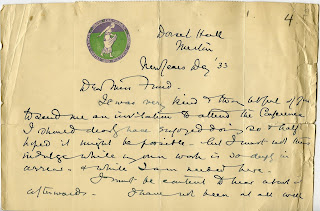
Letter from Rose Lamartine Yates, ref UWT/D/47/1, © Institute of Education
The WSPU was founded by Emmeline Pankhurst and her three daughters Emmeline, Adela and Christabel Pankhurst.  It was founded in 1903, one year before the NUWT, and they were founded out of frustration with what they saw as a lack of action in terms of obtaining the vote for women.  Their motto 'Deeds, not Words' reflects their stance.  The Women's Library website has a great summary of the WSPU so I won't repeat it all here.

As you can see this letter is a bit later, from 1933.  Rose Lamartine Yates (1875 - 1954) was born in Brixton to French parents.  She studied in the UK and in France.  In 1909 she joined the Wimbledon branch of the WSPU and by 1910 she was the Treasurer and Organising Secretary of the Branch.  In the letter she thanks Ethel Froud (the General Secretary of the NUWT at that time) for inviting her to attend NUWT conference but explains that she was too busy [she was] 'needed here', and was also ill, so she could not make it.  It's really interesting that this letter is dated 1933 as the WSPU ceased to exist in 1919 - maybe Rose Lamartine Yates just had an excess of headed notepaper!  The WSPU were very much about publicising the cause wherever possible and the collection of WSPU items at the Museum of London illustrates this - they have WSPU green and purple tea pots, badges, sashes, and WSPU stockings! 

So thank you for reading, it's been nice to share! Any archivists out there have any favourite finds from their cataloguing work?  What about in other professions? Any unusual finds? 

N.B. For more information on the content of the NUWT Archive you can search the catalogue here.  I also post about the NUWT project on the Institute of Education Library and Archive blog, Newsam News.

Tuesday, 3 May 2011

When work and hobbies collide

In my new quest to become a sewing wonder and make my own clothes, I have started off with doing repairs.  Imagine my surprise when repairing a vintage dress I bought in Los Angeles to discover that it was Union Made! Now this may not be that unusual to see on clothing labels, I don't know, but what is so unusual about this for me is how eerily it related to my new job cataloguing the Archive of the National Union of Women Teachers.  So it just seems incredibly serendipitous that the label on my dress says 'Int. Ladies Garment Workers Union - Union Made'.  Of course I couldn't leave it at that, I had to do a bit more digging and find out about the ILGWU.


On the second page of google results (or the first page if you go through wikipedia entry) is the link to the ILGWU Archive, held at the Kheel Center for Labor-Management Documentation and Archives at Cornell University Library.   I mention the ranking in google as I feel that the archive catalogue description should be right up there on the first page, as it's the primary source of information about the union.  The information I've included about the union here is taken from the organisation history included on the catalogue description.  The ILGWU was formed in 1900 in New York City by a variety of immigrant groups, Jewish, Italian, Scots-Irish and Irish, working in the garment industry.  Like the NUWT there was a lot of resistance to the Union but by 1917 they were more powerful and had brought about a great deal of improvements for their members including improved working conditions and unemployment benefit.  I was just cataloguing records today which listed the impressive achievements of the NUWT, including the part they played in gaining equal franchise for women, equal superannuation and pension rights, and of course, their objective - equal pay for women teachers.

There's no point in me just copying out the text from other articles, here and here, where you can read more about the achievements of the ILGWU and some of the horrific events which highlighted the terrible working conditions in place at the time. However the story of the Triangle Waist Company fire in New York.  This was a sweatshop employing 500 people on the ninth floor of a building at Washington Square East.  When a fire broke out on March 25 1911 there was nowhere for the employees, mostly women, many girls as young as 14, to go.  They were unable to open the fire escape or other exits and of the 500 workers, 146 perished that day, either in the fire or jumping from the ninth floor.  Afterwards workers claimed that the owners had locked all the doors to prevent theft, and this was apparently common practice at the time.  The ILGWU proposed a day of mourning and, along with other unions, formed a Joint Relief Committee to help those suffering because of the fire. The company Blanck and Harris were acquitted of any wrongdoing despite the testimonies of all those who survived that they were locked in the building.  Even just writing this now I'm getting shivers up my spine and tears in my eyes just thinking about it, and getting mad as well - how is it that those in power will always get away with their actions for the sake of profit. 

I got the information on the Triangle Factory Fire from an online exhibition at Cornell University to mark 100 years since the fire.  This is a fantastic exhibition with lots of examples of the primary archive material about the fire and all laid out in a very accessible way.

Who would have known I could learn so much from repairing a dress!

Monday, 18 April 2011

New Twitter account for Archives project

Just a brief post to say that I have now set up an NUWT Twitter account specifically for my new job cataloguing the records of the National Union of Women Teachers.  It's a project I'm really excited about and I'm already finding lots of really interesting material in the Archive so am looking forward to sharing it through Twitter, and hopefully soon enough, through a dedicated NUWT blog. 

Equal suffrage demonstration in Lowestoft, Suffolk 
©Institute of Education Archive

Tuesday, 12 April 2011

New Cataloguing Archivist post

I've just started a new job in the Archive at the Institute of Education, London.  It's another project job - this time for fourteen months - and I'm loving it already!  My job is to catalogue the records of the National Union of Women Teachers (NUWT).  The NUWT was founded in 1904 as the Equal Pay League and in 1906 it was re-named the National Federation of Women Teachers. In 1920 it broke away to form an independent union, the National Union of Women Teachers.  I wrote a post about my first impressions and first finds over at the Newsam News blog (the blog of the Institute of Education Library and Archive) so I won't repeat what I've said there except to say that the variety of subjects covered in the archive sounds very exciting, a perfect example is the poster shown below for the 'World Youth Conference' held in Prague in 1947.  The correspondence, pamphlets and posters for this conference were so filled with optimism and hope for the future, for a new peaceful future, that was wonderful to read.  Though at the same time quite sad that the optimism and hopes for peace are still just that, optimism and hope. 
World Youth Festival pamphlet,
UWT/D/28A/2 ©Institute of Education Archive
From what I've read so far the NUWT was filled with strong, independent females and finding out more about them is going to be a pleasure, and a privilege to get to do s part of my daily work!  I've got lots of plans for free publicity I can do and connections and links that can be made with other archives and other organisations, in fact I even had a dream about my plans, on a Friday night - a bit strange granted, but I wouldn't have it any other way, better to over-think and enjoy my work than the other way around.  I think I'll be keeping the majority of posts about the project confined to the Newsam News blog but I'm sure the occasional one will stray over here.  I'm still going to keep this blog up though as there's plenty of other archive related events I can talk about, like a recent exhibition I went to at the Barbican...