I recently discovered a new blog, well new to me that is, the blog has been going since May 2010. I've been enjoying having a sift through their old posts and would thoroughly recommend it as a 'follow'! It's called Reclamation and Representation - the boundaries of the literary archive. Much like this blog was started as part of a project Reclamation and Representation was started to continue discussion and links that were part of the conference of the same name at the University of Exeter.
They help a really interesting sounding day at the University Archive yesterday 'In the Archive with Daphne Du Maurier' - an opportunity to see manuscripts of her most famous works including Rebecca and Jamaica Inn, led by Acting Head of Special Collections and Reclamation panelist Christine Faunch.
They've just posted a nice summary of some of the questions asked on #AskArchivists day. I wish I could have taken part but we were moving office that day so I didn't think I could really give it the time it deserved. I've really enjoyed catching up on the questions asked though. One that is mentioned in Reclamation and Representation's summary is below:
Q: Is there a book or blog to explain how to use archives? E.g. when I don't know what box to order bec. I only know the topic.
A: Best way: look @ catalogue if available or email for advice - see our Special Collections catalogues & Special Collections 'Planning a Visit' for more info (Answer from the Bodlein)
It reminded me of problems I've had as a user of catalogues, only a few years ago it took me ages to work out the right reference numbers for items I wanted to reserve at the National Library of Scotland. Now I'm sure a large part of my problem was purely impatience, yes, even me an archivist used to using archive catalogues, still expects everything set out for me, google style. So in turn this reminded me now that we have to do everything we can to make our catalogues as easy to use as possible as - worst case scenario - people will just stop using if they can't find what they're looking for. Although I think what a lot of people do, and what I did when faced with the same problems, was e-mail the archivist or special collections librarian and ask their help. I think that #AskArchivists day is a fantastic way of showing that we're not intimidating, that we're 'here to help'!
Showing posts with label Twitter. Show all posts
Showing posts with label Twitter. Show all posts
Tuesday, 14 June 2011


Monday, 18 April 2011
New Twitter account for Archives project
Just a brief post to say that I have now set up an NUWT Twitter account specifically for my new job cataloguing the records of the National Union of Women Teachers. It's a project I'm really excited about and I'm already finding lots of really interesting material in the Archive so am looking forward to sharing it through Twitter, and hopefully soon enough, through a dedicated NUWT blog.
 |
| Equal suffrage demonstration in Lowestoft, Suffolk ©Institute of Education Archive |
Tuesday, 22 March 2011
Today was the first day of my last week at Wessex Film and Sound Archive(WFSA) before I move on to pastures new (more of that in a later post once I start the new job!). My post at WFSA was only a six month post and I'll be leaving it four weeks early but having completed all the work I was scheduled to do, in addition to all the extra work me and Zoe Viney have done on promoting and project and the Archive.
What have I learned?
What have I learned?
- Cataloguing films isn't different from cataloguing paper documents in terms of the description of the material i.e. keep it descriptive, don't use words the general public couldn't understand (unless you also provide a glossary), include as much contextual information as possible given time and availability of information constraints, include all the ISAD(G) elements
- Knowledge of the variety of film and audio formats and knowledge of how to identify and differentiate between them
- I've learned more of the quirks and functions of CALM as I've continued using that at WFSA
- The wonders of Excel! - it is fantastic for keeping and managing timetables and deadlines. I can now use an Excel spreadsheet, and create one, with a lot more confidence - thanks Zoe!
- I have been working on a Mac so have greatly increased my knowledge of using that, including simple things like learning how to take screenshots
- I've installed and used DROID - Digital Record Object IDentification
- I've learned how to edit film clips using Quicktime
- Experience of using an 8mm projector
- Plenty of experience now of using a Steenbeck - which I love!
- Splicing film, adding leader tape
- An awareness of the various ways and places in which archive film can be utilised, such as the Little Black Dress exhibition in Portsmouth
- More experience of carrying out research - into film locations and film makers.
- I now have knowledge of Hampshire, Dorset, Isle of Wight - and lots of places which I would now like to visit in person, as opposed to just seeing on film
- Increased experience of the ways in which Twitter and Flickr can be used by Archives to promote specific projects and Archives in general.
Tuesday, 15 March 2011
'Tweeter's' help in identifying building
Last week I was cataloguing a film (AV260/30) by Alan E Turner, an amateur filmmaker from Romsey. The film was called 'West Country Holiday' and having a title is always useful, especially when it identifies the area shown in the film. Inter-titles are even more useful and luckily for us Mr Turner included inter-titles in most of his films. These are titles which appear throughout the film, usually indicating a change of location. In this particular film there was an inter-title Ilfracombe, followed by some footage of the seaside resort of Ilfracombe in the 1930s. The footage is lovely, showing lots of beautiful buildings, some great footage of the Lynton to Lynmouth Cliff Railway, and including this building shown in the image below. I tried with Google Maps, walking about the streets of Ilfracombe in Google street view, looking at tourist websites for Ilfracombe but I just could not identify this building.
I decided to try Twitter as this has been successful before in identifying buildings, particularly when we have the name of the town to help. This time I didn't even need to send messages to local tourist websites, I just posted the image on Twit Pic with a message on Twitter asking if anyone knew what this building was - you can see the response in the second image. People are so helpful - I posted the request for information on the 10th of March and the replies from two individuals both came in the same day!
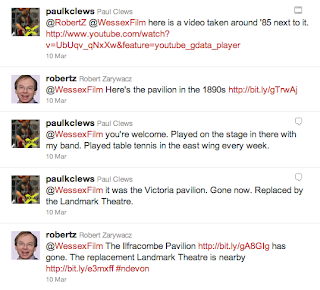
It turns out the building is the Victoria Pavilion. It was built in the 1920s but in 1994 the decision was made that the costs to continue repairing it were too high and the building was demolished and replaced with the Landmark Theatre. I used various online sources to verify the identification of the building and gather information on it but I would never have found any of this without the help from our followers on Twitter. Or I should correct that, I might have found it, if I had been able to track down a book of old photographs of Ilfracombe but there just isn't that kind of time to devote to identifying one building so the use of social media such as Twitter are invaluable in this respect.
 |
| © Wessex Film and Sound Archive, AV966/30 - the Victoria Pavilion, Ilfracombe |

It turns out the building is the Victoria Pavilion. It was built in the 1920s but in 1994 the decision was made that the costs to continue repairing it were too high and the building was demolished and replaced with the Landmark Theatre. I used various online sources to verify the identification of the building and gather information on it but I would never have found any of this without the help from our followers on Twitter. Or I should correct that, I might have found it, if I had been able to track down a book of old photographs of Ilfracombe but there just isn't that kind of time to devote to identifying one building so the use of social media such as Twitter are invaluable in this respect.
Subscribe to:
Posts (Atom)


