I'm very excited to share with you that Lindsay Anderson: Cinema Authorship has now been published! This book is one of the outcomes of the project I worked on for three years at Stirling University 'The Cinema Authorship of Lindsay Anderson' and it is so satisfying to see it in print. I'm really enjoying reading back through it and I'm sure it's going to lead to more viewings of his films and lots of happy memories of cataloguing!
The Lindsay Anderson project was the reason I started this blog way back in February 2009
and I still find it hard to believe sometimes that I got to spend 3
years cataloguing and researching in the Lindsay Anderson Archive - I do
love being an archivist!
Today was the first day of my last week at Wessex Film and Sound Archive(WFSA) before I move on to pastures new (more of that in a later post once I start the new job!). My post at WFSA was only a six month post and I'll be leaving it four weeks early but having completed all the work I was scheduled to do, in addition to all the extra work me and Zoe Viney have done on promoting and project and the Archive.
What have I learned?
Cataloguing films isn't different from cataloguing paper documents in terms of the description of the material i.e. keep it descriptive, don't use words the general public couldn't understand (unless you also provide a glossary), include as much contextual information as possible given time and availability of information constraints, include all the ISAD(G) elements
Knowledge of the variety of film and audio formats and knowledge of how to identify and differentiate between them
I've learned more of the quirks and functions of CALM as I've continued using that at WFSA
The wonders of Excel! - it is fantastic for keeping and managing timetables and deadlines. I can now use an Excel spreadsheet, and create one, with a lot more confidence - thanks Zoe!
I have been working on a Mac so have greatly increased my knowledge of using that, including simple things like learning how to take screenshots
I've installed and used DROID - Digital Record Object IDentification
I've learned how to edit film clips using Quicktime
Experience of using an 8mm projector
Plenty of experience now of using a Steenbeck - which I love!
Splicing film, adding leader tape
An awareness of the various ways and places in which archive film can be utilised, such as the Little Black Dress exhibition in Portsmouth
More experience of carrying out research - into film locations and film makers.
I now have knowledge of Hampshire, Dorset, Isle of Wight - and lots of places which I would now like to visit in person, as opposed to just seeing on film
Increased experience of the ways in which Twitter and Flickr can be used by Archives to promote specific projects and Archives in general.
This was something I wrote when I worked at Stirling University Archives - I thought with the Oscars being topical right now I would finally get round to putting it up!
'An Oscar in the Archive', Kathryn Mackenzie, Archivist/Research Assistant, Lindsay Anderson Collection, University Archives, University of Stirling
One of the more unusual items found when the Lindsay Anderson Collection arrived at the University of Stirling was an Oscar statuette. The ‘Oscar’ was found in the Collection when it was being unpacked by the University Archivist, Karl Magee. The initial excitement at having found an Oscar gave way to a realisation that, going by the weight and material of the statue, it was highly unlikely it was an original! The Lindsay Anderson Collection now contained a fake Oscar rather than the real thing, but it is precisely this fact that makes the story so interesting.
We knew from research into Lindsay Anderson’s films that he had won an Oscar, in 1954, for a film he co-directed with Guy Brenton entitled Thursday’s Children. Set in the Royal School for the Deaf in Margate this 25 minute film shows a group of deaf children in their classroom. The film is narrated by Richard Burton who describes the stories of the individual children and the learning process they go through to enable them to communicate. Thursday’s Children won the Academy Award for Best Documentary Short in 1954. So, the question we faced now was, given that Anderson had won an Oscar, why was the one in the Archive a fake?!
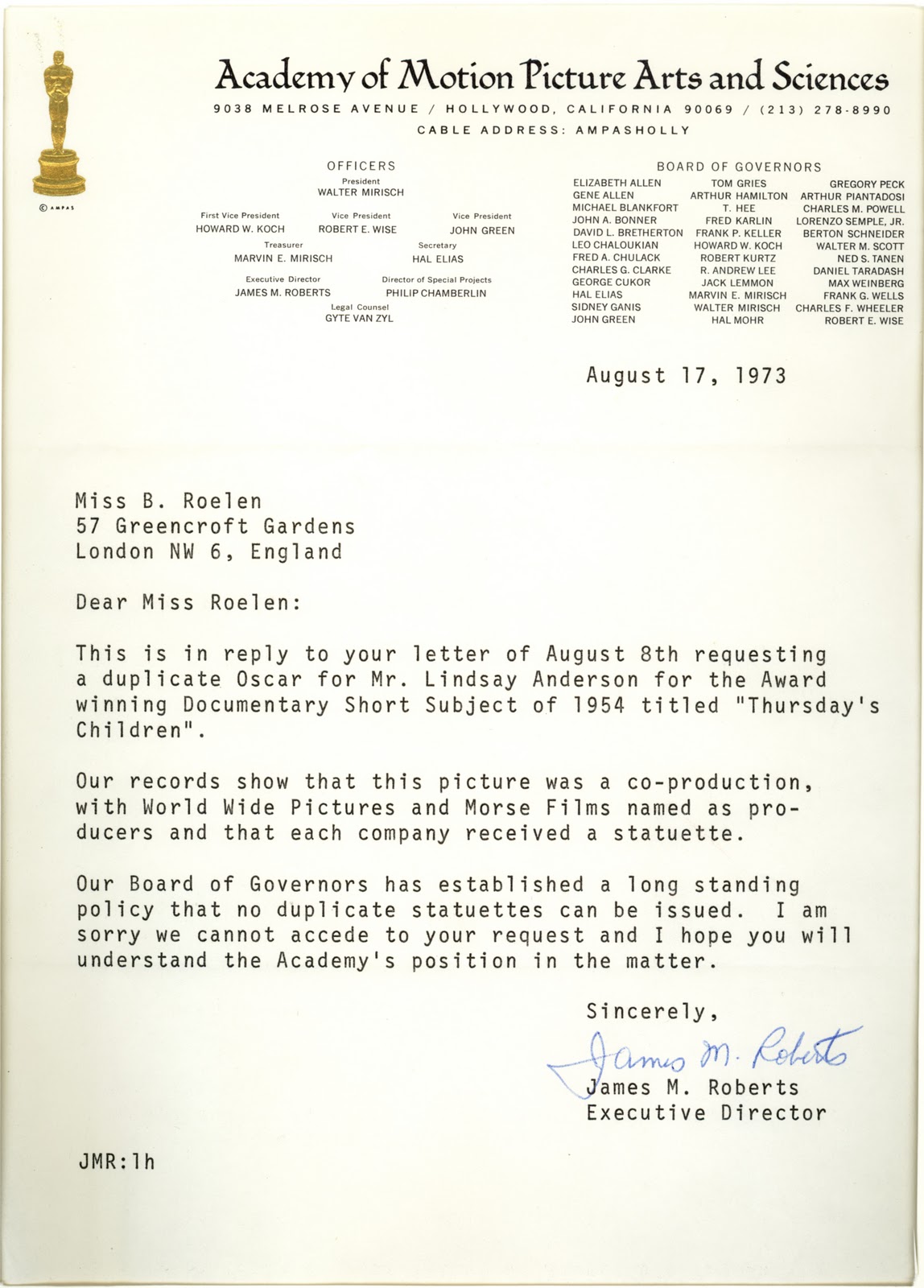
It wasn’t until a few months later, whilst going through the correspondence, that this puzzle was solved. A letter from Lindsay Anderson’s secretary to the Academy of Motion Picture Arts and Sciences, dated 8 August 1973, was the first step in uncovering the story of the Oscar. She explains that the Award for Thursday’s Children was collected by Anderson’s co-director as Anderson was unable to attend. The letter is to enquire if it is possible for Anderson to receive a replica of the Oscar statue. The Executive Director of the Academy replied only a week later on 17 August 1973. He explained that “Our Board of Governors has established a long standing policy that no duplicate statuettes can be issued”. Well, this must have disappointed Anderson greatly, enough in fact that he discussed it with his friends. How do we know this? Because at a meeting of the Lindsay Anderson Memorial Foundation’ we found out it was friends of his who bought him a replica Oscar to fill the gap on his mantelpiece where the statuette should have stood! So we now knew the story behind the Oscar in our collection and, although a real Oscar would have been a wonderful addition to the Collection, I think the story the fake Oscar tells is far more interesting.
The ‘Oscar’ and the letters to and from the Academy are now regular features in an exhibition ‘Is That All There Is? An exhibition of archive material from the Lindsay Anderson Collection’. This exhibition has been on display at the Changing Room Gallery in Stirling, The MacRobert Arts Centre at the University of Stirling and the James Hockey Gallery at the University College for the Creative Arts, Farnham.
(Originally written 14/08/2010)
Post Script:
The Oscar is now part of a new exhibition display Treasure from our Collections at the newly refurbished University of Stirling Archives and Special Collection
Since last Friday me and fellow cataloguer Zoe Viney have been avidly following our Flickr statistics (really not as boring as it sounds!) and the publicity we did has had a huge impact on viewing figures. Just using mailing lists such as the Archives NRA list, Hampshire County Council lists, and our Twitter we had over 300 views by the end of the first day (last Friday, 18th February 2011) and as of five minutes ago we have 495 views - pretty good going for five days I would say! Even though I use Twitter every day, check my mailing lists every day and so on, I was still surprised by the high response rate to our postings. I think this illustrates the high value which such social networking tools as Twitter, Facebook and Flickr can have for an archive, especially in these difficult times of cuts and closures.
Our original aim was to create an online exhibition which would promote the project we are working on specifically and the Wessex Film and Sound Archive more generally. This was an additional outcome to the project rather than a core part of it so we had to do it for free, and without using up our cataloguing time. I had used Flickr before when I worked at Stirling University (see their Flickr here) so I knew how easy it was to set up and to upload images to. I had never used it to upload videos before but this isn't any different to uploading photos so doesn't take long at all. What I had thought would take longer was actually making clips from the digital copies of the films. However this was surprisingly straightforward using Quicktime to select then extract a short section of a film. The quality of the images varied hugely depending on whether we were doing screenshots from Quicktime files, DVD copies, or taking photographs of a screen showing a VHS copy with the Quicktime files giving the best quality still shots.
The exhibition is 'A Sense of Place' - let me know what you think of it and feel free to add any additional information or comments to the Flickr site. It is very easy to use Flickr and by using some free publicity, very easy to direct people to your site. However what seems to be a lot harder, well at least I've found it harder, is encouraging people to interact and communicate with the archives through Flickr. Our aim now should be to try to generate more user interaction, maybe by posting stills of places or people we can't identify - that's the next project to get started on!
Another thing - trying to set up an exhibition within Flickr, (we don't have Flickr Pro so can't use Collections, only Sets) was tricky. It was only due to Zoe's persistence with sorting out the links that it works (well, we think it works, let us know what you think). it took a lot of tweaking to get it so that we could create themes then link to a set of images from a particular film. Flickr Pro would help with this as you could create Collections, then Sets within the Collections - if the exhibition and our general use of Flickr proves to be a success then we hope that Flickr Pro is something the Record Office would consider investing in (not that it's a huge investment really, just $25).
I think this clip below shows just how much you can get out of a 1 minute 30 second clip - there is just so much going on at this market and fair! The film is titled 1939 - 1963 Then and Now as the filmmaker Eda Moore spliced together footage of Salisbury (her hometown) across this date range to show what had changed, and what had stayed the same.