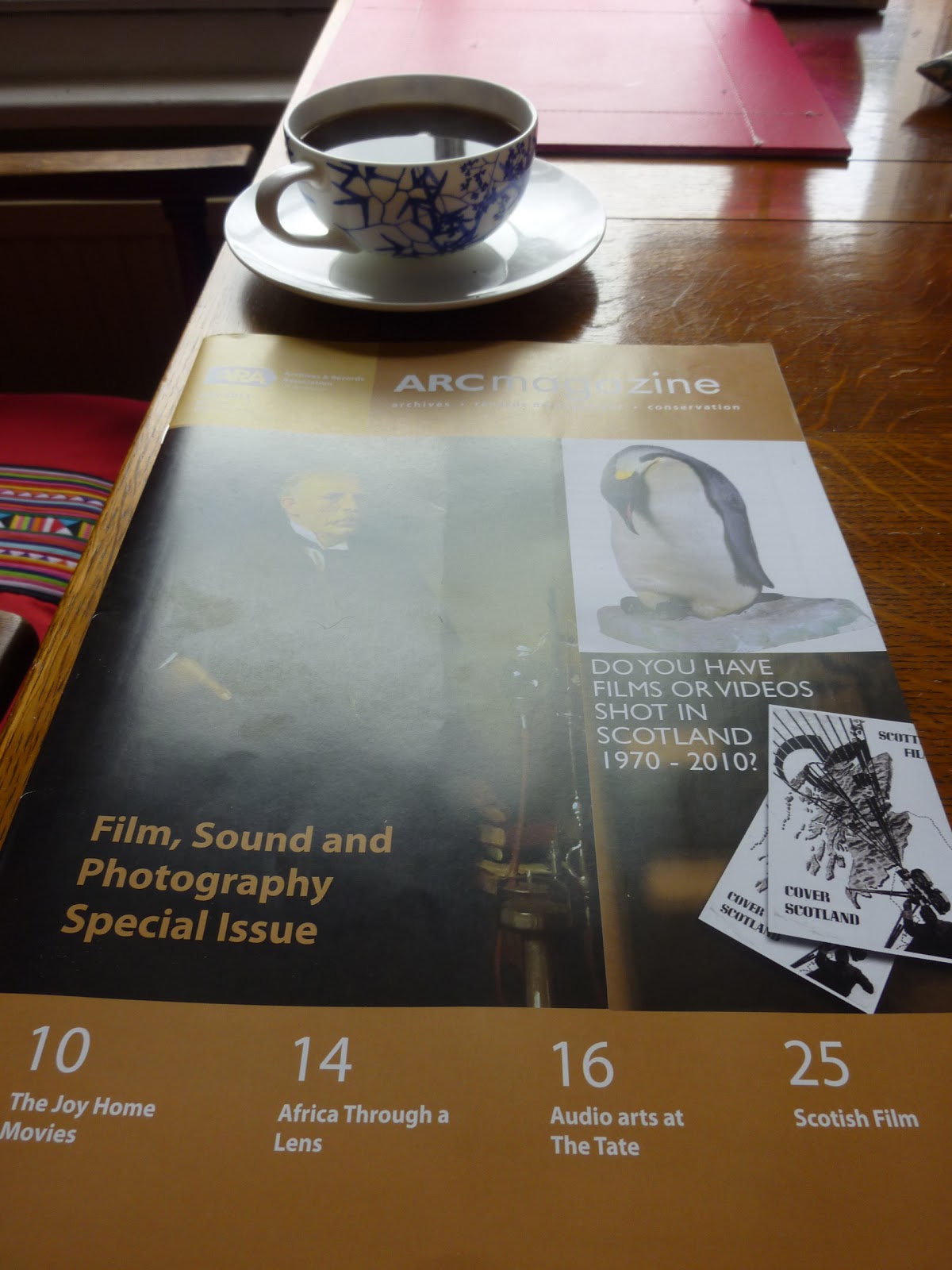
Sunday morning and I'm not reading the Sunday papers yet, no siree, I'm reading my newly arrived (yesterday) copy of ARC. ARC is the monthly magazine published by the Archives and Records Association in the UK. Although I love archives I wouldn't usually be reading this on a Sunday morning, honest!
The July issue is a Film, Sound and Photography Special, edited by my last boss, David Lee, Archivist and Manager of the Wessex Film and Sound Archive. I'd have been really interested in reading it anyway but even more so because yours truly has an article in it - woop! The article is a joint one written by me and Zoe about our experience of cataloguing the films for the Revitalising the Regions project. We concentrated on two of the film-makers, well three really - Frank and Nancy Bealing and Eda Moore. Nancy Bealing and Eda Moore just really captured both our imaginations and we were very privileged to get the chance to go and speak to Nancy Bealing about the films which her husband made, the one which we made, and the ways she helped with his filmmaking. I wrote a bit about a visit we paid to Salisbury to do some research about Eda Moore here.
The current issue of ARC is not available digitally on the website yet, and even when it is it's only available to members so at the moment I can only give you these images off my camera.
Right, now I'm off to read all the other interesting articles in the magazine!
I had to call up the ARA Office to request another copy be sent out, and an extra for Zoe, as mine hadn't arrived (first time I've had anything published in it and first time it's never arrived!)
Now, if you'd asked me any time up until this if I could have fun with statistics the answer would have been a very quick and very clear No! However I've since rediscovered the StatCounter account I set up when I started Archives and Auteurs and I am amazed to find myself idly browsing my blog's statistics. The reason I remembered about the account was thinking about the work Flickr I recently set up with Zoe Viney for the Wessex Film and Sound Archive. We couldn't find any way for collecting statistical information through Flickr beyond the basic page views information. I remembered about StatCounter and surprised myself by remembering my user name and password as well. It had still been running even though I haven't been logging in but as I hadn't added my new IP addresses (work and home) to the list of addresses not to count then I think my results might be slightly skewed. So, if anyone else is setting up StatCounter or any similar statistical service then it is always best to block your own computer's IP address so your figures are more accurate, unless your memory is really bad and you want to keep count of your own views of course.
The images I've included below show the breakdown by country of visitors to my blog over the course of last week, then the second one lists in more detail every country that views have come from. you can narrow this down to city as well. Other useful things you can check are which pages are the most popular, which websites people are directed to your site from, how long they stay (this can sometimes be a bit painful), and lots of other useful, or useless, information depending on your point of view/general inclination to nosiness.
What I found most useful was information on how people had found my blog - what terms they had searched for or what website they had come from. This made me think more about the tagging I use on my posts and I have resolved to try and be a bit more thorough in my tagging - treating it more like my actual cataloguing work than I have done in the past.
I haven't started using it yet for the WFSAFlickr account for two reasons, the first being I thought I would try it first with my Flickr account to see if it worked. With StatCounter, and I assume it is similar whatever software you use, you have to input the HTML code in to your profile on Flickr then add the web pages to your statistic software account. I'm find doing this with my own account but I was a bit unsure with the work one - does this give them access to other information on your Flickr account, do they have rights over the statistical data as it is displayed on their account? These questions are things I would rather investigate more fully before using it for workplace statistics - but for now I'll keep enjoying using it for my own web pages.
Since last Friday me and fellow cataloguer Zoe Viney have been avidly following our Flickr statistics (really not as boring as it sounds!) and the publicity we did has had a huge impact on viewing figures. Just using mailing lists such as the Archives NRA list, Hampshire County Council lists, and our Twitter we had over 300 views by the end of the first day (last Friday, 18th February 2011) and as of five minutes ago we have 495 views - pretty good going for five days I would say! Even though I use Twitter every day, check my mailing lists every day and so on, I was still surprised by the high response rate to our postings. I think this illustrates the high value which such social networking tools as Twitter, Facebook and Flickr can have for an archive, especially in these difficult times of cuts and closures.
Our original aim was to create an online exhibition which would promote the project we are working on specifically and the Wessex Film and Sound Archive more generally. This was an additional outcome to the project rather than a core part of it so we had to do it for free, and without using up our cataloguing time. I had used Flickr before when I worked at Stirling University (see their Flickr here) so I knew how easy it was to set up and to upload images to. I had never used it to upload videos before but this isn't any different to uploading photos so doesn't take long at all. What I had thought would take longer was actually making clips from the digital copies of the films. However this was surprisingly straightforward using Quicktime to select then extract a short section of a film. The quality of the images varied hugely depending on whether we were doing screenshots from Quicktime files, DVD copies, or taking photographs of a screen showing a VHS copy with the Quicktime files giving the best quality still shots.
The exhibition is 'A Sense of Place' - let me know what you think of it and feel free to add any additional information or comments to the Flickr site. It is very easy to use Flickr and by using some free publicity, very easy to direct people to your site. However what seems to be a lot harder, well at least I've found it harder, is encouraging people to interact and communicate with the archives through Flickr. Our aim now should be to try to generate more user interaction, maybe by posting stills of places or people we can't identify - that's the next project to get started on!
Another thing - trying to set up an exhibition within Flickr, (we don't have Flickr Pro so can't use Collections, only Sets) was tricky. It was only due to Zoe's persistence with sorting out the links that it works (well, we think it works, let us know what you think). it took a lot of tweaking to get it so that we could create themes then link to a set of images from a particular film. Flickr Pro would help with this as you could create Collections, then Sets within the Collections - if the exhibition and our general use of Flickr proves to be a success then we hope that Flickr Pro is something the Record Office would consider investing in (not that it's a huge investment really, just $25).
I think this clip below shows just how much you can get out of a 1 minute 30 second clip - there is just so much going on at this market and fair! The film is titled 1939 - 1963 Then and Now as the filmmaker Eda Moore spliced together footage of Salisbury (her hometown) across this date range to show what had changed, and what had stayed the same.