Wednesday, 23 June 2010

Cataloguing milestones

Well, that's me finally finished cataloguing all the A-Z correspondence files - it felt like a never ending task at times but at least the material I'm cataloguing has been very interesting.  The thing about being in an office on your own though is when you do reach a milestone like this there's no one to celebrate with!  It does feel like a pretty big achievement when you complete one section, especially one as big as this one was, with over 3800 items!  It was with great satisfaction that I scored all those files off my timetable!

Today I am not on my own as my room mate Isabelle is in so I'm doing a good job of distracting her from her dissertation with my interesting finds in the named correspondence files.  Yes, once again I'm back to 'A', well 'B' now to be more precise - cataloguing the correspondence between Lindsay Anderson and the artist Don Bachardy, from the named correspondence files.  Bachardy is an artist who paints the most beautiful portraits but is perhaps better known (well he was to me anyway) as the long-term partner of Christopher Isherwood.  Indeed the recent Tom Ford film A Single Man, based on the book by Isherwood, was inspired by a break-up between Bachardy and Isherwood, although in real life the break up was short lived and they were together until Christopher Isherwood died in 1986. 

I am only half way through their correspondence together and I found an interesting description by Anderson of why he felt Bachardy is such a talented artist "they manage to be both portraits and a collective self-portrait, which makes the whole collection a single work - as well as being a wonderfully perceptive and acute assembly of individual studies" [here Anderson is referring to a book of Bachardy's portraits which has just been published].  I thought this definition of Bachardy's talent could be transferred quite easily to film and seems to sum up Anderson's attitudes to his own creative work as a film director "no film can be too personal". 

There are lots of fantastic photographs and colour images of Bachardy's paintings in the file but I would never want to use these without first seeking the permission of the artist.  Instead I thought I would show these images - an invitation to an exhibition of Bachardy's portraits of actors carried out during the shooting of Robert Altman's Short Cuts. 
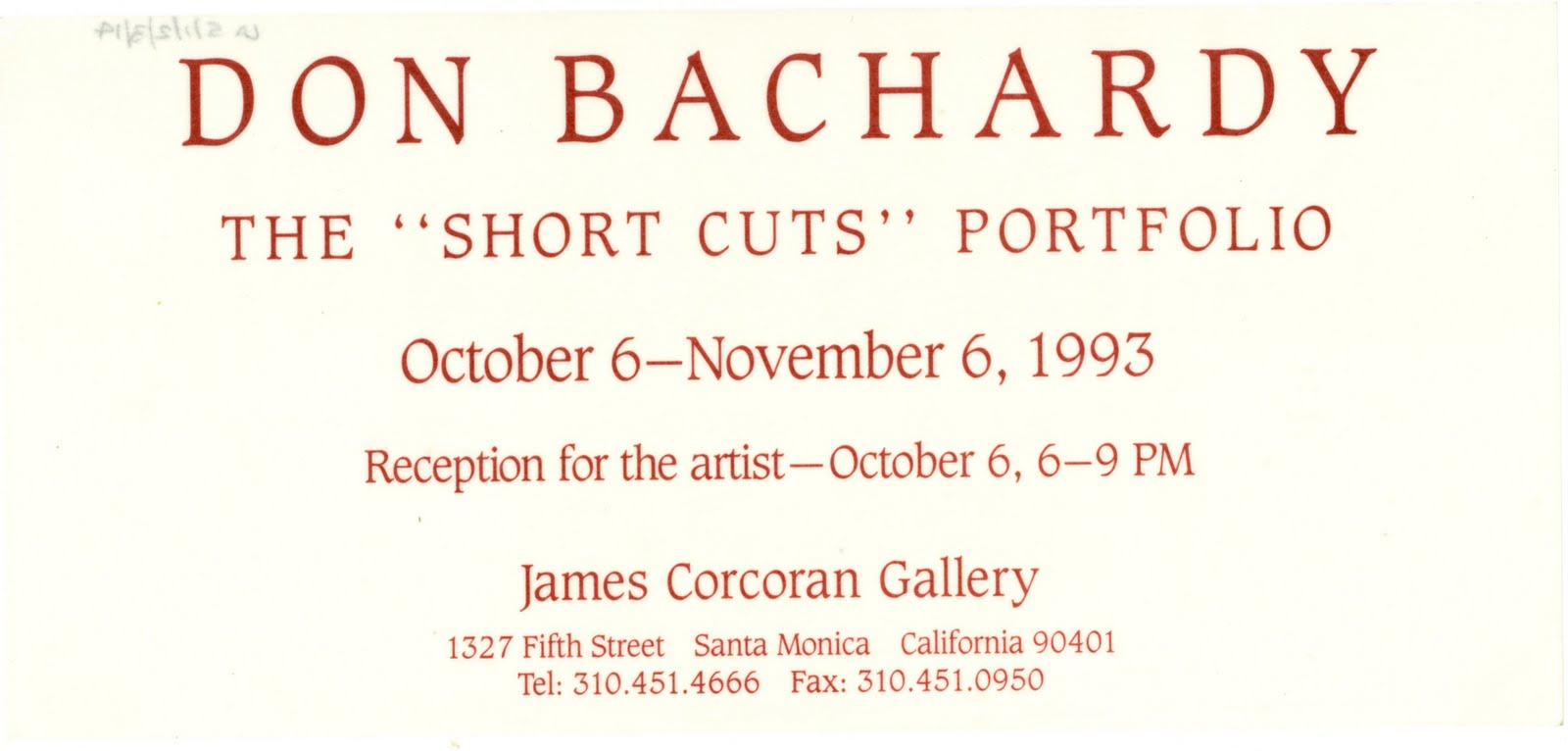
Invitation to exhibition of The 'Short Cuts' portfolio by Don Bachardy, LA/5/1/2/3/14
© Lindsay Anderson Collection, University of Stirling Archives
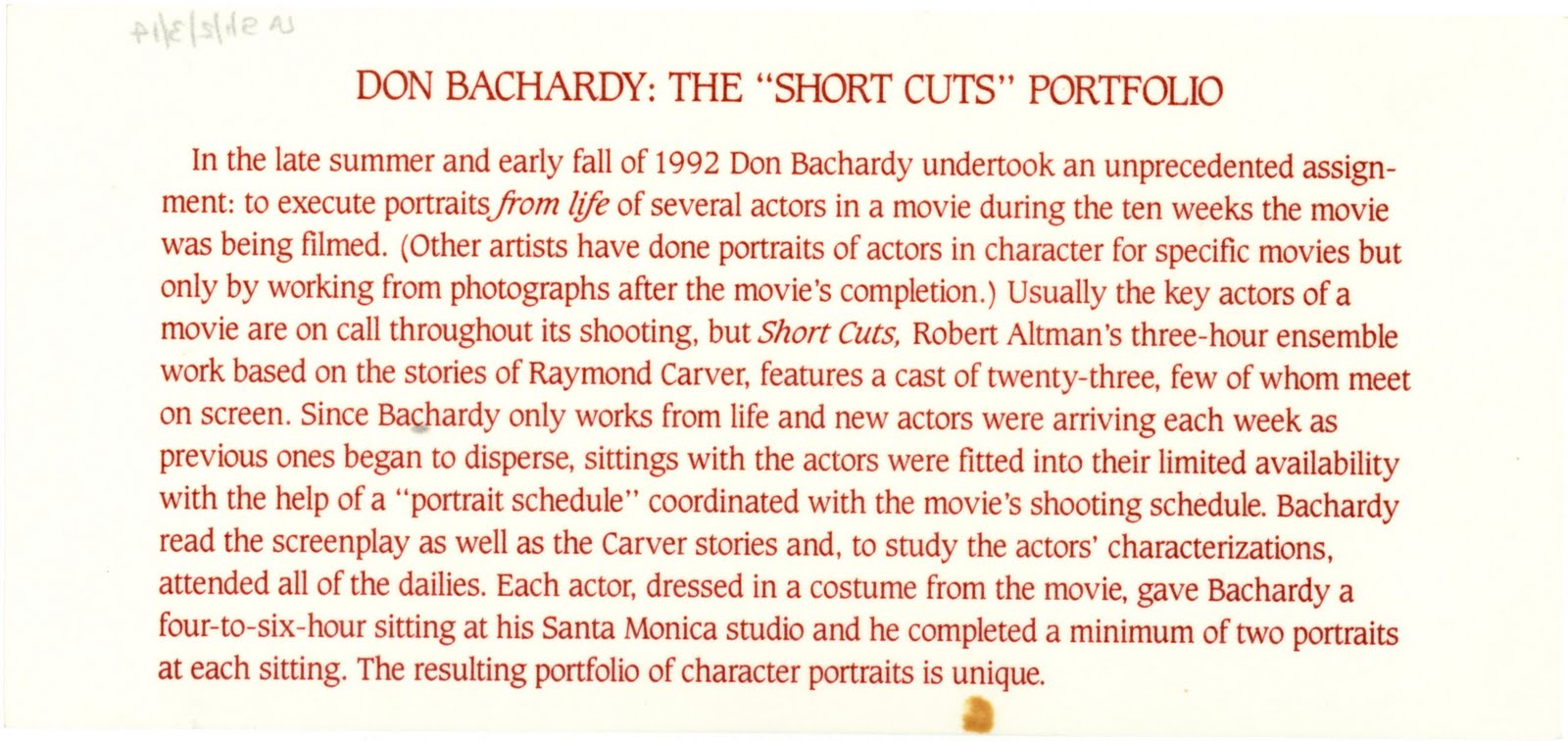
Invitation to exhibition of The 'Short Cuts' portfolio by Don Bachardy, LA/5/1/2/3/14
© Lindsay Anderson Collection, University of Stirling Archives

I have just checked online and the Short Cuts portraits painted by Don Bachardy have been published with the script for Short Cuts.  You can see the front cover of the published script with some of Bachardy's work (though the quality of the image is poor) on Amazon.

Thursday, 10 June 2010

International Archives Day!

Happy (Belated) International Archives Day! I only found out it was International Archives Day yesterday through a link from archivesblog.com. Archives Outside is a blog based in New South Wales and they decided to celebrate International Archives Day by showcasing examples of archive collections from NSW. I thought I would appropriate this idea and pick some of my favourite archives in my home town of Glasgow, Scotland.

But first of all, I am wondering if any archives in the UK picked up on it being International Archives Day and did anything special for it? I didn't see anything on any of the listservs about it which I thought was a bit strange. Although it wasn't very well publicised at all this year, particularly in comparison with the World Day for Audiovisual Heritage in October last year. We certainly didn't know anything about it in time to do anything to celebrate - I'll need to keep a closer eye on potential awareness raising dates like this.

So, on to a couple of my favourite archives in Glasgow. I'll start with my first place of work after qualifying - Glasgow Caledonian University Archives. They have lots of interesting archives, for example, the Scottish Campaign for Nuclear Disarmament (CND) Archive and the anti-apartheid movement in Scotland Archive. I'll just give a bit more information though about one Archive they hold, the one which I worked on as a project archivist whilst I was there, the Scottish Trades Union Congress (STUC) Archive. This Archive contains documentation relating to the STUC and its business from 1897 onwards. I loved my work cataloguing part of this archive in the nine months that I was there and I remember being particularly interested by the minutes of some of the sub-committees, for example the Entertainment and Arts Sub Committee, the Women's Advisory Committee and of course, the letters of the various General Secretary's of the STUC (it's great to get paid to read other people's business!). There's full details of the contents of the archive here

Certificate of affiliation for Scottish Trades Union Congress membership
© Glasgow Caledonian University Archives


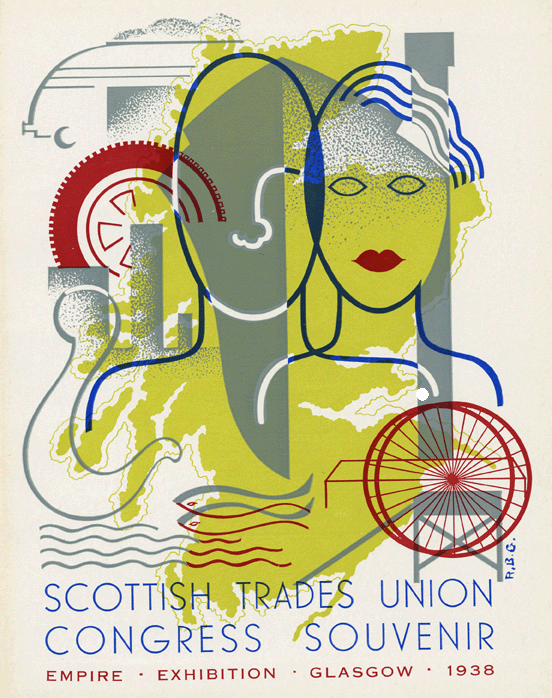
Scottish Trades Union Congress Souvenir 1938, p2
© Glasgow Caledonian University Archives


Also on my list of top archives to visit in Glasgow would be the Glasgow School of Art Archives and Collections. These are based in the beautiful Charles Rennie Mackintosh designed main art school building and I'd love to visit just for a browse through their archives. Going by the images they have on their Flickr site it looks like they've got some really interesting and inspiring stuff! I've attended some really interesting events at the Art School (more of that in later posts) but I've never just been in to look through their archives. Here's a few images from their Flickr pages that illustrate the variety of material in the archive.

Lucienne Day colour poster
© The Glasgow School of Art Archives and Collections


Glasgow School of Art degree show poster, 1988
© The Glasgow School of Art Archives and Collection

I could go on and on as there are lots more archives to visit in Glasgow, including Scottish Screen Archive, the University of Glasgow Archives (who gave me my first work experience and started me off on my chosen career path), Glasgow Women's Library and many more - but if I do that then this post will be more than the one day late it already is for International Archives Day!

Wednesday, 9 June 2010

Archive ephemera

This is in reply to a post on the Orkney Archives blog - "Do other countries actually have nicer stamps than ours or do they just seem exotic because they're foreign?".

Well, I would have to concur that other countries do seem to have far more interesting stamps than ours. This gives me the perfect opportunity to make use of an envelope I came across yesterday which I just had to scan an image of, without quite knowing how I would use it. It's not often that the envelopes have been kept with the letters in the Lindsay Anderson Archive so I assume that either Anderson himself or his secretary liked these stamps too and decided to keep the envelope with the letter. It's from Poland and has two very different but equally interesting images.


I love the abstract design - it looks similar to the style of a lot of Polish film poster designs and is far more interesting than this: -

Also, to my mind anyway, the eagle topped with the crown is far more regal than this. So thank you Orkney Archive for helping me justify why I scanned the envelope in the first place! The example the Orkney Archive show is an envelope from Norway with two botanical drawings on the stamps. Inside the letter is a lovely little square watercolour painting of a seascape.

Tuesday, 8 June 2010

Agnes Varda season at The Auteurs

I just got back from the Glasgow Film Theatre after seeing three short films by Agnes Varda and when I checked my emails there was one from the Auteurs about this season of Varda's films all available to view online, for a small cost. The three films which were screened at the GFT tonight are all available and I would highly recommend them - particularly the first one, Salut les Cubains (1963). It's interesting to see that this film was made the year before Soy Cuba (1964). I've only seen snippets from Soy Cuba but watching Varda's film immediately reminded me of it just because I've seen so little footage of Cuba from that time. Varda's film came across to me as being very positive about the Cuban revolution and Castro and I'd be interested to see Soy Cuba, a Russian/Cuban collaboration, to see what the take is in that film. I loved Varda's film, it's filled with wonderful characters and music and discusses really interesting events and developments in Cuban social and cultural history. I was particularly impressed with the way it is composed of still images linked by narration and themes, and really liked the way the film was organised which I think I'm going to find is a theme with her work as I found the structure of the other two films I saw similarly pleasing - the other films were, Ulysse and Ydessa, the Bears, and etc.

Monday, 7 June 2010

Early John Ford film amongst those found at the New Zealand Film Archive

I was directed to an interesting article in the New York Times via the Association of Moving Image Archivists (AMIA) mailing list. For anyone interested in the preservation of films and film-related material I would highly recommend joining this. I know there's a huge amount of mailing lists out there but this one is really worth it. There are always interesting and lively discussions about developments in film preservation, enquiries from film researchers looking for help finding particular films or information about the films, and news of interesting developments, like the link to this article in the New York Times.

A large number of early American films held in the New Zealand Film Archive are now to be returned to America when it emerged that in some cases they were the only surviving print of the film. 75 of these films, chosen for their historical and cultural importance, are now in the process of being returned to the US. The reason so many foreign films remained in New Zealand after their use in cinemas is due to the high cost of shipping them back.

Of particular interest is the discovery of the only print of Upstream a John Ford film from 1927. This film is being copied to modern safety stock before being transferred back to the US as it is the only copy and they do not want to rick any loss or damage to the print. In About John Ford Lindsay Anderson mentions this film, listing it in Ford's filmography, but there is no mention of it in the book or the index - presumably because there was no possible way of viewing a print of the film. It's amazing to think that all these years later we're going to be able to see it again.


The New York Times article discusses the practicalities of moving, and preserving the films, so I'll include an extract from that article here -

Getting the films, which were printed on the unstable, highly inflammable nitrate stock used until the early 1950s, to the United States hasn’t been easy. “There’s no Federal Express for nitrate out of New Zealand,” said Annette Melville, the director of the foundation. “We’re having to ship in UN-approved steel barrels, a little bit at a time. So far we’ve got about one third of the films, and preservation work has already begun on four titles.”

As the films arrive, they are placed in cold storage to slow further degeneration. “We’re triaging the films,” Ms. Melville said, “so we can get to the worst case ones first. About a quarter of the films are in advanced nitrate decay, and the rest have good image quality, though they are badly shrunken.”

As funds permit, the repatriated films will be distributed among the five major nitrate preservation facilities in the United States — the Library of Congress, the Academy of Motion Picture Arts and Sciences, George Eastman House, the U.C.L.A Film & Television Archive and the Museum of Modern Art — where the painstaking work of reclaiming images from material slowly turning to muck will be performed.


I like that the reason the films came to light was because Brian Meacham, who works at the Film Archive of the Academy of Motion Picture Arts and Sciences, went to visit the New Zealand Film Archive when he was on holiday! Is that something a lot of archivists do, visit archives in their holidays? I know I do and it's good to know I'm not alone in this!