Sunday, 19 February 2012
Canyon Cinema - the impact of the digital on film access and preservation
Home from a weekend back in Scotland today I was saddened that the first e-mail I read was from the AMIA (Association of Moving Image Archivists) list saying that Canyon Cinema is under threat. Canyon Cinema is a film collective based in California who provide over 3,500 film titles for rental, sale and distribution on film and DVD, though mostly on film - Super 8, 16 and 35mm. I first heard of Canyon Cinema at the Society for Cinema and Media Studies conference in LA in March 2010 where I attended a panel - 'Celebrating Chick Strand through screenings and discussions'. The co-operative started in the 1950s and their website gives an account of their history which just makes you wish you'd been there in the beginning! Chick Strand is one of a huge number of the film makers who are represented by Canyon - other famous names include Len Lye, Stan Brakhage and Kenneth Anger.
The story of the threat to Canyon Cinema of course ties in with the ever increasing news coverage being given to the impact of digital on the film world, in terms of preservation and availability of 35mm prints for viewing. The New York Times article which was highlighted on the AMIA list refers to the growth of digital film as the main reason for the large drop in profits from renting, selling and distributing films. The article quotes Dominic Angerame, Executive Director of Canyon Cinema, as saying that about 70% of their film titles are not digitised and that its annual film rental income has dropped from $133,000 in 2004 to about $90,000 now. The suggestion is that they would need to digitise the majority of their film titles in order to survive, and the cost of this is so prohibitive as to make it impossible.
Now I know that nothing stays the same forever and that technologies have to change but I am just so saddened by the implications of the take-over of digital film. The thought of never seeing a film on 35mm in a cinema again, of the ever-increasing difficulty which film archives, film schools, and individual film lovers are going to have in getting hold of and maintaining the equipment needed to project and repair films. All this makes me so sad and I really don't think that change is always a good thing.Of course digitising all the film titles in their collection would increase their accessibility but I just don't see that digitisation is the solution to everything - many of these films were made by the artists to be experience in the particular medium they were made in. Not to mention that there are still many viewers who want to experience the films in their original format. However I'm not a Luddite either and I get that there are lots of benefits to digital over film - I just don't want to have the new over the old - can't they co-exist?
Interestingly the article also says that the money problems of Canyon Cinema have been around for a while and that in 2009 they got $100,00 from Stanford University for selling them their paper archive. I did wonder why the paper records weren't actually held at Canyon - I thought maybe the didn't have the space, the staff, or the time to make them accessible. It hadn't occurred to me that this would be a way of trying to ensure survival of the film collection. Again, although I understand it is rarely practical to house entire paper collections with the film collections they relate to - different preservation needs, storage conditions, different archive specialisms to name but a few issues that spring to mind - in an ideal world I'd love it if more archives did contain the films themselves alongside the paper records relating to their creation, even better if it was all catalogued on the one database - ah well, it's nice to have archive dreams!
I was glad to read in the article that they do have some options and ideas for how to ensure the survival of the film co-operative. The proposition is that by turning themselves into a non-profit they would have a much higher chance of survival - well, I hope this turns out to be true.
Wednesday, 11 January 2012
Cinema in a suitcase
So, I better back up and start at the beginning. When my friend Sarah said she was coming down for the weekend and did I want to meet up I said of course! I happily cancelled my plans for, well, having no plans and staying in, and went out to meet up with Sarah and Bob instead. We headed down to the ICA for the launch night of the London Short Film Festival as Sarah had spotted that Suitcase Cinema were going to be doing an event/workshop in the ICA bar.
Now I had never heard of Suitcase Cinema before but one look at their website and I knew I wanted to go. Suitcase Cinema are all about the celluloid and for this particular event this meant salvaged 16mm films they had found in skips and at flea markets. Here was the event information from the LSFF website:
write and draw directly onto transparent film, or deface a strip of their flea market found film by bleaching, scratching, rewriting and re-imagining. When your work is done, they’ll thread it up and feed it straight into their projector, so you can see your images instantly transformed into moving, living beings.
![]() |
| choosing my tools, Suitcase Cinema event, 06/01/2012 |
What an amazing opportunity to try making a piece of film (however short it was - as it turned out very short due to my previous lack of understanding of how quickly the piece of film I'd drawn, scraped & bleached on would move through the projector!). Also looking at it very simplistically it's the very antithesis of my professional work - defacing and altering something rather than preserving it as it is. My only previous experience of working with film was running it through a Steenbeck and using a splicer to repair film.
![]() | ||
| Me and Sarah, at work/play! |
As the films were salvaged and bought second-hand this was film strip with content and a story already on it. We were given pens, scrapers, paint and bleach to alter/deface this film and create our own images and ideas on top of it. The effect of the bleach on the film was pretty dramatic and I liked using the scraper as well to create lines and patterns. Sarah pointed out to me that any patterns would have to be continued over a number of frames in order to show up when projected - I hadn't realised how much so until I saw the tiny bit of film I'd worked on projected - it was pretty much a case of 'blink and you'd miss it'. It really made me appreciate just how much work must go into any experimental film - Norman Mclaren's work immediately sprang to mind - not, I hasten to add, out of any parallels I drew between his work and my own meagre attempt - just in terms of drawing straight onto film.
I had so much fun at this event and I really think that the experience of making films - even just playing about with it a wee bit like we did - would do so much to enrich the experience of film preservation. I'm sure that most archivists working in film preservation also have experience of film making, definitely of film projection but for me it was a first-time of film-making (however short-lived and fleeting it was). All in all, I'm so glad we went (thanks Sarah, for bringing the event to my attention - and for coming down as I probably wouldn't have gone alone!). And of course a big thanks to Suitcase Cinema, and to the LSFF and the ICA for hosting the event - what a fun and creative way to spend a Friday night.
Long live Celluloid!!
Sunday, 4 December 2011
Made to be destroyed
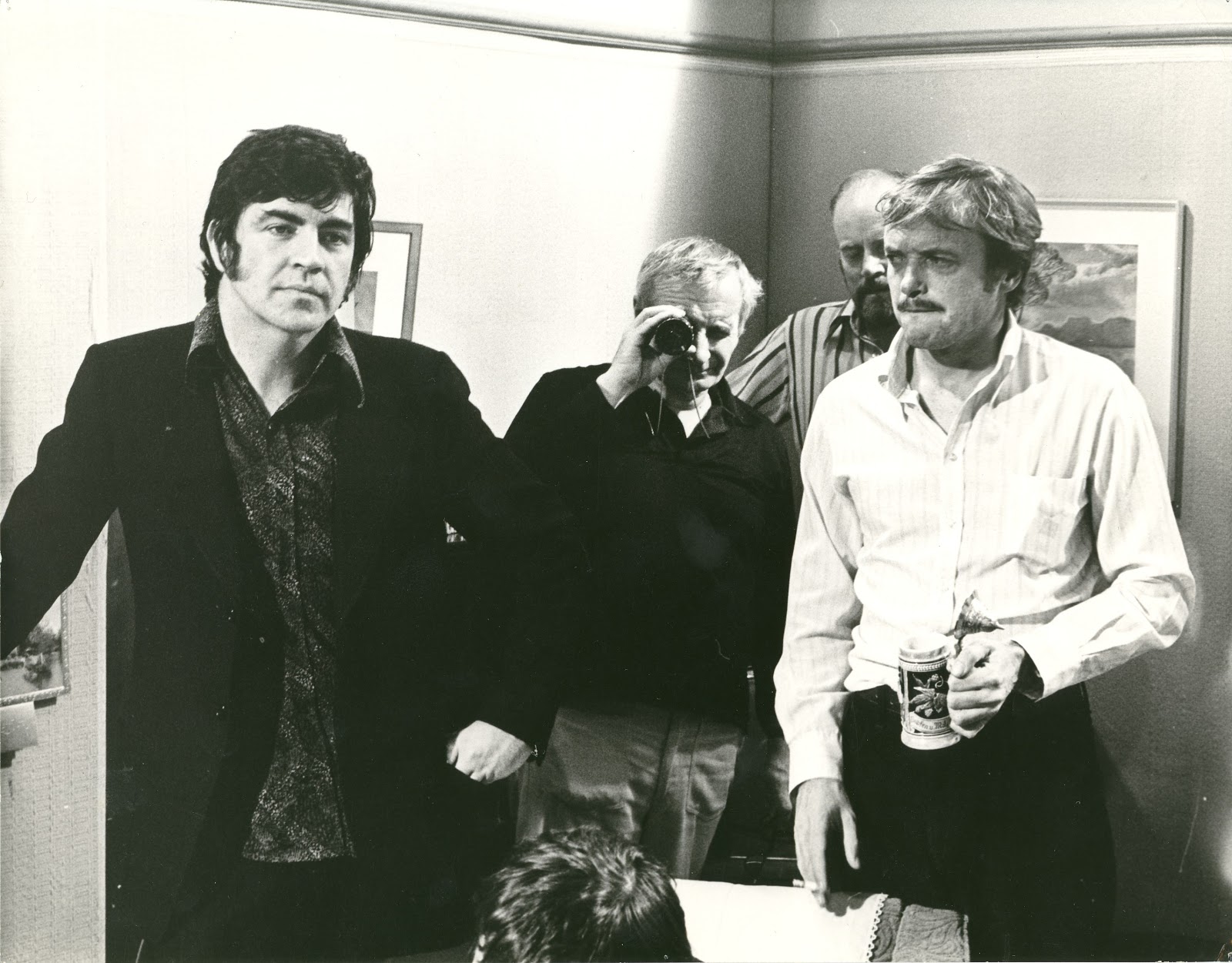
| Still from the filming of In Celebration ©Stirling University Archives |
Atom Egoyan is a Canadian film maker. In the chapter in this book he talks about his early love of the theatre and this leads him on to talking about The American Film Theatre. This was a series devised by Ely Landau, a film producer with a strong interest in adapting plays for the cinema. He invited different film directors to do just that and the result was fourteen very different films with varying degrees of success and popularity. The first of the series Egoyan saw was Peter Hall's version of The Homecoming and he explains his excitement in realising that he could bring together his love of the theatre with his love of modern film makers.
What was interesting to me is that Egoyan says that the idea behind the American Film Theatre series was "that these films would travel to various cities that would never get the play. After the projections, the prints would be destroyed. that was the theory. It would preserve the ephemeral nature of the experience." He goes on to explain that this never took place, and we know that as all fourteen films are now available on DVD. There's so much current talk all over the web, and on film archive discussion boards and mailing lists, about the 'death of film' so it was interesting to read of a series of films who, according to Egoyan, were not supposed to be preserved but were in fact made with their impending destruction in mind. Can anyone corroborate this? I can't find anything online about Ely Landau's intending to destroy the films and I don't remember seeing anything about it in the Lindsay Anderson Archive either. All I remember from that is Anderson's frustrations with the lack on advertising and publicity which he felt his film was getting (if you're interested you can search the Lindsay Anderson Archive here).
Sunday, 23 October 2011
Treasures from the Archives - Wanda
![]() |
| Barbara Loden, director, writer and star of Wanda. Image courtesy of BFI website |
I hadn't heard of the female director Barbara Loden before but the description in the brochure really appealed to me - a 'neo-realist gem... a rural Pennsylvanian housewife embarked on a flight to nowhere.. Wanda floats through her own life as if witness to it'. After recently rewatching Lindsay Anderson's The White Bus with Patricia Healey's depiction of another girl passively watching her own life drift past, I was intrigued by Wanda and am pleased to say my curiosity was well rewarded!
I obviously hadn't read the brochure properly as I didn't notice that Ross Lipman, who restored the film at UCLA, would be introducing the film. This was such a nice surprise as he gave a brilliant description of the problems facing him with the restoration of a film which was originally meant to look lo-fi and gritty. The story with Wanda is one that I've heard so many times before sadly, a film lab was closing down and called UCLA to ask if they wanted a look before the stock all went in a skip. Lipman found the reels for Wanda a day before they were due to be chucked and lost forever. In an article about the film from the Guardian (17/10/201) Lipman told the story of his discovery of the reels, marked 'Wanda', "Unspooling them on my workbench I quickly realised they were the original camera rolls, and that was only the beginning. The film was shot on a beautiful, unfaded Ektachrome reversal stock: any potential restoration would perhaps look better than even the original release. One day more and the original would have gone to landfill."
I realised when Ross Lipman got up on the stage that I recognised him and when he started talking about other American neo-realist films 'Killer of Sheep' and 'The Exiles' I remembered - I'd heard him talking about the preservation of The Exiles when I went to see it at UCLA (which I never actually got round to writing about, except here, before I went). He explained how until relatively recently there wasn't much talk of American neo-realism as so many of these films had disappeared into obscurity - citing The Exiles and The Killer of Sheep as two other examples (I was lucky enough to have seen Killer of Sheep at the GFT, turns out I'm a bit of a UCLA film preservation unit groupie!). These films were pretty obscure upon release, Wanda for example was actually made, according to Lipman, as a tax write-off and although it achieved critical success this didn't translate into commercial success for Loden. It made me wonder what Lindsay Anderson would have made of them, I wonder if he ever saw any of them?It's weird that even a year after moving from Stirling and leaving the Lindsay Anderson Collection behind I still wonder what he would have made of certain films, or film makers. I guess to me, that's one of the wonderful things about being an archivist - getting all bound up with the work you're cataloguing and making connections with the people and events you're cataloguing.
On to Wanda itself - what an incredible film! It has stuck with me for days and I imagine it will do long into the future. When I first read the description I thought of The White Bus, I also thought of more recent female-directed and female-focused films such as Wendy and Lucy and Winter's Bone and in many ways there are similarities. The lack of any soundtrack - all the noises, music and silences are part of the real life of the film, there is no artificial soundtrack. I love this in films, it can be quite disconcerting at first, it makes it a lot harder to watch in a way as you can't escape into it in the same way, instead you're forced to confront the reality of the situation the characters live in. The opening scenes of Wanda are completely silent from what I can remember, maybe a few noises of feet walking on gravel but no music, no talking, and it's all the more powerful for it.
Very early on in the film there's a scene where Wanda is walking across coal fields and the camera follows her in real time, painfully slow as she walks across this barren landscape, walking to meet someone but really going nowhere. As Wanda gets caught up in the crimes of a man she meets on the road she drifts from one situation to another, alienate, alone and hopeless. It really made me think about what it would be like to be born into that kind of poverty with no hope of any alternative, any way out, as did Wendy and Lucy and even more so Winter's Bone. Wanda was expected to be a housewife, raise a family and bring more children into the same cycle of poverty she grew up in - it's no wonder she wanted something different, she just didn't know what. I liked that there's no great realisation, she's not a heroine in the sense that she changes her life round and moves onwards and upwards, she just changes her life because the alternative was to grim for her to bear. I would love the chance to see this film again, and thanks to the work of Ross Lipman
Monday, 7 June 2010
Early John Ford film amongst those found at the New Zealand Film Archive
A large number of early American films held in the New Zealand Film Archive are now to be returned to America when it emerged that in some cases they were the only surviving print of the film. 75 of these films, chosen for their historical and cultural importance, are now in the process of being returned to the US. The reason so many foreign films remained in New Zealand after their use in cinemas is due to the high cost of shipping them back.
Of particular interest is the discovery of the only print of Upstream a John Ford film from 1927. This film is being copied to modern safety stock before being transferred back to the US as it is the only copy and they do not want to rick any loss or damage to the print. In About John Ford Lindsay Anderson mentions this film, listing it in Ford's filmography, but there is no mention of it in the book or the index - presumably because there was no possible way of viewing a print of the film. It's amazing to think that all these years later we're going to be able to see it again.

The New York Times article discusses the practicalities of moving, and preserving the films, so I'll include an extract from that article here -
Getting the films, which were printed on the unstable, highly inflammable nitrate stock used until the early 1950s, to the United States hasn’t been easy. “There’s no Federal Express for nitrate out of New Zealand,” said Annette Melville, the director of the foundation. “We’re having to ship in UN-approved steel barrels, a little bit at a time. So far we’ve got about one third of the films, and preservation work has already begun on four titles.”
As the films arrive, they are placed in cold storage to slow further degeneration. “We’re triaging the films,” Ms. Melville said, “so we can get to the worst case ones first. About a quarter of the films are in advanced nitrate decay, and the rest have good image quality, though they are badly shrunken.”
As funds permit, the repatriated films will be distributed among the five major nitrate preservation facilities in the United States — the Library of Congress, the Academy of Motion Picture Arts and Sciences, George Eastman House, the U.C.L.A Film & Television Archive and the Museum of Modern Art — where the painstaking work of reclaiming images from material slowly turning to muck will be performed.
I like that the reason the films came to light was because Brian Meacham, who works at the Film Archive of the Academy of Motion Picture Arts and Sciences, went to visit the New Zealand Film Archive when he was on holiday! Is that something a lot of archivists do, visit archives in their holidays? I know I do and it's good to know I'm not alone in this!
Friday, 12 March 2010
Archiving the Future| mobilizing the past

In addition to the packed conference programme there are lots of screenings and special events scheduled in as well. One I'm particularly looking forward to is a screening at UCLA of The Exiles. This is a film I mentioned briefly in a previous post about The Pleasure Garden (1953), a film by James Broughton and starring Lindsay Anderson. In the same blog post where I first heard about the release of The Pleasure Garden there was also discussion of another recently restored film The Exiles (1961). This film was the debut feature of Kent Mackenzie who had previously made a short film Bunker Hill about the eponymously named area of Los Angeles. Inspired by the experience of making this documentary he carried on to make this feature film. It follows a group of young Native American men and women living in the Bunker Hill area and is based entirely on interviews with them and their friends.

Still from The Exiles © Milestone FIlms

Still from The Exiles © Milestone FIlms
The film was restored by the UCLA Film & Television Archive in cooperation with University of Southern California Moving Image Archive, National Film Preservation Foundation and Milestone. There's detailed discussion of the preservation process in the press pack for the film. In 2003 a film by Thom Anderson Los Angeles Plays Itself began a renewal of interest in Mackenzie's film. However these plans were shelved partly becuase it was thought that only one 35mm print survived, and also due to concerns over the copyright clearance of the music used throughout the film. When Milestone found out that the music was created specifically for the film, and that there existed both the original negative and the fine grain interpositive for the film, they resurrected the plans to distribute the film. In order to preserve the film before distributing it, it was taken to UCLA where Ross Lipman, the preservationist who also restored Charles Burnett's Killer of Sheep (thanks for that one too!), worked on creating preservation materials and new prints.
I can't wait to see the results!

Still from The Exiles © Milestone FIlms
Sunday, 7 March 2010
BFI restores first ever film of 'Alice in Wonderland' (1903)
Friday, 31 July 2009
World Cinema Foundation and The Auteurs website
They currently have an online film festival dedicated to the World Cinema Foundation (WCF). The WCF is a non-profit organization dedicated to preserving and restoring neglected films from around the world – in particular, those countries lacking the financial and technical ability to do so. It was established by Martin Scorsese and it's goal is "to defend the body and spirit of cinema in the belief that preserving works of the past can encourage future generations to treat film as a universal form of expression." So, something well worth supporting then! There are currently four films available to watch online, via The Auteurs, that have all been preserved and restored with the help of the WCF. So far I've only had the chance to watch one of them but on the strength of it I will be making sure I watch the others.
The Housemaid, directed by Ki Young Kim (1960) is a tense, claustrophobic film set mainly in the confines of the family home. The story concerns a piano teacher who, when his wife is away visiting family, sleeps with their housemaid. The film starts with a young female worker in the factory professing her love for him, something which is forbidden and which resulted in her temporarily losing her job. From this point on events just seem to spiral out of his control. The housemaid whom he takes on to help out his pregnant wife has some kind of personality disorder and after seducing him she gradually takes over the household. None of the characters are portrayed as being innocent and all are seen as out to get what they want without thought to the consequences to others. I love the melodramatic style and the black comedy throughout the film thought the ending just forces the morality aspect a bit too much for my liking.
Wednesday, 15 July 2009
'Home' and film preservation

Ralph Richardson, John Gielgud and Lindsay Anderson on set of Home
© Lindsay Anderson Collection
Home concerns two elderly gentleman, John Gielgud and Ralph Richardson, reminiscing about their past, discussing the clouds, their childhoods, and the news. The conversation is punctuated by oft-repeated phrases such as 'oh yes' 'how extraordinary!' and 'my word!'. It becomes apparent as the conversation goes on, and as two women, played by Dandy Nichols and Mona Washbourne, join them, that they are all residents in a mental hospital. The conversation continues, the characters getting upset at different points, and in the end the women leave, leaving the two men to sit on their own again, contemplating their lives 'Time passes very slowly' says Ralph Richardson as 'Jack'. It's such a moving ending and I can imagine it would have been even more so to see it in the theatre, to see these two actors on the stage.
The correspondence concerns the loss of the original master copy of Home. Anderson spends two years (1986 - 1988) trying to locate the master copy, with help from a fan, and someone at WNET. It really struck me, once again, how little control the Director has over his work once it is made. Maybe this is why he liked to exercise so much control over the film-making himself, knowing that he would lose all control once the film became the property of the production company.
Talking about making the film in a letter to the fan who helped him locate copies of the film Anderson said "That production is certainly one of my most cherished memories... It was a happy experience for all of us." He finished the letter "I do hope we are able to find a copy of HOME - for you, for me and for the rest of the world." The correspondence continues, with Anderson locating, with the help of this fan, a copy of Home in the Lincoln Center Performing Arts Library in New York. Writing to them to ask if he could have a copy of their copy Anderson explains "I'm sure I don't need to emphasise the value and importance that HOME has for both Mr Storey and myself, for purely personal as well as for creative reasons." Anderson is grateful to get a copy from them but is disappointed that it's not of transmission quality - so the quest continues...
He then finds out that there may be a copy at the National Film Archive (NFA) at the British Film Institute so he follows this lead up. Luckily for him, and for us all, they had a/the master copy of Home, which had been sent to them from the BBC, and made a copy for Anderson and for WNET (WNET paid for Anderson's copy as well as they had been as keen as Anderson to locate it). Writing to the NFA Anderson expresses his happiness at finding his film "I need hardly say how delighted I am to find that HOME is not after all lost, but has been in such safe keeping all this time." It turned out that the BBC had bought a/the master copy from WNET and that eventually this copy, in line with BBC policy at the time, was donated to the NFA. The final letter in the sequence of correspondence, once again to the NFA, ends with "God bless the National Film Archive!"

Contact sheet for stage production of Home © Lindsay Anderson Collection
The lack of concern over the misplacement/loss of the master copy seems to indicate that, as a television adaption, Home was deemed less important than a 'proper' film. From the stories we hear in the news about the loss of classic television recordings it seems that this was quite common in the 1960s/1970s and there was less concern over preserving television broadcasts. Neither are there any on-set photographs in the Anderson Collection, which, given the large amount that exist for Anderson's films and theatre productions, seems a bit of an anomaly. So the photos which I've included here are from the stage production. It must have been awful, as the creator of a film, to realise that it could be so easily misplaced, and to know, as Anderson did, that such events were outwith your control, although he proves that with some determination and good friends and supporters, there can be a happy ending. Home is now available to buy on Video and DVD through Amazon, although I have to qualify this by saying it is rather expensive. It is also available to rent on Lovefilm.