Showing posts with label BFI. Show all posts

Sunday, 4 December 2011

Made to be destroyed

I've had the BFI Screen Epiphanies book by Geoffrey Macnab for a few years now and although I've read most of it I still dip in and out of it and discover new things.  Most recently I was reading the chapter with Atom Egoyan and came across some interesting information relating to Lindsay Anderson's In Celebration.  

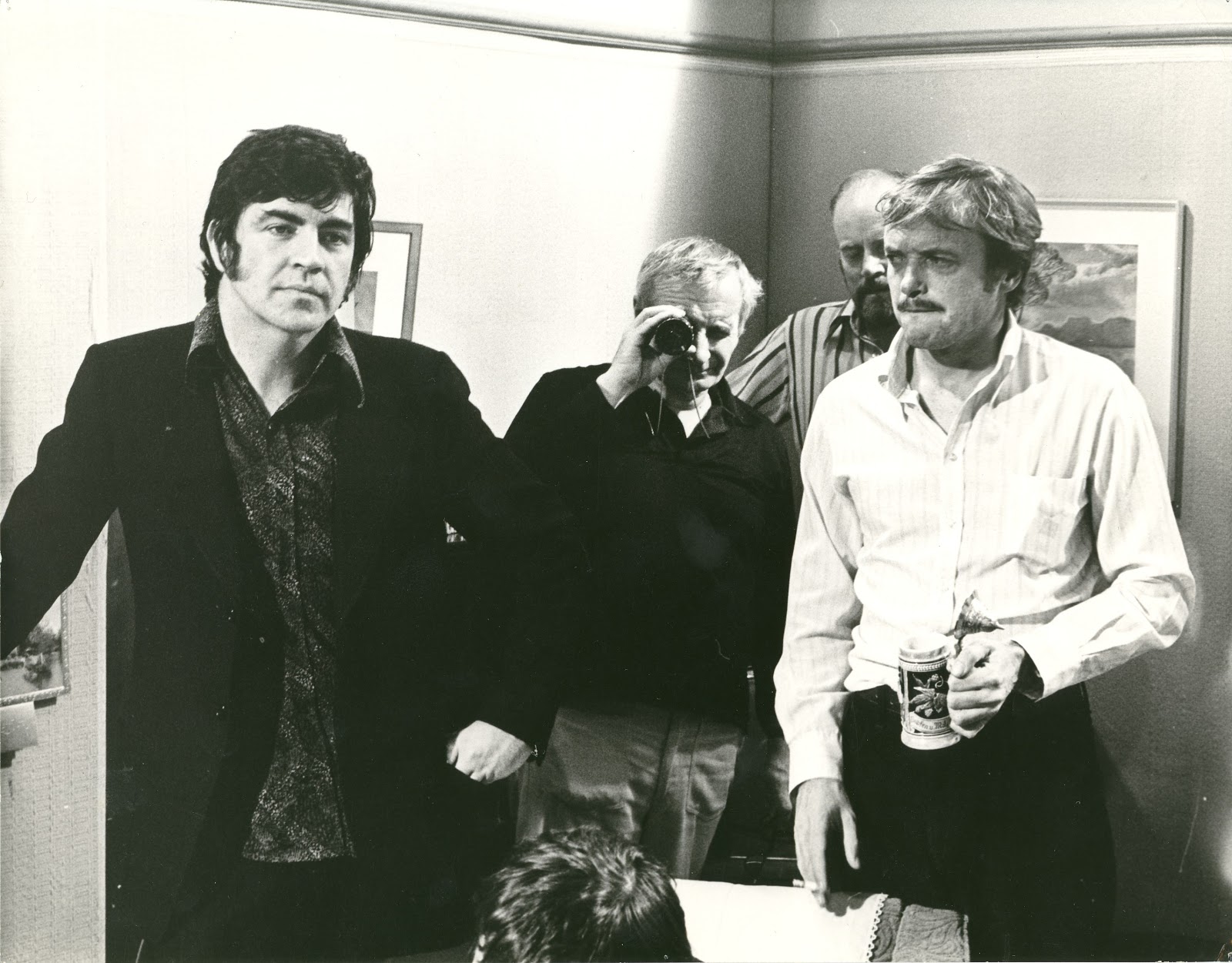
Still from the filming of In Celebration ©Stirling University Archives


Atom Egoyan is a Canadian film maker.  In the chapter in this book he talks about his early love of the theatre and this leads him on to talking about The American Film Theatre.  This was a series devised by Ely Landau, a film producer with a strong interest in adapting plays for the cinema.  He invited different film directors to do just that and the result was fourteen very different films with varying degrees of success and popularity. The first of the series Egoyan saw was Peter Hall's version of The Homecoming and he explains his excitement in realising that he could bring together his love of the theatre with his love of modern film makers.

What was interesting to me is that Egoyan says that the idea behind the American Film Theatre series was "that these films would travel to various cities that would never get the play. After the projections, the prints would be destroyed. that was the theory.  It would preserve the ephemeral nature of the experience."  He goes on to explain that this never took place, and we know that as all fourteen films are now available on DVD.  There's so much current talk all over the web, and on film archive discussion boards and mailing lists, about the 'death of film' so it was interesting to read of a series of films who, according to Egoyan, were not supposed to be preserved but were in fact made with their impending destruction in mind.  Can anyone corroborate this? I can't find anything online about Ely Landau's intending to destroy the films and I don't remember seeing anything about it in the Lindsay Anderson Archive either.  All I remember from that is Anderson's frustrations with the lack on advertising and publicity which he felt his film was getting (if you're interested you can search the Lindsay Anderson Archive here).

Sunday, 23 October 2011

Treasures from the Archives - Wanda

On looking through the London Film Festival brochure all the films that immediately appealed to me were from, yes, you've guessed it the 'Treasures from the Archives' strand.  Then, when the reality of my bank balance hit I had to whittle down what I was going to see to a select few, well a select one actually - Wanda.
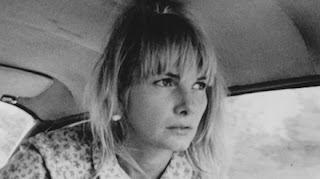
Barbara Loden, director, writer and star of Wanda. Image courtesy of BFI website

I hadn't heard of the female director Barbara Loden before but the description in the brochure really appealed to me - a 'neo-realist gem... a rural Pennsylvanian housewife embarked on a flight to nowhere.. Wanda floats through her own life as if witness to it'.  After recently rewatching Lindsay Anderson's The White Bus with Patricia Healey's depiction of another girl passively watching her own life drift past, I was intrigued by Wanda and am pleased to say my curiosity was well rewarded!

I obviously hadn't read the brochure properly as I didn't notice that Ross Lipman, who restored the film at UCLA, would be introducing the film.  This was such a nice surprise as he gave a brilliant description of the problems facing him with the restoration of a film which was originally meant to look lo-fi and gritty.  The story with Wanda is one that I've heard so many times before sadly, a film lab was closing down and called UCLA to ask if they wanted a look before the stock all went in a skip.  Lipman found the reels for Wanda a day before they were due to be chucked and lost forever.  In an article about the film from the Guardian (17/10/201) Lipman told the story of his discovery of the reels, marked 'Wanda', "Unspooling them on my workbench I quickly realised they were the original camera rolls, and that was only the beginning. The film was shot on a beautiful, unfaded Ektachrome reversal stock: any potential restoration would perhaps look better than even the original release. One day more and the original would have gone to landfill."

I realised when Ross Lipman got up on the stage that I recognised him and when he started talking about other American neo-realist films 'Killer of Sheep' and 'The Exiles' I remembered - I'd heard him talking about the preservation of The Exiles when I went to see it at UCLA (which I never actually got round to writing about, except here, before I went).  He explained how until relatively recently there wasn't much talk of American neo-realism as so many of these films had disappeared into obscurity - citing The Exiles and The Killer of Sheep as two other examples (I was lucky enough to have seen Killer of Sheep at the GFT, turns out I'm a bit of a UCLA film preservation unit groupie!).  These films were pretty obscure upon release, Wanda for example was actually made, according to Lipman, as a tax write-off and although it achieved critical success this didn't translate into commercial success for Loden.  It made me wonder what Lindsay Anderson would have made of them, I wonder if he ever saw any of them?It's weird that even a year after moving from Stirling and leaving the Lindsay Anderson Collection behind I still wonder what he would have made of certain films, or film makers. I guess to me, that's one of the wonderful things about being an archivist - getting all bound up with the work you're cataloguing and making connections with the people and events you're cataloguing.

On to Wanda  itself - what an incredible film! It has stuck with me for days and I imagine it will do long into the future.  When I first read the description I thought of The White Bus, I also thought of more recent female-directed and female-focused films such as Wendy and Lucy and Winter's Bone and in many ways there are similarities.  The lack of any soundtrack - all the noises, music and silences are part of the real life of the film, there is no artificial soundtrack.  I love this in films, it can be quite disconcerting at first, it makes it a lot harder to watch in a way as you can't escape into it in the same way, instead you're forced to confront the reality of the situation the characters live in.  The opening scenes of Wanda are completely silent from what I can remember, maybe a few noises of feet walking on gravel but no music, no talking, and it's all the more powerful for it. 

Very early on in the film there's a scene where Wanda is walking across coal fields and the camera follows her in real time, painfully slow as she walks across this barren landscape, walking to meet someone but really going nowhere.  As Wanda gets caught up in the crimes of a man she meets on the road she drifts from one situation to another, alienate, alone and hopeless.  It really made me think about what it would be like to be born into that kind of poverty with no hope of any alternative, any way out, as did Wendy and Lucy and even more so Winter's Bone.  Wanda was expected to be a housewife, raise a family and bring more children into the same cycle of poverty she grew up in - it's no wonder she wanted something different, she just didn't know what.  I liked that there's no great realisation, she's not a heroine in the sense that she changes her life round and moves onwards and upwards, she just changes her life because the alternative was to grim for her to bear.  I would love the chance to see this film again, and thanks to the work of Ross Lipman
Thursday, 21 April 2011

Researcher's Tales at the BFI

Monday was the first time I went to a 'Researcher's Tales' evening at the British Film Institute Library and Archive on Stephen Street.  I've been wanting to go for ages but would never have been home from work in time before - it's so great now that I'm both living and working in the same city!  Researcher's Tales is billed as "An occasional series of informal discussions for BFI National Library members in which leading writers, historians and practitioners in film, television, artists' film and the moving image reflect on their past, current and future work."

It was such a great evening - the talk by Laura Mulvey and Mark Lewis was fascinating, and the clips they used to illustrate their points were great.  They talked over each other at times, contradicted and corrected each other but that was all part of the dialogue and you really got a feel for the regard and affection they have for each other. The talk was about Rear Projection - a film technique which I recognised but hadn't heard the term for before.  Basically for anyone else like me who hasn't heard the term used, it means that the stars are shot doing their scene in a studio with the scene itself e.g. the landscape, city scape, ocean etc projected behind them on a flat screen.  I'm sure everyone can think of at least a few examples from films they know but what I hadn't realised was just how widely used it was, particularly from the early 1930s through to the late 1950s.  Laura and Mark recalled how they first began talking about, and discovering their mutual interest in this under theorised and under discussed area of cinematic history.  Laura was showing Mark one of her favourite films - the 1930 film Her Man and although Mark was uninterested in the initial aspect Laura wanted to show him he was intrigued by the use of rear projection. This started the dialogue and research which they discussed on Monday night as they "realised that rear projection had an intrinsic aesthetic interest of its own and that its very artificiality, its lack of transparency, brought with it a certain 'modernist' self-consciousness".  You can read more of their views on rear projection here.

We were also privileged to see clips and segments from a number of films by Mark Lewis.  These films were fantastic, particularly Backstory (2009) and Molly Parker (2006).  I really enjoyed the Researcher's Tales and am looking forward to making it to more of them in the future.  You have to be a member of the BFI Library in order to go but that's fine by me too - going back to the Library at Stephen Street for the first time in ages reminded me of what a special place it is.  I so hope they change their mind/the finances change and they don't move it, as proposed, to the much smaller space in the exhibition room at BFI Southbank.

N.B. The clip that they showed from Her Man was copied from Laura's VHS copy of the film.  Mark referred to the poor quality of this but said it was all they could get as the original film has been destroyed and there aren't any copies of it in archives.  I had a look online and it seems you can get it on DVD but these are poor quality copies, probably also from VHS, which I think people can sell now as the film is in the public domain - though I'm not sure if that's just in America or worldwide.  It made me think again of film archiving, obviously not all films can be preserved, or indeed merit being preserved - however, how much of what is saved and what is lost is often down to chance.