Showing posts with label John Ford. Show all posts

Tuesday, 13 July 2010

The wonders of modern technology!

I am steadily making my way through the Lindsay Anderson named correspondence files.  I had a very pleasant day recently cataloguing the correspondence between Lindsay Anderson and Harry Carey Jr.  The son of Harry Carey, Harry Carey Jr. was, like his father, an actor in John Ford's Stock Company.  He starred in ten John Ford's films: 3 Godfathers (1948); She Wore a Yellow Ribbon (1949); Wagonmaster (1950); Rio Grande (1950); The Long Gray Line (1955); Mister Roberts (1955); The Searchers (1956); Two Rode Together (1961); Flashing Spikes (1962); Cheyenne Autumn (1964).  Harry Carey Jr. (also known as Dobe due to the colour of his hair)  wrote  a memoir of his time as an actor for John Ford Company of Heroes and this occupies a lot of the discussion in the correspondence between Anderson and Carey.  The correspondence starts in 1980 but we know they met earlier than this as there is an interview Anderson conducted with Carey in About John Ford in 1978.  

Insert sent to Anderson by Harry Carey Jr. with copy of Company of Heroes
© Lindsay Anderson Collection, University of Stirling Archives

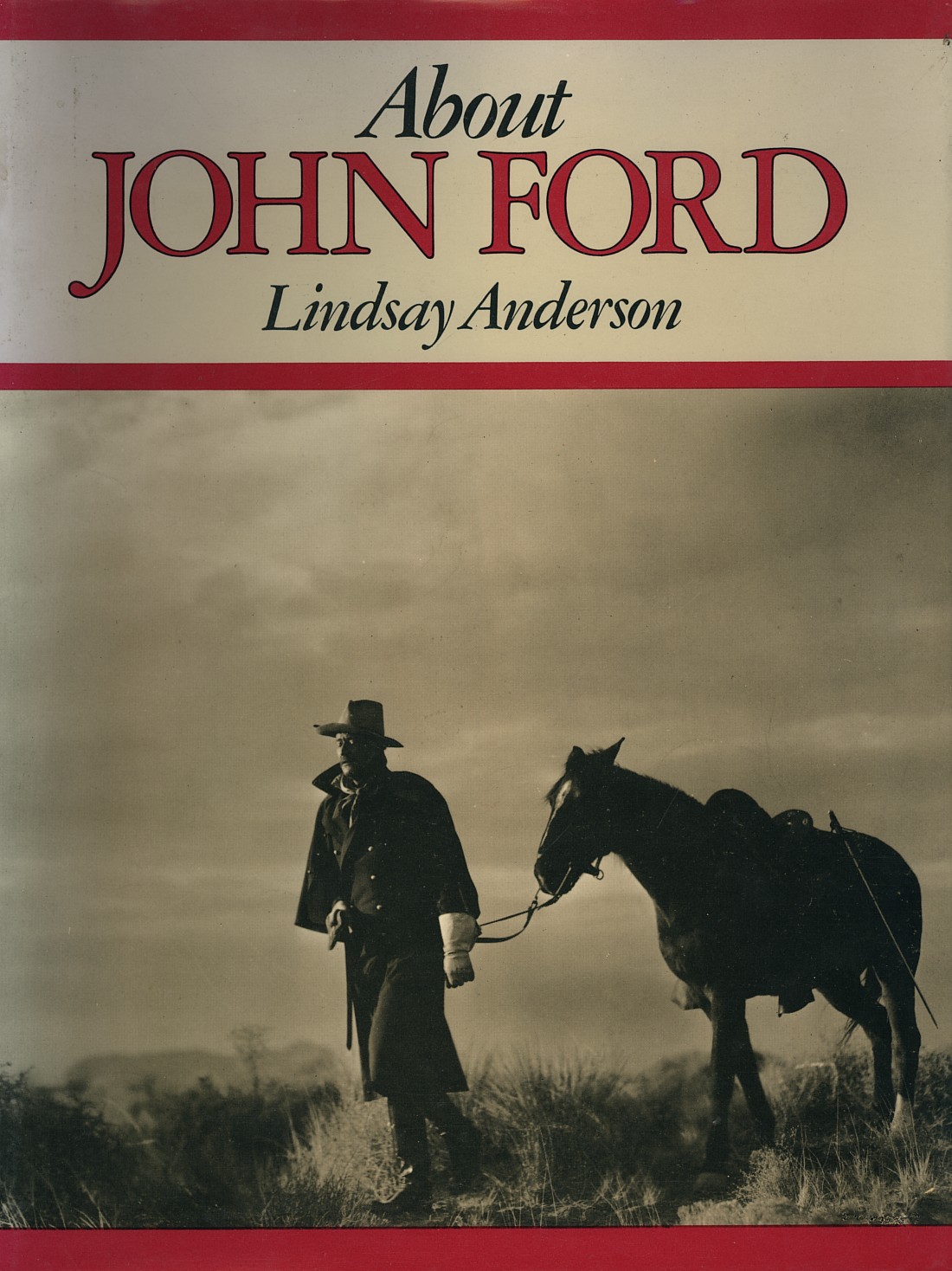
About John Ford
© Lindsay Anderson Collection, University of Stirling Archives

The reason I said that this was a very pleasant way to spend the day is that Harry Carey Jr. just comes across as such a lovely man - the correspondence between them is warm, filled with reminiscences about John Ford and discussions of his films, but also some very vivid descriptions of Monument Valley and the surrounding areas which are great to read.

The first letter in the file from Anderson to Harry Carey Jr. is dated 6 February 1980 and in it Anderson discusses his latest purchase - a video recorder!  Anderson mentions this is correspondence with a number of people so it's apparent that he was very excited by this new ability to record films from the television and create his own film library.  Here he is filling Harry Carey Jr. in on his purchase:


"We've had YELLOW RIBBON here on TV recently , followed by LIBERTY VALANCE.  I indulged myself in a video-recorder before Christmas - so now I am building up a classic-film library.  So far, besides the aforementioned, I have MEET ME IN ST. LOUIS, THE MALTESE FALCON,  Renoir's LE GRAND ILLUSION, LITTLE CAESAR and PUBLIC ENEMY etc., etc.  Little did I think I would have copies of such pictures of my own, available at the press of a couple of switches.  Modern technology at last pays off!" LA/5/01/2/5/2

Ah, modern technology!  I was going to say it's easy to take this technology for granted but, not having a sky box or any similar thing for recording of the television, and being too lazy to try and tune my video recorder to the TV, I don't take this for granted anymore!  I have to hope that any programmes I miss are on BBC and will be repeated on the iPlayer, or that they are available for hire.  Of course, I could just get myself a sky box or similar technology but that would be too easy, I usually wait at last a few years before catching up with the latest technology.  I'll get an iPhone one of these days but only having got an iPod in the last few years, after years of a personal CD player when everyone else had a minidisc player, and before that years of a cassette player when everyone else had long moved on to CD's I guess I should just accept to being slightly behind the times with personal use of technology!

Monday, 7 June 2010

Early John Ford film amongst those found at the New Zealand Film Archive

I was directed to an interesting article in the New York Times via the Association of Moving Image Archivists (AMIA) mailing list. For anyone interested in the preservation of films and film-related material I would highly recommend joining this. I know there's a huge amount of mailing lists out there but this one is really worth it. There are always interesting and lively discussions about developments in film preservation, enquiries from film researchers looking for help finding particular films or information about the films, and news of interesting developments, like the link to this article in the New York Times.

A large number of early American films held in the New Zealand Film Archive are now to be returned to America when it emerged that in some cases they were the only surviving print of the film. 75 of these films, chosen for their historical and cultural importance, are now in the process of being returned to the US. The reason so many foreign films remained in New Zealand after their use in cinemas is due to the high cost of shipping them back.

Of particular interest is the discovery of the only print of Upstream a John Ford film from 1927. This film is being copied to modern safety stock before being transferred back to the US as it is the only copy and they do not want to rick any loss or damage to the print. In About John Ford Lindsay Anderson mentions this film, listing it in Ford's filmography, but there is no mention of it in the book or the index - presumably because there was no possible way of viewing a print of the film. It's amazing to think that all these years later we're going to be able to see it again.


The New York Times article discusses the practicalities of moving, and preserving the films, so I'll include an extract from that article here -

Getting the films, which were printed on the unstable, highly inflammable nitrate stock used until the early 1950s, to the United States hasn’t been easy. “There’s no Federal Express for nitrate out of New Zealand,” said Annette Melville, the director of the foundation. “We’re having to ship in UN-approved steel barrels, a little bit at a time. So far we’ve got about one third of the films, and preservation work has already begun on four titles.”

As the films arrive, they are placed in cold storage to slow further degeneration. “We’re triaging the films,” Ms. Melville said, “so we can get to the worst case ones first. About a quarter of the films are in advanced nitrate decay, and the rest have good image quality, though they are badly shrunken.”

As funds permit, the repatriated films will be distributed among the five major nitrate preservation facilities in the United States — the Library of Congress, the Academy of Motion Picture Arts and Sciences, George Eastman House, the U.C.L.A Film & Television Archive and the Museum of Modern Art — where the painstaking work of reclaiming images from material slowly turning to muck will be performed.


I like that the reason the films came to light was because Brian Meacham, who works at the Film Archive of the Academy of Motion Picture Arts and Sciences, went to visit the New Zealand Film Archive when he was on holiday! Is that something a lot of archivists do, visit archives in their holidays? I know I do and it's good to know I'm not alone in this!

Monday, 30 November 2009

Archival detective work

One of the best aspects of my job (especially for a girl like me with a penchant for trashy American crime shows and detective novels!) is the detective work which is necessary when cataloguing archival material. Recently I've spent plenty of time doing archival detective work on the two large boxes of material we have in the Lindsay Anderson Archive which relate to About John Ford.


About John Ford
is a very interesting mixture of critical analysis of the films of John Ford, mixed with Anderson's personal reminiscences of his meetings with John Ford, and interviews he conducted with various people who worked with Ford. Anderson's admiration of John Ford began in 1946 when he first saw My Darling Clementine. It continued through his reviews and articles about Ford in Sequence, his meetings with Ford over the years, and two television programmes: an Omnibus two-part programme on Ford narrated by Anderson (1992) ; and a Channel Four programme (1987) , where Anderson gave a 'masterclass' to a group of students about the art of film-making through the example of My Darling Clementine

The boxes relating to About John Ford contain: notes made by Anderson on Ford's films; press cuttings re: John Ford; early drafts of the book; correspondence with friends, colleague's and family of Ford; correspondence with publishers; correspondence with readers and critics; promotional material for the book; and reviews of the book.

The first big piece of detective work was with the early drafts of the book. There were some pages paper clipped together which obviously ran as a section (anything from 2 pages to 32 pages long), but there were no page numbers or chapter headings to work out where in the published version of the book they relate to. The first decision I had to make was, do I take the time to locate each of these draft sections in the published book? Well, I quickly decided that yes, it was worth the time to do this as it would be of value to future researchers, and it's always interesting to see what remains and what is changed from draft to published version. So then, how to work out where all these pages were located in the published book? Not that I'm claiming any great shakes as a detective, just common sense really, but I determined that the quickest way would be to use the index in About John Ford, and look for the least common, or least famous, actors names or place names. Where there were only a few occurrences of a name it was relatively quick to locate the draft pages and reference them in my cataloguing. Now, this may not be interesting to everyone, but somehow to me, this job was immensely satisfying - I guess that's why I'm an archivist!

Another problem I encountered was due to my less than all encompassing knowledge of John Ford's films. By this I must confess that prior to cataloguing this material I had only seen one Ford film, The Quiet Man. So I started attending screenings for John Izod's class
'Genre in Hollywood: The Western' (the benefits of working in a University!) . I have now seen, and enjoyed, My Darling Clementine, Stagecoach, and Iron Horse. Only a drop in the ocean as far as the number of John Ford films but it has helped with the cataloguing. It didn't help me much though when I came across a file with four black&white photographs of stills from John Ford films. With so many films to choose from, and having seen so few of them, I was having real trouble trying to identify them. So, rather than spend huge amounts of time going through images on IMDb from all his films, I decided to call in the cavalry (excuse the bad pun!). I e-mailed Charles Barr, a Professor of Film at University College Dublin and a John Ford expert (Charles Barr gave a very interesting paper About the John Ford Archive at our conference in September). Charles was able to identify the images for me, including the photograph of Charley Grapewin, from 'Tobacco Road' (1941) which I've included here.

LA/4/3/10/3, Still from Tobacco Road
© Lindsay Anderson Collection, University of Stirling Archives

I love all the research and detective work that goes into cataloguing archives, all the new directions it sends you off in. As I've been going along with this cataloguing - over two years so far! - it's been so rewarding to see all the connections starting to build up, recognising more of the names I come across, almost like old friends even though I never knew any of them. Resources that I've found particularly useful for the Lindsay Anderson Collection have been the IMDb, Lindsay Anderson Memorial Foundation, BFI Film and Television database, Screenonline and Doollee

N.B. John Ford's papers are held at the Lilly Library, Indiana University in Bloomington, Indiana.