Showing posts with label Free Cinema. Show all posts

Sunday, 20 February 2011

Perfection is not an aim.

Danny Boyle on David Lean "[Lean] dominates the British landscape in a way that I think is unhealthy really.  He was a perfectionist and I'm not sure that the pursuit of perfection is what it's about really.  I think it's about expression, not perfection... I find that perfection a little bit glossy at times really." (from an interview with Danny Boyle in the Guardian - I have searched online and cannot find the article this came from, I should the have kept the paper copy!)

I wrote this down at the time because it stuck in my head in reference to the Free Cinema Manifesto which Lindsay Anderson wrote:

“No film can be too personal…
Perfection is not an aim.
An attitude means a style.
A style means an attitude.”
Lindsay Anderson, Free Cinema Manifesto from the 1956 Free Cinema Programme


I'm with Lindsay Anderson and Danny Boyle on this one, perfection is definitely not what it's about!

Wednesday, 15 September 2010

Lindsay Anderson's 'O Dreamland' screening in London

There will be a screening of Lindsay Anderson's O Dreamland next Thursday in London as part of a night of poetry, performance and film screenings under the banner of 'Plectrum Live Edition'.   The event 'Plectrum Live Edition: Postcards from the Promenade' is organised by 'Plectrum - the cultural pick' - an arts magazine published on-line and bi-monthly in print.  I heard of this event via The Horse Hospital - this is an arts venue in London. In their own words "The Horse Hospital is a three tiered progressive arts venue in London providing an encompassing umbrella for the related media of film fashion, music and art." Oh, so many things to explore when I move to London!  Although unfortunately I'll miss this event as I'm travelling back up from London on the 23rd after a few days flat hunting and starting a film course at Lux - Opening up the Archive - a Guided tour of Artists Moving Image.

Here is some more information about the event which the screening of O Dreamland is a part of:

"Returning from a seaside summer holiday, the first Plectrum Live Edition of the autumn mixes postcards from the promenade and the view into the fairground fortune teller’s crystal ball, with fresh perspectives on the sights and sounds of London, to present an evening of author readings, film screening, live music, poetry, and more with Travis Elborough, Lindsay Anderson’s O Dreamland, Karen McLeod, The Vatican Cellars, and Benedict Newbery, hosted by Guy Sangster Adams."

Thursday 23 September at The Horse Hospital, Colonnade, Bloomsbury, London WC1N 1JD.  Doors at 7.30 performances begin 8pm.    Tickets £6 on the door.


Set in a funfair in Margate called 'Dreamland' Lindsay Anderson's 1953 film O Dreamland wasn't actually screened until the first Free Cinema programme at the National Film Theatre in 1956.  A short film of 12 minutes which tours round the funfair showing the 'attractions' which in this film appear very bleak, and at times, sinister.  The effect of the film is described brilliantly by Gavin Lambert in an article he wrote on Free Cinema:

 "Everything is ugly... It is almost too much. The nightmare is redeemed by the point of view, which, for all the unsparing candid camerawork and the harsh, inelegant photography, is emphatically humane. Pity, sadness, even poetry is infused into this drearily tawdry, aimlessly hungry world."

Lindsay Anderson on location for O Dreamland,
© Lindsay Anderson Collection, University of Stirling Archives


N.B. The funfair at Margate is still there today although it closed in 2005.

N.B. If you are in a Library, College or University which has an account with BFI Screenonline then you can watch O Dreamland  for free online at http://www.screenonline.org.uk/film/id/438978/

Wednesday, 23 June 2010

Cataloguing milestones

Well, that's me finally finished cataloguing all the A-Z correspondence files - it felt like a never ending task at times but at least the material I'm cataloguing has been very interesting.  The thing about being in an office on your own though is when you do reach a milestone like this there's no one to celebrate with!  It does feel like a pretty big achievement when you complete one section, especially one as big as this one was, with over 3800 items!  It was with great satisfaction that I scored all those files off my timetable!

Today I am not on my own as my room mate Isabelle is in so I'm doing a good job of distracting her from her dissertation with my interesting finds in the named correspondence files.  Yes, once again I'm back to 'A', well 'B' now to be more precise - cataloguing the correspondence between Lindsay Anderson and the artist Don Bachardy, from the named correspondence files.  Bachardy is an artist who paints the most beautiful portraits but is perhaps better known (well he was to me anyway) as the long-term partner of Christopher Isherwood.  Indeed the recent Tom Ford film A Single Man, based on the book by Isherwood, was inspired by a break-up between Bachardy and Isherwood, although in real life the break up was short lived and they were together until Christopher Isherwood died in 1986. 

I am only half way through their correspondence together and I found an interesting description by Anderson of why he felt Bachardy is such a talented artist "they manage to be both portraits and a collective self-portrait, which makes the whole collection a single work - as well as being a wonderfully perceptive and acute assembly of individual studies" [here Anderson is referring to a book of Bachardy's portraits which has just been published].  I thought this definition of Bachardy's talent could be transferred quite easily to film and seems to sum up Anderson's attitudes to his own creative work as a film director "no film can be too personal". 

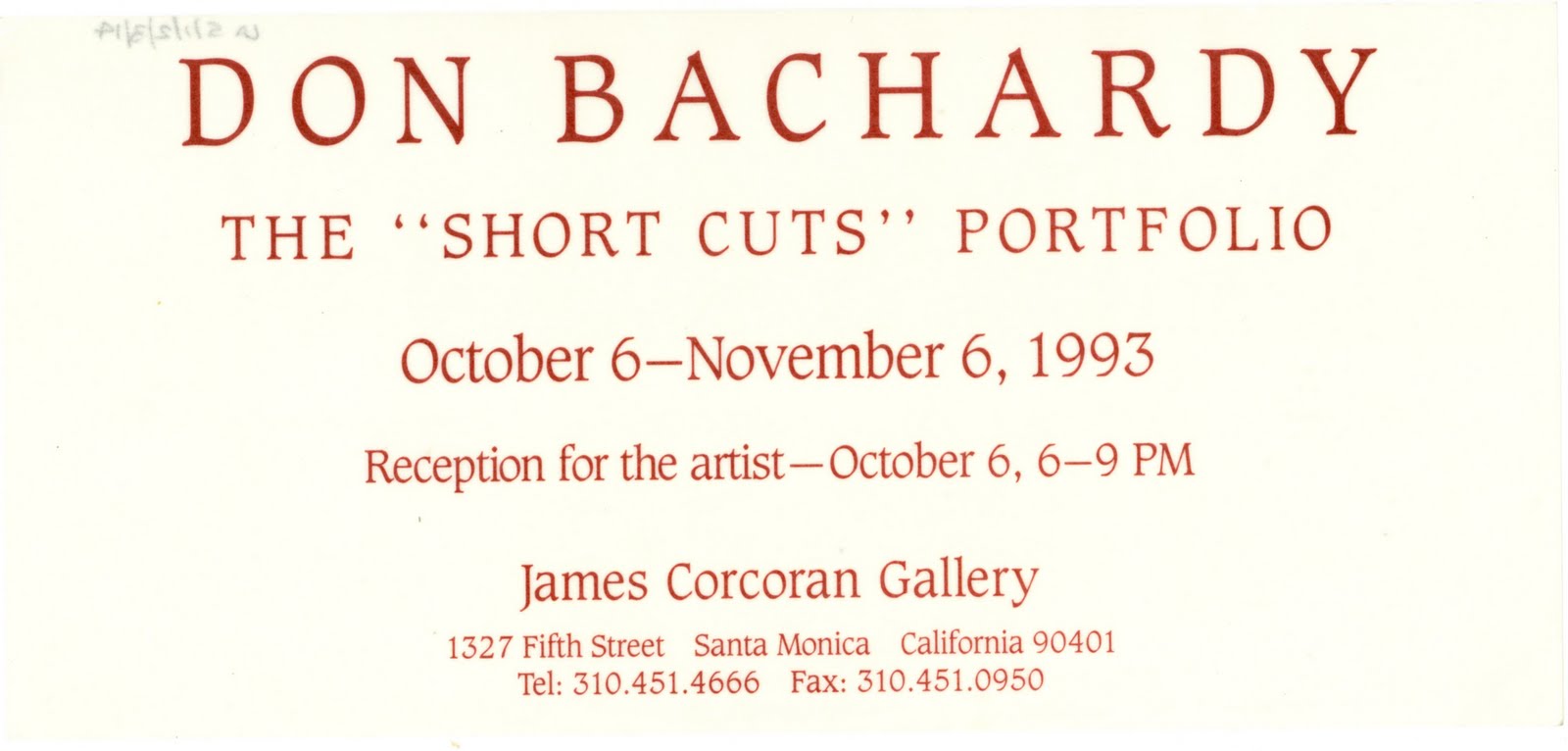
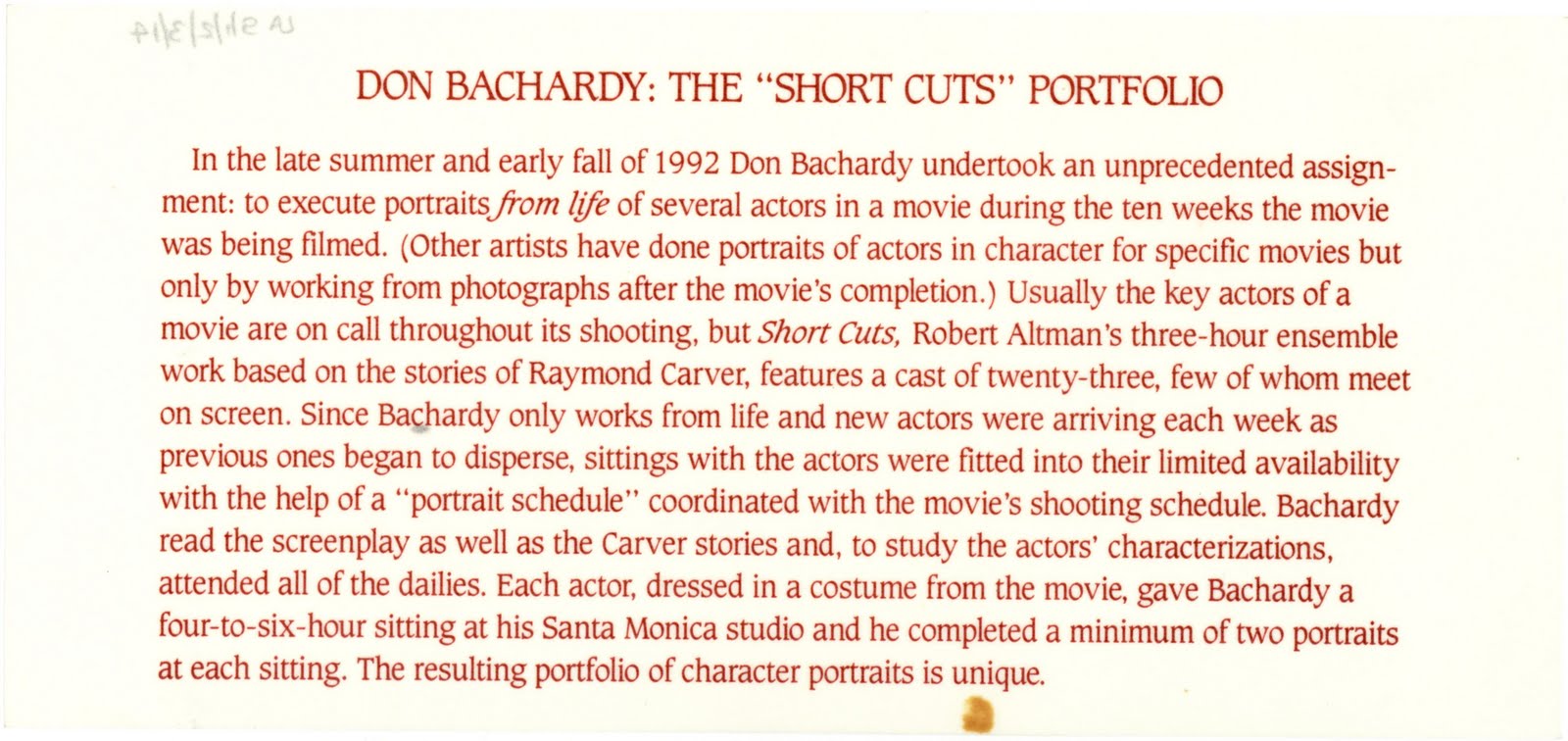
There are lots of fantastic photographs and colour images of Bachardy's paintings in the file but I would never want to use these without first seeking the permission of the artist.  Instead I thought I would show these images - an invitation to an exhibition of Bachardy's portraits of actors carried out during the shooting of Robert Altman's Short Cuts. 

Invitation to exhibition of The 'Short Cuts' portfolio by Don Bachardy, LA/5/1/2/3/14
© Lindsay Anderson Collection, University of Stirling Archives

Invitation to exhibition of The 'Short Cuts' portfolio by Don Bachardy, LA/5/1/2/3/14
© Lindsay Anderson Collection, University of Stirling Archives

I have just checked online and the Short Cuts portraits painted by Don Bachardy have been published with the script for Short Cuts.  You can see the front cover of the published script with some of Bachardy's work (though the quality of the image is poor) on Amazon.

Thursday, 12 February 2009

The Cinema Authorship of Lindsay Anderson

The Cinema Authorship of Lindsay Anderson is a three-year research project at the University of Stirling, funded by the Arts and Humanities Research Council (AHRC). There are four of us in the research team. Myself (Research Assistant), John Izod (Principal Investigator) Karl Magee (Co-investigator and University Archivist) and Isabelle Gourdin (Doctoral Candidate). The project will use Lindsay Anderson's personal and working papers together with previously published material, to examine the director's claim to the status of authorship by investigating the connection between his films and his personality. This will be done by comparing his private thoughts, expressed in his diaries, correspondence and other personal papers, with his public statements about his films, the film industry in general, and the ways in which films are received, found in his articles, interviews, books and letters to the press. Both the public and the private aspects of Anderson's claims to authorship will be examined in the wider context of the ways in which his ideas were received, interpreted and disseminated by the various publics to which they were addressed.

Lindsay Anderson is a central figure in the history of British cinema in the twentieth century. There are his well-known and critically acclaimed films of the 1960s and 1970s including This Sporting Life, starring Richard Harris and If.... starring Malcolm McDowell. Anderson was also one of the founders of the 'Free Cinema' movement in the 1950s which challenged the established conservatism of British cinema with documentaries (and some dramas) reflecting the everyday lives of ordinary people. In addition he was a respected writer and film critic and one of the founders of the influential film journal Sequence in 1947. As well as his important to the history of British cinema he was also a highly respected theatre director. He worked with many of the most well-known and central figures of the British stage. Lindsay Anderson died in 1994, aged 71. There is a complete list (to file level), composed by the University Archivist Karl Magee, which details all of Lindsay Anderson's film/stage/television work and critical writings.

The main focus of my part in this project is to catalogue the collection to item level so that the material can be easily accessed and used for research. The project is now halfway through so I feel I know the Collection quite well now, though there are still lots of surprises (one of the joys of working with archive material) like the other day when I came across a letter from Lindsay Anderson to his friend, the writer Gavin Lambert, where he informs Lambert that he has had to turn down a part in 'Return of the Jedi' because he was too busy with his own work!
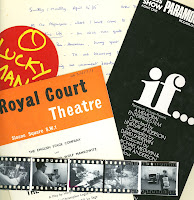
© Lindsay Anderson Collection,
University of Stirling

The Lindsay Anderson Collection contains a huge variety of types of records: letters; diaries; notebooks from the sets of films; production notes; on-set photographs for both film and theatre work; personal photograph albums; Anderson's large book library (with annotations by him in some of the books); his personal VHS library with its own card catalogue system; music cassettes; recordings of Anderson transcribing letters; press cuttings (reviews of his work and press cuttings that he used for inspiration for his work); family memorabilia; and many of the paintings and prints that hung on the walls of his home. I'm sure I will still have missed some out but you get the picture! It is a really interesting collection to work with, though I know most archivists think that of the collections they work with - again I think this is one of the joys of the job, getting to work with such a variety of records and realising the potential and interest in all these records. The Collection contains material on Anderson's theatre and film work but as the research project is 'The Cinema Authorship of Lindsay Anderson' my priority is to catalogue all the parts of the collection relating to his film work. This distinction is not always so clear cut, for example, in a letter to a theatre critic Anderson might also discuss the reception of his latest film. However as the Collection is divided up primarily by film/play/television production/book this makes my job slightly easier and gave me a starting point. In future posts I'll talk more about the arrangement of the Collection and highlight some of the interesting records I've come across but for now I'll stop as I just wanted to give an introduction and a broad picture of the Archive I'm working with.