Showing posts with label Sequence. Show all posts

Friday, 30 March 2012

Archival links in published books

I think this is a tendency in all archivists really, or in anyone who loves their jobs - finding connections everywhere!  In my case I always seem to find archive connections in what I'm reading, listening to, talking to friends about, or going to see in exhibitions.  I'm still really enjoying reading through Raymond Chandler's published letters in The Raymond Chandler Papers (sadly reaching the end of the book now!).  I was particularly happy when I came across a Lindsay Anderson link (if you're new here then I should point out that I spent 3 years working at Stirling University Archives cataloguing parts of Lindsay Anderson's archive). Towards the end of the book there is a letter from Raymond Chandler to the editor of Sequence magazine.  This is undated but is in amongst the early 1952 letters which would have been about right given the content of the letter.
“I hate to see the magazine fold. There is so little intelligent writing about films, so little that walks delicately but surely between the avant garde type, which is largely a reflection of neuroticism, and the deadly commercial stuff. I think you have been a little too hard at times on English films, which even when not top notch do give you the feeling of moving around in a civilised world – something which the Hollywood product falls pretty short of as a rule. Even if you had been less intelligent, I should be sorry to see you go. Sight and Sound is all very well so far as it goes. I suppose it is subsidised, and everything that is subsidised compromises, and everything that compromises ends up by being negative."
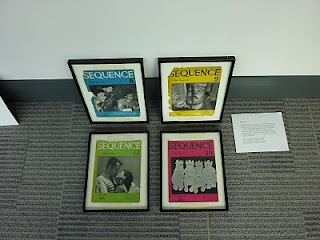
Sequence covers, ready to go up as part of an exhibition at Stirling Uni ©Lindsay Anderson Archive, University of Stirling 
Sequence was a film journal started by Lindsay Anderson, Gavin Lambert and Peter Ericsson. It started in 1948 and fourteen issues were published, the final in 1952. I still get so happy when I come across links to Lindsay Anderson so of course my first thought was to check the catalogue. I knew I'd catalogued all the Sequence correspondence and I didn't have any memory of a Raymond Chandler letter but of course there's no way of remembering everything you've catalogued! Unfortunately it's not there so the original of the letter didn't make it to the Lindsay Anderson Archive. In the book the authors say that Raymond Chandler's archive is held between the Bodlein and UCLA, though neither of these have their Chandler collection catalogued to item level online so I can't even see which archive holds Chandler's carbon copy of the letter he sent.
It's disappointing the letter isn't in the Lindsay Anderson Archive but then it would be impossible for an archive collection ever to be 'complete'.  Maybe the letter is in the archive of one of the other founders of Sequence (Gavin Lambert's papers are at the Howard Gotlieb Archival Research Centre in Boston) , maybe it ended up with someone else who was a fan of Chandler, or maybe it just got lost of misplaced at some point before the collection arrived at the University.  We'll never know I suppose.
 
Interestingly, there is a mention of Raymond Chandler in the Sequence series of the Lindsay Anderson Archive. It's in section LA/4/1/6 'Letters from readers and subscribers to Sequence' and is a letter from J. B. Priestley to a Mr Panting and my catalogue description reads
Thanks for sending a copy of Sequence; and expressing interest in an article on Raymond Chandler. 
It's dated 30/05/1949 so I wonder if there was an article in Sequence which discussed Raymond Chandler's writing, either novels or screen writing, or a film adaptation of one of his books. Mr. Panting seems an odd name but I seem to remember that the authors of Sequence would sometimes write under pseudonyms. I know from the Raymond Chandler Papers that Chandler knew Priestley, but I don't know when from - the earliest mention of Priestley in the book is from 1951.  I'm going to have delve a bit further into this sometime, starting with another good look through Sequence - a good excuse for a visit to the new BFI library at Southbank!

Thursday, 12 February 2009

The Cinema Authorship of Lindsay Anderson

The Cinema Authorship of Lindsay Anderson is a three-year research project at the University of Stirling, funded by the Arts and Humanities Research Council (AHRC). There are four of us in the research team. Myself (Research Assistant), John Izod (Principal Investigator) Karl Magee (Co-investigator and University Archivist) and Isabelle Gourdin (Doctoral Candidate). The project will use Lindsay Anderson's personal and working papers together with previously published material, to examine the director's claim to the status of authorship by investigating the connection between his films and his personality. This will be done by comparing his private thoughts, expressed in his diaries, correspondence and other personal papers, with his public statements about his films, the film industry in general, and the ways in which films are received, found in his articles, interviews, books and letters to the press. Both the public and the private aspects of Anderson's claims to authorship will be examined in the wider context of the ways in which his ideas were received, interpreted and disseminated by the various publics to which they were addressed.

Lindsay Anderson is a central figure in the history of British cinema in the twentieth century. There are his well-known and critically acclaimed films of the 1960s and 1970s including This Sporting Life, starring Richard Harris and If.... starring Malcolm McDowell. Anderson was also one of the founders of the 'Free Cinema' movement in the 1950s which challenged the established conservatism of British cinema with documentaries (and some dramas) reflecting the everyday lives of ordinary people. In addition he was a respected writer and film critic and one of the founders of the influential film journal Sequence in 1947. As well as his important to the history of British cinema he was also a highly respected theatre director. He worked with many of the most well-known and central figures of the British stage. Lindsay Anderson died in 1994, aged 71. There is a complete list (to file level), composed by the University Archivist Karl Magee, which details all of Lindsay Anderson's film/stage/television work and critical writings.

The main focus of my part in this project is to catalogue the collection to item level so that the material can be easily accessed and used for research. The project is now halfway through so I feel I know the Collection quite well now, though there are still lots of surprises (one of the joys of working with archive material) like the other day when I came across a letter from Lindsay Anderson to his friend, the writer Gavin Lambert, where he informs Lambert that he has had to turn down a part in 'Return of the Jedi' because he was too busy with his own work!

© Lindsay Anderson Collection,
University of Stirling

The Lindsay Anderson Collection contains a huge variety of types of records: letters; diaries; notebooks from the sets of films; production notes; on-set photographs for both film and theatre work; personal photograph albums; Anderson's large book library (with annotations by him in some of the books); his personal VHS library with its own card catalogue system; music cassettes; recordings of Anderson transcribing letters; press cuttings (reviews of his work and press cuttings that he used for inspiration for his work); family memorabilia; and many of the paintings and prints that hung on the walls of his home. I'm sure I will still have missed some out but you get the picture! It is a really interesting collection to work with, though I know most archivists think that of the collections they work with - again I think this is one of the joys of the job, getting to work with such a variety of records and realising the potential and interest in all these records. The Collection contains material on Anderson's theatre and film work but as the research project is 'The Cinema Authorship of Lindsay Anderson' my priority is to catalogue all the parts of the collection relating to his film work. This distinction is not always so clear cut, for example, in a letter to a theatre critic Anderson might also discuss the reception of his latest film. However as the Collection is divided up primarily by film/play/television production/book this makes my job slightly easier and gave me a starting point. In future posts I'll talk more about the arrangement of the Collection and highlight some of the interesting records I've come across but for now I'll stop as I just wanted to give an introduction and a broad picture of the Archive I'm working with.