Showing posts with label Lindsay Anderson Collection. Show all posts

Tuesday, 11 May 2010

New publication on Lindsay Anderson and O Lucky Man!

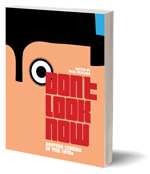
Another output from the 'Cinema Authorship of Lindsay Anderson' team here at Stirling University - a chapter in Don't Look Now, a new book published this month by Intellect Ltd. The book investigates film and television culture in the 1970s. Besides being very interesting anyway, and a beautiful looking book, I can highly recommend this book as it contains a chapter by our team here at Stirling ‘What is there to smile at?’ Lindsay Anderson’s O Lucky Man!, by John Izod, Karl Magee, Kathryn Mackenzie and Isabelle Gourdin-Sangouard. As with all of our work it is based in research conducted in the material held in the Lindsay Anderson Archive at the University of Stirling.


I've enclosed the synopsis for the book below:

"While postwar British cinema and the British new wave have received much scholarly attention, the misunderstood period of the 1970s has been comparatively ignored. Don’t Look Now uncovers forgotten but richly rewarding films, including Nicolas Roeg’s Don’t Look Now and the films of Lindsay Anderson and Barney Platts-Mills. This volume offers insight into the careers of important film-makers and sheds light on the genres of experimental film, horror, and rock and punk films, as well as representations of the black community, shifts in gender politics, and adaptations of television comedies. The contributors ask searching questions about the nature of British film culture and its relationship to popular culture, television, and the cultural underground."

Here are some reviews of the book:

'The essays in this highly stimulating collection reveal, clearly and persuasively, just how diverse, energetic and imaginative British cinematic creativity was during this rather maligned decade... In shining a bright light into one of the remaining dark corners in British cinema history Don’t Look Now is a welcome and extremely valuable contribution to the field.' – Professor Duncan Petrie, University of York

'Long overdue for a closer look, this volume provides a comprehensive, wide-ranging and stimulating range of new scholarship on British cinema and television in the 1970s. ' – Professor Sarah Street, University of Bristol

Sunday, 29 November 2009

Paper published on audience reception to Lindsay Anderson's 'Britannia Hospital', examined through material in the Anderson Archive

Back in May I wrote about a conference I went to in Edinburgh in March, where I presented a paper examining the relationship between Lindsay Anderson and his audiences, based on archival evidence in the Lindsay Anderson Collection relating to Britannia Hospital (1982). The Edinburgh International Film Audiences Conference was organised by Ailsa Hollinshead, Lecturer in Sociology at Edinburgh Napier University. A selection of papers from the conference have now been published in the online film journal Participations: Journal of Audience and Reception Studies.

Well, I'm pleased to say that the paper which I presented, which I co-authored with Karl Magee (with thanks to John Izod and Isabelle Gourdin-Sangouard for their help) is part of the selection of papers published in Volume 6 of the journal. I really enjoyed the conference and thought all the papers were really interesting so it was great to get the chance to re-read some of them in the journal.

I've included the abstract from our article below and you can read the article here:

Britannia Hospital was the final part of a trilogy of films directed by Lindsay Anderson which started so successfully with If…. in 1968 and continued with O Lucky Man in 1973. However, Britannia Hospital, released in 1982, was condemned by the critics and largely ignored by the public, a disappointing end to the trilogy. This paper is going to look at aspects of the relationship between the director and his audience by examining the strains exerted on this relationship by the promotion and critical reception of Britannia Hospital. The Lindsay Anderson Archive at the University of Stirling provides the main source material for this through: Anderson’s correspondence with friends, fans and critics; ideas for the advertising campaign for the film; and correspondence with the distribution companies.

Monday, 9 November 2009

Letter to Lillian Hellman in the Lindsay Anderson Archive

Sometimes you come across a letter so unexpected that it just lights up the whole day. This happened to me on Friday whilst cataloguing a series of material in the Lindsay Anderson Collection related to a book he wrote, About John Ford. It's been an incredibly interesting section of material to catalogue anyway, containing transcripts of interviews Anderson carried out with Henry Fonda, Dudley Nichols, and Harry Carey Jr; various handwritten drafts of Anderson's book; and lots of reviews of John Ford films.

The letter which made my day on Friday was Lindsay Anderson writing to Lillian Hellman. It came as a real surprise to me as I didn't know that they had met. Although I had heard of Hellman's plays it was actually through her autobiographical book Pentimento that I first got to know about her. I know she is a controversial figure who is said to have invented her biography to varying degrees, depending on which critic you believe, but she was such a wonderfully strong character that I can't help but admire her. There is also a letter in the same file which Lillian Hellman wrote to Anderson in which she says 'It would give me great pleasure if you were ever interested in directing it[The Little Foxes]' (Lillian Hellman writing to Lindsay Anderson, 29/04/1981) - I wish that this had happened!


Section of a letter from Lindsay Anderson to Lillian Hellman, LA/4/3/16/8
© Lindsay Anderson Collection, University of Stirling Archives


The Lillian Hellman papers are at the Harry Ransom Centre at the University of Texas.

Wednesday, 29 July 2009

The Old Crowd


Invitation to attend screening of The Old Crowd in Venice, California with ‘Director’s note’ written by Anderson © Lindsay Anderson Collection


I keep thinking about The Old Crowd after watching it again recently, it makes for such uncomfortable viewing and it's such a great piece of work that I feel it deserves to be considered on the same terms as Lindsay Anderson's films. I knew it was based on a play by Alan Bennett but I hadn't realised until cataloguing the correspondence what a collaborative piece of work the television adaptation was.

A little piece of context - Stephen Frears (who was Anderson's assistant director on If....) produced a series of six plays by Alan Bennett for LWT (London Weekend Television). The Old Crowd was the one that most interested Lindsay Anderson when he was asked to direct one of them.

[Plot synopsis – I realised after I posted this that I didn’t really include a plot synopsis as I got carried away talking about what’s in the Archive! Hmmn, not very good for an archivist though, not putting it in context, oops. So, what happens – George and Betty are having a dinner party in the large house they have just moved into with George’s mother. There is no furniture in the house due to a mix-up with the furniture ending up in another city. They are hosting a dinner party and the first people to arrive at the door are ‘the Slaves’, these two servants are Harold and Glyn and they instantly give off a sense of foreboding and menace. The windows in the house are covered in newspaper and whenever one of the guests arrives at the door there is an emphasis made on shutting the door, shutting out the outside world. There is a talk of a virus sweeping the country, of muggers, riots, rampant crime. All the guests arrive, including Totty, a friend they had been talking about who has just been given six months to live. The ‘Old Crowd’ are depicted as self-centred, boorish, bourgeoisie, but the ‘Slaves’ are not portrayed any better, they’re devious, threatening and opportunistic. The crack which appears in a ceiling at the start of the film is representative of the cracks within their own social group, the unlikelihood of their survival, and the cracks in society as a whole. All this is intensified by the glimpses of the camera, crew and edges of the set, making the whole thing much more uncomfortable and ‘real’ in the sense of a possible merging of their world and ours.]

In the correspondence files we have copies of the letter which Anderson originally sent to Alan Bennett, explaining that he would like to direct the play but asking if Bennett would mind if he made some changes. Then follows detailed correspondence between the two of them where they discuss changes to the plot, the script and the characters, it is also noted in Anderson's introduction to the play in The Writer in Disguise, that they met up to collaborate on the script. Every revision seems to make the play more disturbing, more satirical and more surreal. Anderson mentions Bunuel as an influence that came to his mind when reading the script, and also Max Frisch's play The Fire Raisers. I was very pleased to read this as one of my thoughts when I was watching the film was the Slaves, Harold and Glyn (played by Philip Stone and Frank Grimes, both wonderfully threatening and sinister in their roles), were reminiscent of the two intruders in The Fire Raisers. Indeed the overall feel of the play, the sense of foreboding, of events being out of their control, and yet that this lack of control was actually of their own making, their own blindness, is something that I got from both The Fire Raisers and Anderson's adaptation of The Old Crowd. In fact, thinking of it now, maybe the blindness of the piano player at the beginning is meant to be symbolic, I think it's one of those films that reveals more the more you watch it.


Lindsay Anderson, Jill Bennett and Frank Grimes on set ofThe Old Crowd © Lindsay Anderson Collection

Writing to Philip Stone, the actor who played Harold, before the film was aired on ITV, Anderson pre-empted the hostile reception the film would receive -

“I’m afraid it is fearfully sophisticated for a television “play” – in fact I have grown used to calling it an anti-television play. It will be another work I fear a few years advance of its time and one which disastrously will need to be seen more than once. And I don’t need to tell you that television isn’t designed for a product of this kind.” 28/07/1978, LA/2/3/3/4/17

There were a number of positive reviews, most notably by Alexander Walker and Tom Sutcliffe in The Guardian. These were however, overwhelmed by the slightly hysterical nature of the critical reviews, for example, Clive James writing for The Observer (04/02/1979)

"[The Old Crowd] was so unsophisticated in its presentation that it could scarcely be said to exist... People like Lindsay Anderson can never learn what people like Alan Bennett should know in their bones: that common sense and a sense of humour are the same thing, moving at different speeds".

Well I'm certainly not sure what that last bit is meant to mean but I know that 'common sense' as Clive James put it, is something which Anderson had little patience for in relation to humour. This is illustrated in a letter Anderson wrote to Melvyn Bragg where he asks ""the English tradition of Nonsense. Why have people generally lost their capacity to respond to it, or 'understand' it?" 28/02/1979, LA/2/3/3/3/9

The repeated glimpses, throughout the film, of the camera and crew are intended, in Anderson's own words "not to alienate the audiences from the drama, but rather to focus their attention on its essential - not its superficial or naturalistic - import." (taken from The Writer in Disguise, Alan Bennett, introduction to The Old Crowd by Lindsay Anderson, p164). He highlighted alienate as he didn't like the Brechtian term Alienation for the reasons outlined in the above quote. The critic Herbert Kretzmer, writing for the Daily Mail, said that these devices, intended to alienate, only served "in reassuring frightened viewers that they had nothing to worry about - it's only TV, folks!". Well, for me they did the exact opposite, making the content of the play more aligned with reality and illustrating the disturbing habits which we all have, of enclosing ourselves in our own little reality and ignoring what's going on outside.

There are a large amount of press cuttings for The Old Crowd in the file. A lot of reviews, but also a large number of letters to the editor from viewers who either strongly liked or disliked the film. It seems to have been, and will probably continue to be, a film which divides audiences into these strict camps.

Having all of Anderson’s correspondence relating to the film, all the press cuttings he collected (and was sent), the scripts, on-set photographs, production material and promotional material all together is such a wonderful resource and research tool and even from this preliminary look whilst cataloguing the correspondence, I feel like I’ve gained a much better insight into The Old Crowd. I hope quotes from Anderson’s correspondence and the on-set photographs are providing as much interest to others on here as they do to me whilst cataloguing them!


Lindsay Anderson and Rachel Roberts on set of The Old Crowd
© Lindsay Anderson Collection
Thursday, 16 July 2009

'Who Do You Think You Are' - Davina McCall

The first episode of the new series of 'Who Do You Think You Are' aired on BBC1 last night and it more than justified it's prime time slot - according to figures I read today it attracted 6.4 million viewers.

I really enjoyed this one, and yes, you won't believe it, I have even found a connection to Lindsay Anderson in there (me, obsessed with my work, never!). Anyway before I reveal the connection here's a brief synopsis of the show for anyone who didn't see it (it's available on the iPlayer)

Davina McCall was brought up largely by her grandmother, as her mother was an alcoholic and in Davina's own words 'still a child herself'. She grew up hearing stories that she was descended from George IV, with a distant relative being his illegitimate son. It turned out that this wasn't the case, but her ancestor had been the King's master stonemason and had left an impressive legacy of work, along with a very divisive will which caused a number of family tragedies. I got the impression that because of her mother's unstable personality she was expecting to find more of the same when she delved into her mother's French background. However nothing could be further from the truth. She found out that her great-grandfather was Celestin Hennion, head of the French police in the early 1900's. He is still revered and honoured in France, both for his work in modernising the police force, and for his support for Captain Alfred Dreyfus. During the Dreyfus Affair, when the military captain was accused of spying and unjustly convicted (due to rampant anti-semitism in France at this time) Hennion stood up for him and according to an historian Davina McCall met with in France, the testimony of her great-grandfather was central to his defence, although he was still found guilty. Eventually, due to worldwide public condemnation, aided by a public letter of protest sent by Emile Zola to a French newspaper, Dreyfus was pardoned.

So, now to the Lindsay Anderson connection - Lindsay Anderson starred in Prisoner of Honor. This film about the Dreyfus affair was directed by Ken Russell in 1991 for HBO and starred Richard Dreyfuss and Oliver Reed. Lindsay Anderson played the French Minister of War. So far in my cataloguing I've come across a number of mentions of the film by Anderson. In a letter to an actor friend he says "I've no doubt it does a director a lot of good to find out what it's like in front of the camera." Writing to his friend Gavin Lambert he talks about having problems remembering all the lines, because he didn't feel there were enough rehearsals. He goes on the talk about Ken Russell, the director, saying "I do respect him for the way he's kept going and always, it seems, on his own terms" - something that was of the utmost importance to Anderson himself.

Going back to Who Do You Think You Are it was interesting to hear that the case, which was huge news in France at the time, was one of the very early instances of documentary film in France. Looking into this further I found an interesting website which documents all the films made about the Dreyfus Affair. It mentions four minutes of footage that was filmed at the trial in 1899 which could be the footage referred to in Who Do You Think You Are. This original footage was then used by the film maker Georges Méliès for an eleven minute film where he interspersed the original footage with reconstructed scenes. I watched this film on YouTube and I couldn't really tell which bits were the original footage, although sometimes it was obvious which bits weren't, if you know what I mean. I read that Méliès was often inspired by photographs and there is one scene in the film, where Dreyfus is arriving back from the penal colony that looks just like a photograph which was shown on the BBC programme. It's amazing how many directions one short programme can lead you in! I now want to watch more of the documentaries and films which have been made about the case.

Tuesday, 7 July 2009

Interview for The Big Picture magazine

I recently did an interview about the Lindsay Anderson Archive for The Big Picture magazine with Jez Conolly and it is now up on their website - my first interview!

The Big Picture is a new, free film magazine (and website) that 'offers an intelligent take on cinema, focussing on how film affects our lives. Aimed at the enthusiastic film-goer at large, The Big Picture provides an original take on the cinematic experience. Drawing from cinema's fundamental visual power, The Big Picture turns traditional magazine publishing on its head, allowing the powerful filmic images to do the talking rather than masses of text. The Big Picture can be picked up for free from major independent cinemas nationwide.'

Here's the front page extract and link to the complete article:

O Dreamland: inside the Lindsay Anderson Archive


Kathryn Mackenzie is a member of the research team based at the University of Stirling currently working with the Lindsay Anderson Archive, a large collection of the filmmaker's personal and working papers, photographs and memorabilia. Jez Conolly asked Kathryn to shed some light on the man and his legacy as she sees it through her contact with the archival materials.

Friday, 26 June 2009

The Fire Raisers


Leaflet for The Fire Raisers at the Royal Court Theatre 1961
© The Royal Court Theatre, London

At the moment I'm cataloguing A-Z correspondence files from the Anderson Collection and it's great the amount of surprises it throws up. There are lots of interesting letters from members of the public and from some big names as well. The other day I catalogued a letter from the playwright, author and architect, Max Frisch, congratulating Anderson on his production of Frisch's play The Fire Raisers. Lindsay Anderson produced this play at the Royal Court Theatre in 1961 and the production starred Alfred Marks, James Booth, Colin Blakely, John Thaw and Doris Hare.

Stage shot of The Fire Raisers at the Royal Court Theatre 1961
© The Lindsay Anderson Collection, University of Stirling

The play concerns Mr Biedermann ('honest man' or 'worthy man'), a wealthy bourgeois man suffering guilt over how he made his fortune. Living in a town recently subject to a string of arson attacks Mr Biedermann refuses to believe that two dodgy characters who have managed to work their way into his home are the culprits of these attacks. The two arsonists build up a collection of petrol drums in Biedermann's attic and even then he refuses to believe they are the arsonists, in the end giving them the match they use to set his home on fire. Written in 1953 this play was intended as a metaphor for Nazism and Communism but I think it works well as a parable about the dangers of pretending not to see what is going on around you.

In a contemporary review of the play the theatre critic Irving Wardle used a Brecht poem in his review, part of which I thought I would reproduce here:
"In one of Brecht's didactic poems the Buddha answers a doubting pupil by telling a story about a burning house. Its occupants, he says, were in no hurry to leave: -
One of them
While the heat was already scorching his eyebrows,
Asked me what it was like outside,
Whether it wasn't raining,
Whether the wind wasn't blowing,
perhaps, whether there was
Another house for them, and more
of this kind. Without answering
I went out again. These people here,
I thought,
Must burn to death before they stop asking questions.
This uncomfortable little parable could stand as an epigraph for Max Frisch's The Fire Raisers, a streamlined satire on bourgeois idealism which would have earned the approval of the Master....
The final third of the play in Lindsay Anderson's production is nothing short of terrifying... as the incendiarists deliver a solid blow to one's sense of security." (Irving Wardle, Fire up above, The Observer, 1961).

Alfred Marks and chorus of Firemen
in The Fire Raisers, Royal Court Theatre 1961
© The Lindsay Anderson Collection, University of Stirling


Back of above photo with Lindsay Anderson's handwritten description
© The Lindsay Anderson Collection, University of Stirling


I went to see a production of the play, this time entitled The Arsonists, at the Royal Court Theatre in London in 2007. It was directed by Ramin Gray in the Jerwood Theatre downstairs and this was its first major UK revival since Anderson's production in 1961. I really enjoyed seeing the play, and it was great to just be sitting in the Royal Court Theatre, somewhere where Lindsay Anderson spent so much of his time.

When cataloguing the letter from Max Frisch to Lindsay Anderson I checked online and found that there is a Max Frish Archive at the Swiss Federal Institute of Technology in Zurich - where the papers of Thomas Mann are also held.

Tuesday, 16 June 2009

Photographs from the Lindsay Anderson Collection


Lindsay Anderson and Richard Harris rehearsing a scene from This Sporting Life
© Lindsay Anderson Collection, University of Stirling

The Institute of Contemporary Arts (ICA) in London has just finished screenings of Lindsay Anderson's 1963 classic This Sporting Life, starring Richard Harris and Rachel Roberts. In addition to this they showed three of his short films, Wakefield Express, The White Bus and O Dreamland. Hmmn, I think this post may have been more useful at the beginning of the month but anyway I thought I would use it as a chance to show some of the wonderful on-set photographs we've got here in the Lindsay Anderson Collection.

Of the short films being shown my favourite would be The White Bus - I love the feel of the film, the loneliness of Patricia Healey's character even when surrounded by people, the funny and surreal elements to the film, and the beautiful camerawork by Miroslav Ondricek (the Czechoslovakian cinematographer who would go on to work with Anderson on If... and O Lucky Man!).

Lindsay Anderson directing a scene on the set of The White Bus
© Lindsay Anderson Collection, University of Stirling


Lindsay Anderson, Miroslav Ondricek and interpreter on set of The White Bus
© Lindsay Anderson Collection, University of Stirling


The film was originally supposed to be part of a trilogy of films called Red, White and Zero, the other parts being directed by Tony Richardson and Peter Brook. The trilogy was never released and we've got some wonderful correspondence where the reasons behind this are discussed. Lindsay Anderson felt the other two films had deviated far too far from the original remit of a short film based on a story by Shelagh Delaney. I love this film and I wish someone would release it on DVD as it is an essential part of Anderson's film output.

Wednesday, 20 May 2009

Akira Kurosawa in the Lindsay Anderson Collection

Letter from Akira Kurosawa to Lindsay Anderson, 16/06/1969

© Lindsay Anderson Collection

I'm currently reading, and enjoying, Akira Kurosawa's Something like an Autobiography so I thought I would post an image from the Lindsay Anderson Collection of a letter he received from Kurosawa in 1969. The letter was sent to congratulate Anderson on winning the Grand Prix at Cannes for If.... in 1968.

I've only recently started Something like an Autobiography, and, as it's a book from the Anderson Collection, I'm only getting to read it on the lunch breaks when I'm not out running (which, given the amount of rain we've had recently, is most lunch breaks!). The book is part of Anderson's own book collection and it's so nice to know the history of the book, and imagine Anderson reading it when he owned it. What I've read so far of the book is really interesting, not just because it's about a great film director, but as a snapshot of life in Japan in the early 20th century (Kurosawa was growing up 1912 - 1926).

Friday, 8 May 2009

Screenings of Lindsay Anderson's 'O Lucky Man!'

Cover from a VHS edition of O Lucky Man!
© Lindsay Anderson Collection,
University of Stirling

There are two screenings of Lindsay Anderson's 1973 film O Lucky Man! this month.

The Cinematek in Brussels has given the British writer Jonathon Coe a season of films called "Carte Blanche" with the freedom to programme twenty-five of his favourite films. On May 18 he has chosen O Lucky Man! (Le Meilleur des Mondes Possibles). In a companion interview for the magazine Agenda/Cinema, Jonathon Coe said: "if there is one film in this season that I hope people will come and see, it's O Lucky Man! I think it will change people's minds completely about the nature of British cinema. It has everything - politics, comedy, horror, and a use of music that is completely original, all done on an epic scale. It's one of the most ambitious and imaginative films ever made in the UK. Come and see for yourselves!"


Lindsay Anderson, Alan Price and Miroslav Ondricek on the set of O Lucky Man!
© Lindsay Anderson Collection, University of Stirling

The National Film Theatre at the British Film Institute Southbank, London, is screening O Lucky Man! in conjunction with an exhibition 'Radio Mania: An Abandoned Work' by Iain Forsyth & Jane Pollard. On the 27 May the artists have chosen a selection of work by fellow artist and filmmakers and have chosen to screen their favourite film, O Lucky Man!, after it. The film will be screened again on the 31 May.

Thursday, 7 May 2009

Edinburgh International Film Audiences Conference 2009


LA/1/09/3/12/1 Draft for Britannia Hospital advertising
campaign © Lindsay Anderson Collection, University of Stirling

This post is slightly late - only two months! In March I attended the Edinburgh International Film Audiences conference at the Filmhouse in Edinburgh along with two of my colleagues Karl Magee and Isabelle Gourdin. The conference was really interesting as were the people and it just had such a lovely atmosphere but what was particularly special about this conference to me was that it was the first time I have given a conference paper! I shan't bore you with how nervous I was beforehand but suffice to say, I was quite apprehensive. I think it went quite well though, and I even enjoyed the presenting, once I got over the nerves! The subject of my paper was the reception of Lindsay Anderson's 1982 film Britannia Hospital.


LA/1/9/6 Press cutting, The Daily Mail, 18/05/1982 © Lindsay Anderson Collection, University of Stirling

The quotation above, from the Daily Mail, is a striking example of the general reception of the film by the critics in Britain.

Here is just a brief summary of the abstract put forward for the conference:
The film took a critical swipe at several elements of British society and its pessimistic view of the country was not appreciated by a nation fighting in the Falklands. The effect on the audience of negative press stories and poor reviews will be examined as will Anderson’s reactions which can be found in the letters he wrote to the critics who savaged his film.
Anderson replied to the fans who wrote to him, thanking them for their positive feedback on the film, and that personal aspect of the relationship between the director and his audience will be examined through a study of this correspondence.
The film’s failure at the British box office caused difficulties when it came to promoting Britannia Hospital in other countries. The search for an audience led down very different routes with advertisements presenting the film as a sub ‘Carry On’ romp in the US, an art-house movie in France and a video nasty in Australia. Anderson’s correspondence with the various distribution companies concerned with the film’s release provides an insight into its marketing, files enlivened by the director’s criticisms about how the promotional campaigns were conducted.


I've included a few examples below of posters from the promotional campaigns for the film from various countries which highlight the various ways in which the film was promoted in different countries.


LA/1/09/5/3/5 Advertisement for the Italian opening of
Britannia Hospital © Lindsay Anderson Collection,
University of Stirling


LA/1/09/5/3/4 Advertisement for the Australian
opening of Britannia Hospital © Lindsay Anderson
Collection, University of Stirling

I thought I would finish up with the image below of the headless corpse. This is taken from a scene in the film and this was the angle that Lindsay Anderson originally wanted to take with the British advertising campaign. However in a letter to Nat Cohen, a film producer, Anderson admitted “I could also see that the image of the headless torso waving a Union Jack … was not a good idea in view of the wholly unexpected turn that public affairs have taken during the last month or so” (LA/1/9/3/6/8, 18/05/1982). I know it wouldn't have done the advertising campaign, or the reception of the film, any favours but wouldn't it have been great if this was the image that had actaully been used in the British campaign?!


LA/1/09/3/12/1 Draft for Britannia Hospital advertising campaign
© Lindsay Anderson Collection, University of Stirling

Friday, 3 April 2009

Visit to the Jocelyn Herbert Archive


Photograph of Jocelyn Herbert by
Sandra Lousada © Sandra Lousada

I have now visited the Jocelyn Herbert Archive in London on two separate occasions and I hope to return again as I'm sure there's still a lot more material of interest to me and the Lindsay Anderson Collection. It's a wonderful Collection, housed at the University of the Arts, London. It was the express wish of Jocelyn Herbert that her Archive would have an active use as part of an art school. An exhibition was held in April 2008 to mark the move of the Archive to Wimbledon College of Art, the University of the Arts, London and there is currently an exhibition, until the 25th May, curated by David Harris. The exhibition (scroll down this blog to entry for Saturday April 18) showcases material from the Archive alongside interpretations and responses to the Archive by three current students at the University of the Arts. I wish I could get down to see it as it's so nice to know that the material is providing inspiration for new artists.

Three-dimensional stage model by Jocelyn Herbert for 'The Changing Room',
© Jocelyn Herbert Archive, University of the Arts, London

The Jocelyn Herbert Archive is a hugely important theatre design collection. The Archive includes her drawings for set and costume designs (between 4000 to 5000!); notebooks; sketchbooks; diaries; three-dimensional stage models (like the image included above); colour swatches for costumes; budgets and invoices; production photos; some of the masks and puppet figures from productions (like the image of the mask for the Daughters of Ocean for Tony Harrison's 1998 film Prometheus, included below); correspondence with directors and writers such as Lindsay Anderson (of course!), Tony Richardson and John Osborne; and paperwork relating to the Royal Court Theatre and the design of the National Theatre on London's South Bank.

Drawing by Jocelyn Herbert, mask for the Daughters of Ocean in Prometheus, © Jocelyn Herbert Archive, University of the Arts, London

Jocelyn Herbert was a stage designer and my interest in her is based on the huge amount of work she did with Lindsay Anderson. She designed the sets for a huge number of Lindsay Anderson's stage productions, including: Sergeant Musgrave's Dance (1959, The Royal Court); Inadmissible Evidence (Nie Do Obrony) (October 1966, at the Contemporary Theatre, Warsaw); Home (1970, The Royal Court); The Changing Room (1971, The Royal Court) and Stages (1992, The Cottesloe Theatre). In addition to this she was also the production designer for If.... (1968); O Lucky Man! (1973); and The Whales of August (1987). They did have their arguments though and he could be quite critical of her in letters to others, but he was critical of everyone and had very high standards which, he was happy to admit, Jocelyn met. For example when he went to Warsaw to direct a production of John Osborne's Inadmissible Evidence he had terrible problems with the stage workers there and Jocelyn Herbert flew over to help him. I found two letters in the Jocelyn Herbert Archive - in the first one he talks at length about the problems he's having with the production, in the second he is thanking her for flying out to help her. After talking to Cathy Courtney about this it has become apparent that this event was key to his admiration for Jocelyn Herbert's talent and professionalism as it was in such contrast to what he was dealing with in the theatre in Warsaw. This contact with Cathy Courtney, who knew both Jocelyn Herbert and Lindsay Anderson, has been invaluable in getting the most out of the Archive and illustrates that Archives are about the people who look after them as well as the people who are in them! It was also very helpful to see some earlier letters that he wrote to Jocelyn Herbert - as it wasn't until the 1970's and the arrival of Kathy Burke as his secretary, that carbon copies were kept of all outgoing letters (thanks Kathy!).
So far I've only catalogued a few letters from Jocelyn Herbert to Lindsay Anderson and vice versa as I have still to get to a whole section of files which were organised by name. This section of named files includes: Jocelyn Herbert; John Ford, Milos Forman; Bill Douglas, Richard Harris; Rachel Roberts; and David Storey, to name but a few! The image I've included below is a drawing, by Jocelyn Herbert, from the Lindsay Anderson Collection, sent to him after they had made The Whales of August. I'm hoping there might be more drawings in the file I've still to catalogue!

Drawing of Lillian Gish and Bette Davis on set of The Whales of August
by Jocelyn Herbert © Lindsay Anderson Archive, University of Stirling

Thursday, 12 February 2009

The Cinema Authorship of Lindsay Anderson

The Cinema Authorship of Lindsay Anderson is a three-year research project at the University of Stirling, funded by the Arts and Humanities Research Council (AHRC). There are four of us in the research team. Myself (Research Assistant), John Izod (Principal Investigator) Karl Magee (Co-investigator and University Archivist) and Isabelle Gourdin (Doctoral Candidate). The project will use Lindsay Anderson's personal and working papers together with previously published material, to examine the director's claim to the status of authorship by investigating the connection between his films and his personality. This will be done by comparing his private thoughts, expressed in his diaries, correspondence and other personal papers, with his public statements about his films, the film industry in general, and the ways in which films are received, found in his articles, interviews, books and letters to the press. Both the public and the private aspects of Anderson's claims to authorship will be examined in the wider context of the ways in which his ideas were received, interpreted and disseminated by the various publics to which they were addressed.

Lindsay Anderson is a central figure in the history of British cinema in the twentieth century. There are his well-known and critically acclaimed films of the 1960s and 1970s including This Sporting Life, starring Richard Harris and If.... starring Malcolm McDowell. Anderson was also one of the founders of the 'Free Cinema' movement in the 1950s which challenged the established conservatism of British cinema with documentaries (and some dramas) reflecting the everyday lives of ordinary people. In addition he was a respected writer and film critic and one of the founders of the influential film journal Sequence in 1947. As well as his important to the history of British cinema he was also a highly respected theatre director. He worked with many of the most well-known and central figures of the British stage. Lindsay Anderson died in 1994, aged 71. There is a complete list (to file level), composed by the University Archivist Karl Magee, which details all of Lindsay Anderson's film/stage/television work and critical writings.

The main focus of my part in this project is to catalogue the collection to item level so that the material can be easily accessed and used for research. The project is now halfway through so I feel I know the Collection quite well now, though there are still lots of surprises (one of the joys of working with archive material) like the other day when I came across a letter from Lindsay Anderson to his friend, the writer Gavin Lambert, where he informs Lambert that he has had to turn down a part in 'Return of the Jedi' because he was too busy with his own work!

© Lindsay Anderson Collection,
University of Stirling

The Lindsay Anderson Collection contains a huge variety of types of records: letters; diaries; notebooks from the sets of films; production notes; on-set photographs for both film and theatre work; personal photograph albums; Anderson's large book library (with annotations by him in some of the books); his personal VHS library with its own card catalogue system; music cassettes; recordings of Anderson transcribing letters; press cuttings (reviews of his work and press cuttings that he used for inspiration for his work); family memorabilia; and many of the paintings and prints that hung on the walls of his home. I'm sure I will still have missed some out but you get the picture! It is a really interesting collection to work with, though I know most archivists think that of the collections they work with - again I think this is one of the joys of the job, getting to work with such a variety of records and realising the potential and interest in all these records. The Collection contains material on Anderson's theatre and film work but as the research project is 'The Cinema Authorship of Lindsay Anderson' my priority is to catalogue all the parts of the collection relating to his film work. This distinction is not always so clear cut, for example, in a letter to a theatre critic Anderson might also discuss the reception of his latest film. However as the Collection is divided up primarily by film/play/television production/book this makes my job slightly easier and gave me a starting point. In future posts I'll talk more about the arrangement of the Collection and highlight some of the interesting records I've come across but for now I'll stop as I just wanted to give an introduction and a broad picture of the Archive I'm working with.