Showing posts with label correspondence. Show all posts

Friday, 30 March 2012

Archival links in published books

I think this is a tendency in all archivists really, or in anyone who loves their jobs - finding connections everywhere!  In my case I always seem to find archive connections in what I'm reading, listening to, talking to friends about, or going to see in exhibitions.  I'm still really enjoying reading through Raymond Chandler's published letters in The Raymond Chandler Papers (sadly reaching the end of the book now!).  I was particularly happy when I came across a Lindsay Anderson link (if you're new here then I should point out that I spent 3 years working at Stirling University Archives cataloguing parts of Lindsay Anderson's archive). Towards the end of the book there is a letter from Raymond Chandler to the editor of Sequence magazine.  This is undated but is in amongst the early 1952 letters which would have been about right given the content of the letter.
“I hate to see the magazine fold. There is so little intelligent writing about films, so little that walks delicately but surely between the avant garde type, which is largely a reflection of neuroticism, and the deadly commercial stuff. I think you have been a little too hard at times on English films, which even when not top notch do give you the feeling of moving around in a civilised world – something which the Hollywood product falls pretty short of as a rule. Even if you had been less intelligent, I should be sorry to see you go. Sight and Sound is all very well so far as it goes. I suppose it is subsidised, and everything that is subsidised compromises, and everything that compromises ends up by being negative."
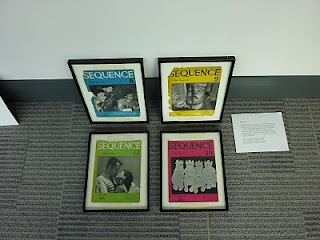
Sequence covers, ready to go up as part of an exhibition at Stirling Uni ©Lindsay Anderson Archive, University of Stirling 
Sequence was a film journal started by Lindsay Anderson, Gavin Lambert and Peter Ericsson. It started in 1948 and fourteen issues were published, the final in 1952. I still get so happy when I come across links to Lindsay Anderson so of course my first thought was to check the catalogue. I knew I'd catalogued all the Sequence correspondence and I didn't have any memory of a Raymond Chandler letter but of course there's no way of remembering everything you've catalogued! Unfortunately it's not there so the original of the letter didn't make it to the Lindsay Anderson Archive. In the book the authors say that Raymond Chandler's archive is held between the Bodlein and UCLA, though neither of these have their Chandler collection catalogued to item level online so I can't even see which archive holds Chandler's carbon copy of the letter he sent.
It's disappointing the letter isn't in the Lindsay Anderson Archive but then it would be impossible for an archive collection ever to be 'complete'.  Maybe the letter is in the archive of one of the other founders of Sequence (Gavin Lambert's papers are at the Howard Gotlieb Archival Research Centre in Boston) , maybe it ended up with someone else who was a fan of Chandler, or maybe it just got lost of misplaced at some point before the collection arrived at the University.  We'll never know I suppose.
 
Interestingly, there is a mention of Raymond Chandler in the Sequence series of the Lindsay Anderson Archive. It's in section LA/4/1/6 'Letters from readers and subscribers to Sequence' and is a letter from J. B. Priestley to a Mr Panting and my catalogue description reads
Thanks for sending a copy of Sequence; and expressing interest in an article on Raymond Chandler. 
It's dated 30/05/1949 so I wonder if there was an article in Sequence which discussed Raymond Chandler's writing, either novels or screen writing, or a film adaptation of one of his books. Mr. Panting seems an odd name but I seem to remember that the authors of Sequence would sometimes write under pseudonyms. I know from the Raymond Chandler Papers that Chandler knew Priestley, but I don't know when from - the earliest mention of Priestley in the book is from 1951.  I'm going to have delve a bit further into this sometime, starting with another good look through Sequence - a good excuse for a visit to the new BFI library at Southbank!

Wednesday, 1 February 2012

On reading other people's letters

The joys of cataloguing correspondence - I'm sure I've gone on about it plenty on this blog, and on my work blog so apologies if you're bored of it by now.  There's a real feeling of privilege I get when reading someone else's correspondence.  I hasten to add this doesn't mean I steal people's mail or anything like that - I 'm very lucky in that I get to read other people's mail as part of my job!  I also enjoy reading edited collections of correspondence such as The Raymond Chandler Papers.

[photo by me]

The letters can be quite hard-going sometimes, particularly when he's suffering from writer's block or has finished up working on a film script.  Like with any collection of letters, you really get the sense that you're getting to know the individual, and for me, they also give a real sense of the richness of archives - but then I'm slightly archive-obsessed!

One of my favourite exchange of letters so far has been about Farewell, my Lovely. The title of the book was the cause of some disagreement.  In a letter to fellow writer George Harmon Coxe on 27 June 1940 Chandler explains that the publishers wanted to call his second novel The Second Murderer.  Chandler goes on to say 'when I turned the manuscript in they howled like hell about the title, which is not at all a mystery title, but they gave in.  We'll see. I think the title is an asset. They think it is a liability'. Apparently this book was largely ignored by the critics and the publishers blamed this, at least partly, on the title.  I really enjoyed Farewell, my Lovely when I read it recently but I've yet to see the film - I can't imagine anyone else but Humphrey Bogart as Philip Marlowe!

The book includes some non-fiction writing alongside the letters and, as it's topical at the moment I thought I'd include a piece he wrote on the Oscars.  In 1946 Chandler, fed up and jaded from working for Hollywood studios, had moved to La Jolla to focus on his own writing.  However, he returned to Los Angeles to report for 'The Atlantic Monthly' on the 1946 Oscar ceremony.  Here are some of my personal highlights from his report:

‘in the motion picture business we possess an art medium whose glories are not all behind us.  It has already produced great work, and if, comparatively and proportionately, far too little of that great work has been in achieved in Hollywood, I think that’s all the most reason why in its annual tribal dance of the stars and big-shot producers Hollywood should contrive a little quiet awareness of the fact.  Of course it won’t. I’m just daydreaming.’

‘If you can go past those awful idiot faces on the bleachers outside the theatre without a sense of collapse of the human intelligence; if you can stand the hailstorm of flash bulbs popping at the poor patient actors who, like kings and queens, have never the right to look bored; if you can glance out over this gathered assemblage to what is supposed to be the elite of Hollywood and say to yourself without a sinking feeling, ‘in these hands lie the destinies of the only original art form the modern world has ever conceived’; if you can laugh, and you probably will, at the cast-off jokes from the comedians on the stage, stuff that wasn’t good enough to use on their radio shows... if you can do all these things with grace and pleasure, and not have a wild and forsaken horror at the thought that most of these people actually take this shoddy performance seriously ... if you can do all these things and still feel the next morning that the picture business is worth the attention of one single intelligent, artistic mind, then in the picture business you certainly belong.”

It doesn't really sound like a whole lot has changed in Hollywood, or at the Oscars, does it?!