Staying on the subject of Norman McLaren. I just remembered about a Student Radio Broadcast project which my colleagues and friends Karl Magee and Sarah Neely had been part of whilst I was at Stirling, called 'Finding Norman'. You can listen to the broadcast on the Stirling Film, Media and Journalism YouTube page. The narrator, a student at Stirling Uni is talking about 'Norman' a show I was lucky enough to see at the MacRobert Arts Centre in Stirling - I wrote a wee preview of the show here.
Karl Magee gives some background about Norman McLaren and does a bit of promotion for the archive! There is an excerpt of Norman McLaren talking in the radio broadcast and he says that 'if all his films had to be destroyed except one I would choose Neighbours'. Of course, I wouldn't want any of his films to be destroyed but I think it's interesting he chose Neighbours. It's a superb film and the anti-war message is put across so brilliantly - maybe they should show this film to world leaders who are all too eager to start fights and wars with each other!
Showing posts with label Glasgow School of Art Archives and Collections Centre. Show all posts
Showing posts with label Glasgow School of Art Archives and Collections Centre. Show all posts
Wednesday, 27 July 2011


Thursday, 10 June 2010
International Archives Day!
Happy (Belated) International Archives Day! I only found out it was International Archives Day yesterday through a link from archivesblog.com. Archives Outside is a blog based in New South Wales and they decided to celebrate International Archives Day by showcasing examples of archive collections from NSW. I thought I would appropriate this idea and pick some of my favourite archives in my home town of Glasgow, Scotland.
But first of all, I am wondering if any archives in the UK picked up on it being International Archives Day and did anything special for it? I didn't see anything on any of the listservs about it which I thought was a bit strange. Although it wasn't very well publicised at all this year, particularly in comparison with the World Day for Audiovisual Heritage in October last year. We certainly didn't know anything about it in time to do anything to celebrate - I'll need to keep a closer eye on potential awareness raising dates like this.
So, on to a couple of my favourite archives in Glasgow. I'll start with my first place of work after qualifying - Glasgow Caledonian University Archives. They have lots of interesting archives, for example, the Scottish Campaign for Nuclear Disarmament (CND) Archive and the anti-apartheid movement in Scotland Archive. I'll just give a bit more information though about one Archive they hold, the one which I worked on as a project archivist whilst I was there, the Scottish Trades Union Congress (STUC) Archive. This Archive contains documentation relating to the STUC and its business from 1897 onwards. I loved my work cataloguing part of this archive in the nine months that I was there and I remember being particularly interested by the minutes of some of the sub-committees, for example the Entertainment and Arts Sub Committee, the Women's Advisory Committee and of course, the letters of the various General Secretary's of the STUC (it's great to get paid to read other people's business!). There's full details of the contents of the archive here


Also on my list of top archives to visit in Glasgow would be the Glasgow School of Art Archives and Collections. These are based in the beautiful Charles Rennie Mackintosh designed main art school building and I'd love to visit just for a browse through their archives. Going by the images they have on their Flickr site it looks like they've got some really interesting and inspiring stuff! I've attended some really interesting events at the Art School (more of that in later posts) but I've never just been in to look through their archives. Here's a few images from their Flickr pages that illustrate the variety of material in the archive.


But first of all, I am wondering if any archives in the UK picked up on it being International Archives Day and did anything special for it? I didn't see anything on any of the listservs about it which I thought was a bit strange. Although it wasn't very well publicised at all this year, particularly in comparison with the World Day for Audiovisual Heritage in October last year. We certainly didn't know anything about it in time to do anything to celebrate - I'll need to keep a closer eye on potential awareness raising dates like this.
So, on to a couple of my favourite archives in Glasgow. I'll start with my first place of work after qualifying - Glasgow Caledonian University Archives. They have lots of interesting archives, for example, the Scottish Campaign for Nuclear Disarmament (CND) Archive and the anti-apartheid movement in Scotland Archive. I'll just give a bit more information though about one Archive they hold, the one which I worked on as a project archivist whilst I was there, the Scottish Trades Union Congress (STUC) Archive. This Archive contains documentation relating to the STUC and its business from 1897 onwards. I loved my work cataloguing part of this archive in the nine months that I was there and I remember being particularly interested by the minutes of some of the sub-committees, for example the Entertainment and Arts Sub Committee, the Women's Advisory Committee and of course, the letters of the various General Secretary's of the STUC (it's great to get paid to read other people's business!). There's full details of the contents of the archive here

Certificate of affiliation for Scottish Trades Union Congress membership
© Glasgow Caledonian University Archives
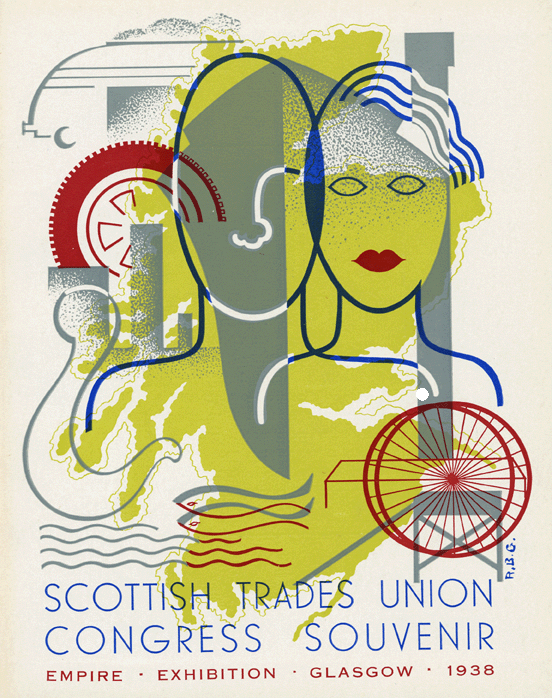
Scottish Trades Union Congress Souvenir 1938, p2
© Glasgow Caledonian University Archives
Also on my list of top archives to visit in Glasgow would be the Glasgow School of Art Archives and Collections. These are based in the beautiful Charles Rennie Mackintosh designed main art school building and I'd love to visit just for a browse through their archives. Going by the images they have on their Flickr site it looks like they've got some really interesting and inspiring stuff! I've attended some really interesting events at the Art School (more of that in later posts) but I've never just been in to look through their archives. Here's a few images from their Flickr pages that illustrate the variety of material in the archive.

Lucienne Day colour poster
© The Glasgow School of Art Archives and Collections

Glasgow School of Art degree show poster, 1988
© The Glasgow School of Art Archives and Collection
Monday, 16 February 2009
Awaken awakened: project & process - research seminar
'Awaken awakened: project & process' was a research seminar at the Glasgow School of Art based upon an exhibition 'Awaken' which is on at the School of Art until 28 February 2009. For the exhibition designers based in the Department of Textiles and CAT (Centre for Advanced Textiles) were invited to reinterpret archive materials from the Glasgow School of Art Archives and Collections Centre for current and future textile and design work.

The seminar was chaired by the exhibition curator, and programme leader for the Textiles Department, Jimmy Stephen-Cran, with contributions from a number of the artists involved, along with the Art School Archivist, Susannah Waters. Issues raised and discussed during the seminar included the idea of the experience of encounter with the archive, questions over originality and authorship, and the use of personal archives and found objects in the creative process. The artist's talks were all very interesting, particularly as they all seemed to have quite different experiences of the encounter with the archive.
Susannah Waters, and a number of the artists, commented on the difficulty of the initial visit to the archive. With such a vast amount of potentially useful and interesting material how do you find a starting point. For me this highlighted the importance of the archivist as a facilitator, suggesting possible materials of interest, and being able to offer their knowledge of the collections to assist the artist in narrowing down the type of material they would like to look at. One thing which really came across in the seminar was the amount of inter-departmental co-operation between the Archive, the Textile Department and CAT, in order to make the artists work possible, and make the exhibition a success.

I think Susannah raised a very interesting point when she contrasted the artists use of the archive with that of the more usual visitor to the archive - the historical researcher. Not only do artists use the material in different ways but they would also look at and categorise it differently. So, to quote an example Susannah used, a series of posters of events at the art school were catalogued according to their content, e.g. 'degree show poster 1977' fashion show poster 1968', the artists were generally more interested in the style of the poster, the colours, design layout, than the content and context. This idea of different user groups benefiting from different types of cataloguing is something I have also had to consider whilst cataloguing the Lindsay Anderson Collection. The project I work on is in collaboration with the Film, Media and Journalism department and I have found it very beneficial to consult with other team members from that department when I was compiling my subject index. This ensured that the index would be accessible and relevant to them in their research and, we hope, to other film and media academics. Obviously you cannot catalogue a collection purely with one particular user group in mind but it has been very useful to have the insight of film and media academics at hand and I imagine that the same can be said in the case of the GSA archive and its use by these talented artists and teachers.
Something which I’ve been thinking about a lot recently is the idea of personal archives, people creating their own archives as they go along, whether consciously or unconsciously. This related to my own work cataloguing the Lindsay Anderson Collection but it was also an issue that was raised during this seminar. I noticed that when Joanna Kinnersley Taylor was talking about her project she mentioned that a starting point had been an old map she had up on her wall. It was also noted during the seminar that the artists used their own objects, in particular items they had found and collected over the years, as inspiration for the project. This blend of personal, informal archives with the institutional archive is something that strikes me as being very different to the type of research that archives are normally used for, where context and source are all important. I also liked the idea of the CPJ's (Creative Process Journal's) which the artists worked on as they went along, documenting their design process and the development of their ideas. These CPJ's are works of art in their own right and could one day be valuable archival items for other artists and researchers.
I’m not sure if it’s just because I’m looking for it, but it seems to me that archives are being used in an increasing variety of ways to re-imagine and invigorate ideas about the valuie of the Archive. Opening up the archives to re-interpretation and re-examination by artists/film makers/academics seems to be something I’m hearing about more and more, though like I said maybe it is just because I’m looking for it?

© The Glasgow School of Art
John Walter Lindsay's travel journal is almost 60 years old
The seminar was chaired by the exhibition curator, and programme leader for the Textiles Department, Jimmy Stephen-Cran, with contributions from a number of the artists involved, along with the Art School Archivist, Susannah Waters. Issues raised and discussed during the seminar included the idea of the experience of encounter with the archive, questions over originality and authorship, and the use of personal archives and found objects in the creative process. The artist's talks were all very interesting, particularly as they all seemed to have quite different experiences of the encounter with the archive.
Susannah Waters, and a number of the artists, commented on the difficulty of the initial visit to the archive. With such a vast amount of potentially useful and interesting material how do you find a starting point. For me this highlighted the importance of the archivist as a facilitator, suggesting possible materials of interest, and being able to offer their knowledge of the collections to assist the artist in narrowing down the type of material they would like to look at. One thing which really came across in the seminar was the amount of inter-departmental co-operation between the Archive, the Textile Department and CAT, in order to make the artists work possible, and make the exhibition a success.

© Joanna Kinnersley Taylor Print croquet on paper
I think Susannah raised a very interesting point when she contrasted the artists use of the archive with that of the more usual visitor to the archive - the historical researcher. Not only do artists use the material in different ways but they would also look at and categorise it differently. So, to quote an example Susannah used, a series of posters of events at the art school were catalogued according to their content, e.g. 'degree show poster 1977' fashion show poster 1968', the artists were generally more interested in the style of the poster, the colours, design layout, than the content and context. This idea of different user groups benefiting from different types of cataloguing is something I have also had to consider whilst cataloguing the Lindsay Anderson Collection. The project I work on is in collaboration with the Film, Media and Journalism department and I have found it very beneficial to consult with other team members from that department when I was compiling my subject index. This ensured that the index would be accessible and relevant to them in their research and, we hope, to other film and media academics. Obviously you cannot catalogue a collection purely with one particular user group in mind but it has been very useful to have the insight of film and media academics at hand and I imagine that the same can be said in the case of the GSA archive and its use by these talented artists and teachers.
Something which I’ve been thinking about a lot recently is the idea of personal archives, people creating their own archives as they go along, whether consciously or unconsciously. This related to my own work cataloguing the Lindsay Anderson Collection but it was also an issue that was raised during this seminar. I noticed that when Joanna Kinnersley Taylor was talking about her project she mentioned that a starting point had been an old map she had up on her wall. It was also noted during the seminar that the artists used their own objects, in particular items they had found and collected over the years, as inspiration for the project. This blend of personal, informal archives with the institutional archive is something that strikes me as being very different to the type of research that archives are normally used for, where context and source are all important. I also liked the idea of the CPJ's (Creative Process Journal's) which the artists worked on as they went along, documenting their design process and the development of their ideas. These CPJ's are works of art in their own right and could one day be valuable archival items for other artists and researchers.
I’m not sure if it’s just because I’m looking for it, but it seems to me that archives are being used in an increasing variety of ways to re-imagine and invigorate ideas about the valuie of the Archive. Opening up the archives to re-interpretation and re-examination by artists/film makers/academics seems to be something I’m hearing about more and more, though like I said maybe it is just because I’m looking for it?
Subscribe to:
Posts (Atom)