Wednesday, 9 June 2010

Archive ephemera

This is in reply to a post on the Orkney Archives blog - "Do other countries actually have nicer stamps than ours or do they just seem exotic because they're foreign?".

Well, I would have to concur that other countries do seem to have far more interesting stamps than ours. This gives me the perfect opportunity to make use of an envelope I came across yesterday which I just had to scan an image of, without quite knowing how I would use it. It's not often that the envelopes have been kept with the letters in the Lindsay Anderson Archive so I assume that either Anderson himself or his secretary liked these stamps too and decided to keep the envelope with the letter. It's from Poland and has two very different but equally interesting images.


I love the abstract design - it looks similar to the style of a lot of Polish film poster designs and is far more interesting than this: -

Also, to my mind anyway, the eagle topped with the crown is far more regal than this. So thank you Orkney Archive for helping me justify why I scanned the envelope in the first place! The example the Orkney Archive show is an envelope from Norway with two botanical drawings on the stamps. Inside the letter is a lovely little square watercolour painting of a seascape.

Tuesday, 8 June 2010

Agnes Varda season at The Auteurs

I just got back from the Glasgow Film Theatre after seeing three short films by Agnes Varda and when I checked my emails there was one from the Auteurs about this season of Varda's films all available to view online, for a small cost. The three films which were screened at the GFT tonight are all available and I would highly recommend them - particularly the first one, Salut les Cubains (1963). It's interesting to see that this film was made the year before Soy Cuba (1964). I've only seen snippets from Soy Cuba but watching Varda's film immediately reminded me of it just because I've seen so little footage of Cuba from that time. Varda's film came across to me as being very positive about the Cuban revolution and Castro and I'd be interested to see Soy Cuba, a Russian/Cuban collaboration, to see what the take is in that film. I loved Varda's film, it's filled with wonderful characters and music and discusses really interesting events and developments in Cuban social and cultural history. I was particularly impressed with the way it is composed of still images linked by narration and themes, and really liked the way the film was organised which I think I'm going to find is a theme with her work as I found the structure of the other two films I saw similarly pleasing - the other films were, Ulysse and Ydessa, the Bears, and etc.

Monday, 7 June 2010

Early John Ford film amongst those found at the New Zealand Film Archive

I was directed to an interesting article in the New York Times via the Association of Moving Image Archivists (AMIA) mailing list. For anyone interested in the preservation of films and film-related material I would highly recommend joining this. I know there's a huge amount of mailing lists out there but this one is really worth it. There are always interesting and lively discussions about developments in film preservation, enquiries from film researchers looking for help finding particular films or information about the films, and news of interesting developments, like the link to this article in the New York Times.

A large number of early American films held in the New Zealand Film Archive are now to be returned to America when it emerged that in some cases they were the only surviving print of the film. 75 of these films, chosen for their historical and cultural importance, are now in the process of being returned to the US. The reason so many foreign films remained in New Zealand after their use in cinemas is due to the high cost of shipping them back.

Of particular interest is the discovery of the only print of Upstream a John Ford film from 1927. This film is being copied to modern safety stock before being transferred back to the US as it is the only copy and they do not want to rick any loss or damage to the print. In About John Ford Lindsay Anderson mentions this film, listing it in Ford's filmography, but there is no mention of it in the book or the index - presumably because there was no possible way of viewing a print of the film. It's amazing to think that all these years later we're going to be able to see it again.


The New York Times article discusses the practicalities of moving, and preserving the films, so I'll include an extract from that article here -

Getting the films, which were printed on the unstable, highly inflammable nitrate stock used until the early 1950s, to the United States hasn’t been easy. “There’s no Federal Express for nitrate out of New Zealand,” said Annette Melville, the director of the foundation. “We’re having to ship in UN-approved steel barrels, a little bit at a time. So far we’ve got about one third of the films, and preservation work has already begun on four titles.”

As the films arrive, they are placed in cold storage to slow further degeneration. “We’re triaging the films,” Ms. Melville said, “so we can get to the worst case ones first. About a quarter of the films are in advanced nitrate decay, and the rest have good image quality, though they are badly shrunken.”

As funds permit, the repatriated films will be distributed among the five major nitrate preservation facilities in the United States — the Library of Congress, the Academy of Motion Picture Arts and Sciences, George Eastman House, the U.C.L.A Film & Television Archive and the Museum of Modern Art — where the painstaking work of reclaiming images from material slowly turning to muck will be performed.


I like that the reason the films came to light was because Brian Meacham, who works at the Film Archive of the Academy of Motion Picture Arts and Sciences, went to visit the New Zealand Film Archive when he was on holiday! Is that something a lot of archivists do, visit archives in their holidays? I know I do and it's good to know I'm not alone in this!

Cataloguing - timetables and deadlines

All my plans of getting straight back into posting in May came to naught as I've become increasingly aware of my looming project deadlines. However I now have a very helpful Excel spreadsheet with a full breakdown of everything I want to achieve, set out week by week! Although there's still a huge amount to do before the project finishes at the end of August I now feel that it is all achievable and it makes it so much easier to just get on with the work and not panic. Part of my timetable includes posting on my blog so I thought I would start with a topical (for me) post about my cataloguing.

The thing that's so hard about doing a timetable for cataloguing archival records is that until you open each individual file you don't know how many letters there are, and until you catalogue each letter you don't know how much content there is in it. Letters with lots of interesting content take far longer than say, a greetings card sent simply to say 'Happy New Year'. Quite often the letters with lots of detail about film projects, theatre projects, actors, directors etc also require research into the people and subjects referred to as these will have to be added to the name and subject indexes on the cataloguing system. So I have to remind myself that if some weeks I don't quite meet my targets that's ok as other weeks I can have met them by the Thursday - as long as I get there by the end of August!


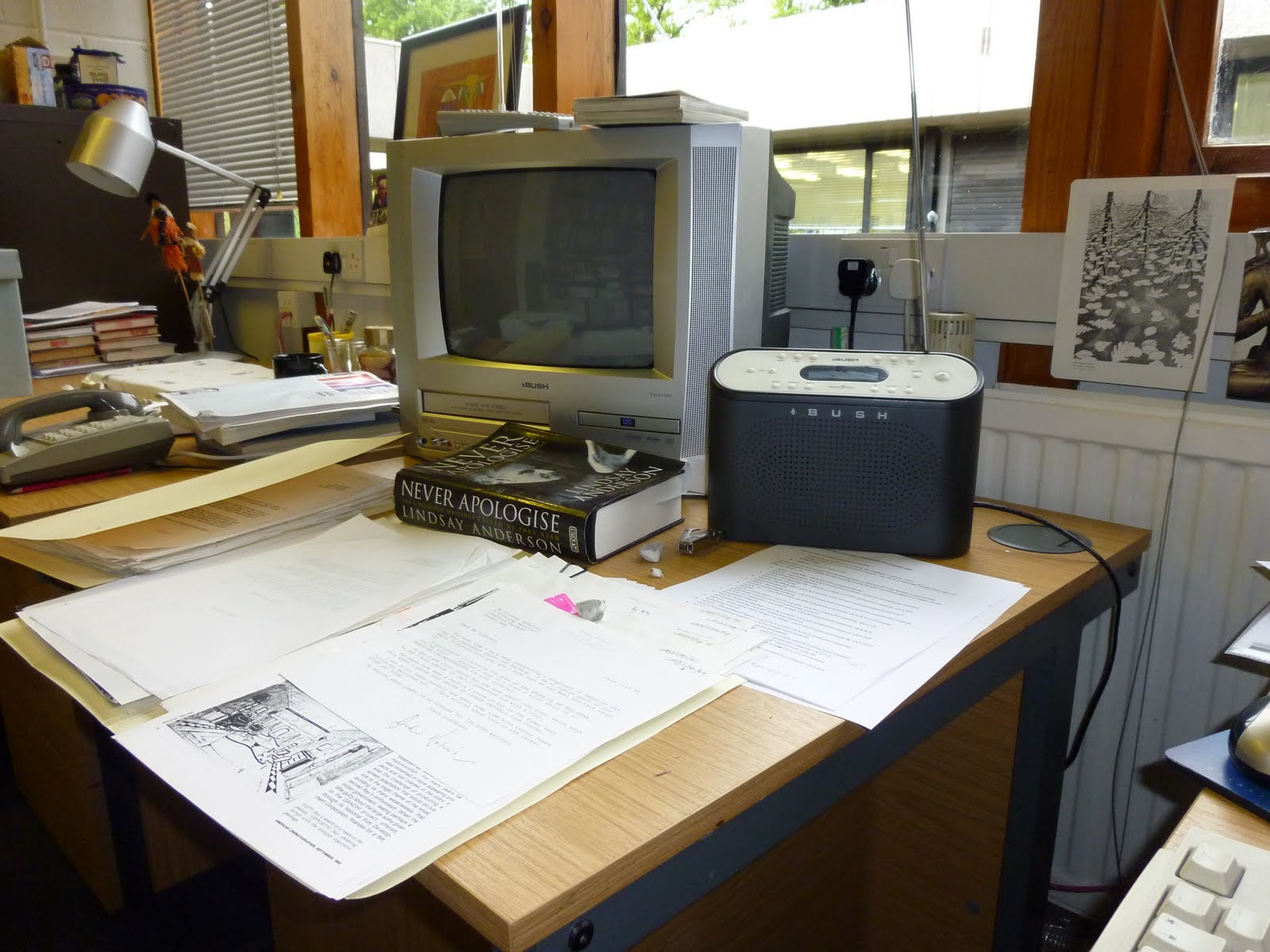
This first photo shows the files I am currently cataloguing - the A-Z correspondence files. I've talked about the fun of cataloguing these before as you never know quite what you're going to find - Friday's cataloguing included letters from Lindsay Anderson to Ridley Scott and this mornings started with a series of letters between Anderson and Dame Maggie Smith re a film version of The Cherry Orchard which was in development for a long time, but which finally fell through. Anderson had long wanted to direct a film of this play by Chekhov, having directed it in the theatre twice. Maggie Smith had agreed to star in it and the plan was to get Dustin Hoffman for the lead male role - if only it had happened!


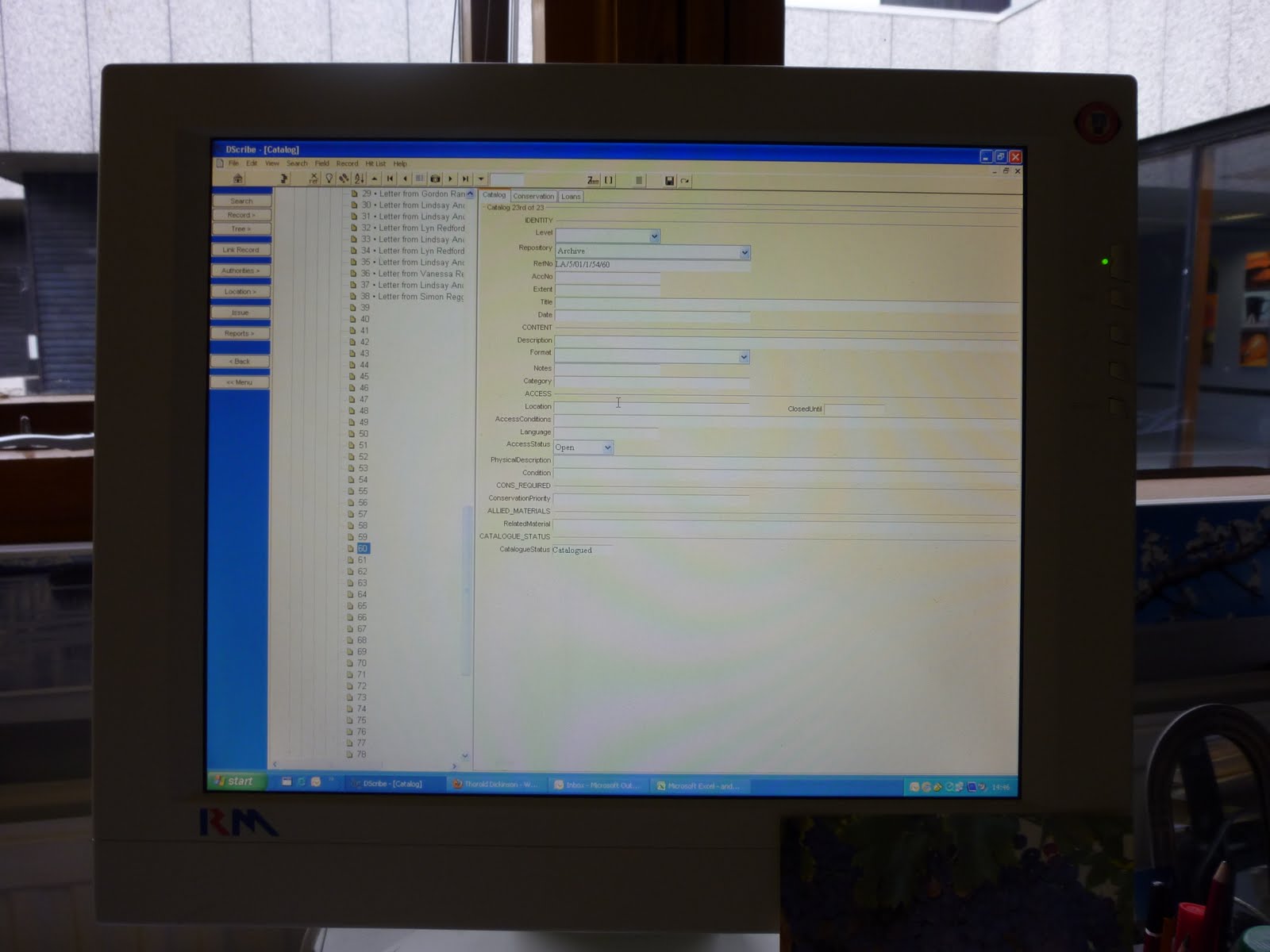
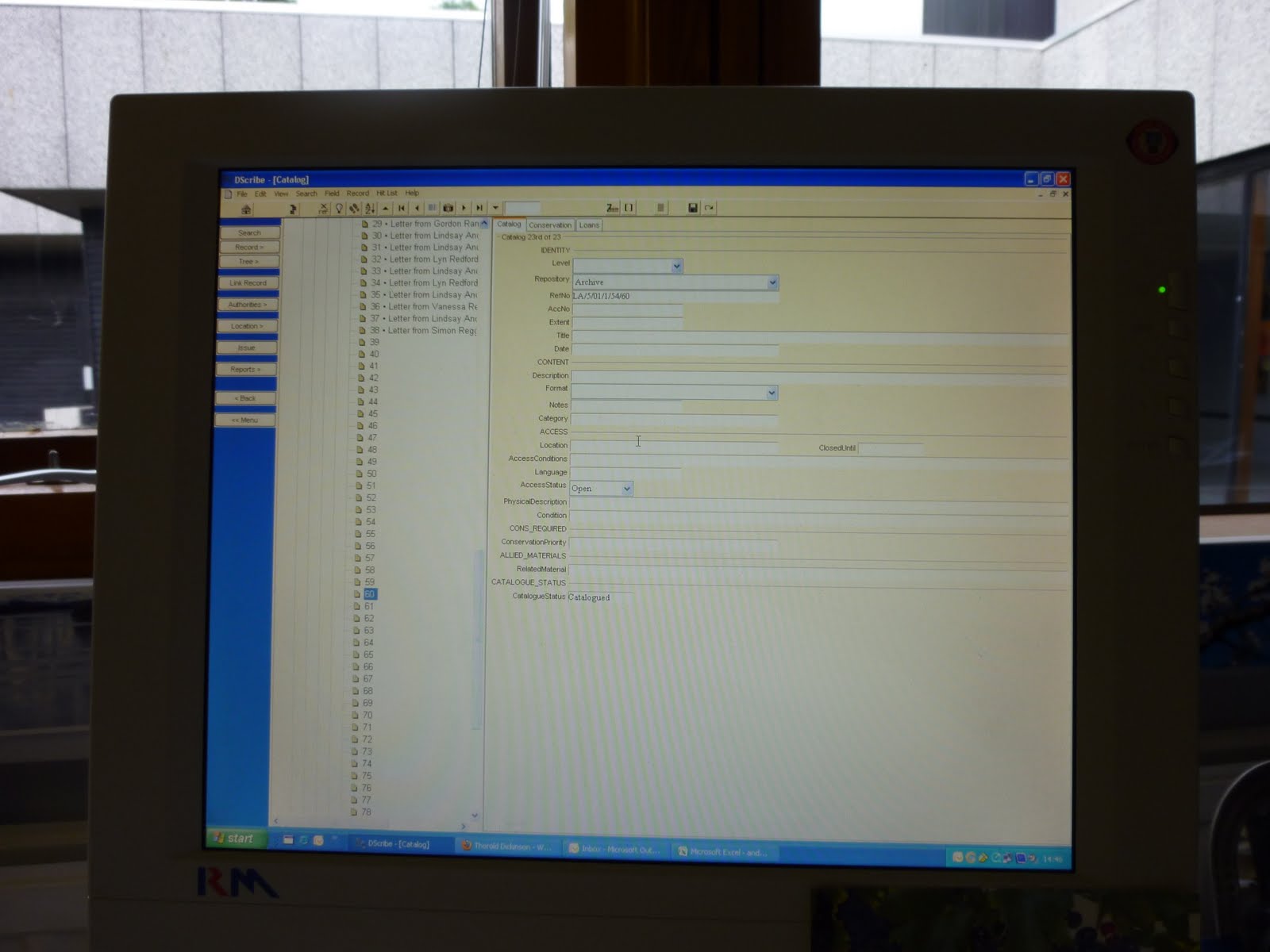
The cataloguing of each file begins by sorting the letters into order alphabetically, then chronologically from earliest to most recent, helpfully all the letters with each correspondent are usually already together. Then it's a case of numbering every letter with a unique identifying code which consists of the collection name, sub-collection, series, sub-series, file and item, for example at the moment I'm doing LA/5/1/1/57/45 with 'LA' identifying the collection, 5 identifying the sub-collection 'working papers', the first 1 is the series 'correspondence files', the second 1 is the sub-series 'correspondence files A-Z', the 57 is the file number and is 'correspondence, S' and 45 is the number of the individual letter from Maggie Smith. After the numbering is done then the folder will be catalogued onto the cataloguing software CALM for Archives - you can see a screenshot in the photo above - this is going to be ingrained on my brain by the end of the project as I've already started dreaming about cataloguing on days when I have a particularly heavy workload!

Once catalogued the folder will be divided up into two or three folders if the amount of letters is too heavy for one folder and these folders are put in new acid-free paper, archival standard boxes. It may not sound too exciting but I love it! The TV in the room is strictly for work-related use by the way! Quite a few of Anderson's films are not available on DVD so it's been really handy to have this TV with a VHS and DVD player built in. Glory! Glory! and The Whales of August are the two which come to mind immediately as being only on VHS (in the UK) so it was necessary to watch them before cataloguing the material relating to them.


Tuesday, 11 May 2010

New publication on Lindsay Anderson and O Lucky Man!

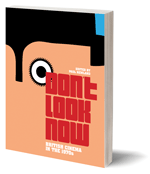
Another output from the 'Cinema Authorship of Lindsay Anderson' team here at Stirling University - a chapter in Don't Look Now, a new book published this month by Intellect Ltd. The book investigates film and television culture in the 1970s. Besides being very interesting anyway, and a beautiful looking book, I can highly recommend this book as it contains a chapter by our team here at Stirling ‘What is there to smile at?’ Lindsay Anderson’s O Lucky Man!, by John Izod, Karl Magee, Kathryn Mackenzie and Isabelle Gourdin-Sangouard. As with all of our work it is based in research conducted in the material held in the Lindsay Anderson Archive at the University of Stirling.


I've enclosed the synopsis for the book below:

"While postwar British cinema and the British new wave have received much scholarly attention, the misunderstood period of the 1970s has been comparatively ignored. Don’t Look Now uncovers forgotten but richly rewarding films, including Nicolas Roeg’s Don’t Look Now and the films of Lindsay Anderson and Barney Platts-Mills. This volume offers insight into the careers of important film-makers and sheds light on the genres of experimental film, horror, and rock and punk films, as well as representations of the black community, shifts in gender politics, and adaptations of television comedies. The contributors ask searching questions about the nature of British film culture and its relationship to popular culture, television, and the cultural underground."

Here are some reviews of the book:

'The essays in this highly stimulating collection reveal, clearly and persuasively, just how diverse, energetic and imaginative British cinematic creativity was during this rather maligned decade... In shining a bright light into one of the remaining dark corners in British cinema history Don’t Look Now is a welcome and extremely valuable contribution to the field.' – Professor Duncan Petrie, University of York

'Long overdue for a closer look, this volume provides a comprehensive, wide-ranging and stimulating range of new scholarship on British cinema and television in the 1970s. ' – Professor Sarah Street, University of Bristol