Wednesday, 28 July 2010

New images on Stirling University Archives Flickr

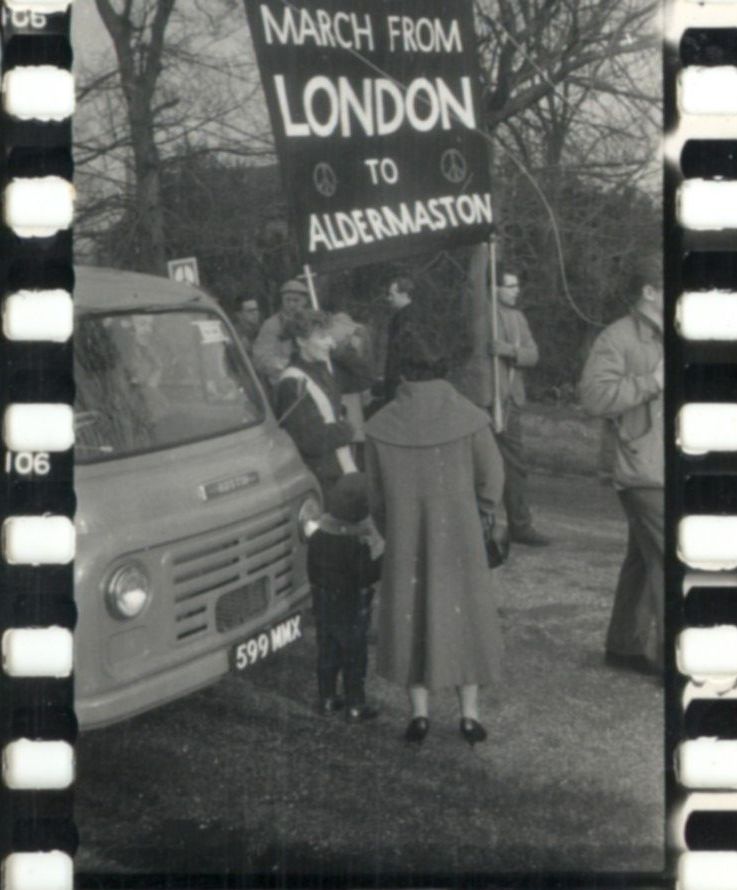
LA/6/2/2/29/4(5) Image from the march to Aldermaston, Easter 1958
© Lindsay Anderson Collection, University of Stirling Archives

I'm having a short enforced break from cataloguing whilst my database (notice the possessive use here!) is being converted to become an online catalogue.  Hopefully this will be ready within the next two weeks and I can share it all here.  Today I can start back on cataloguing (phew!) but I thought I'd share some of alternative work I've been doing over the past few days before I get back to my files!  Seeing as how discussing the numbering and reordering I've been doing may be slightly dull I thought I'd focus on the new sets of images I've uploaded to the University Archives Flickr site.  I've scanned in five sets of photographs, or contact strips to be more precise and although the quality isn't all that great in a few of them - some fading, bright spots, tears etc. the content of the images is great and I think the distress on some of them just adds to the character. 

The main subject of the images is the 1958 march from London to Aldermaston.  This was a march organised over the Easter weekend 1958 by the Campaign for Nuclear Disarmament (CND).  CND was formed a few months earlier in February 1958 and this was their first large organised protest.  Several thousand people took part in the four day march which travelled from London to the Atomic Weapons Research Establishment at Aldermaston in Berkshire.  There was a contingent of friends and supporters from the Royal Court Theatre who took part in this march and they can be seen, with their theatre inspired banners ('To be or not to be'), in the images below.

LA/6/2/2/30/2(6) Image from the march to Aldermaston, Easter 1958
© Lindsay Anderson Collection, University of Stirling Archives
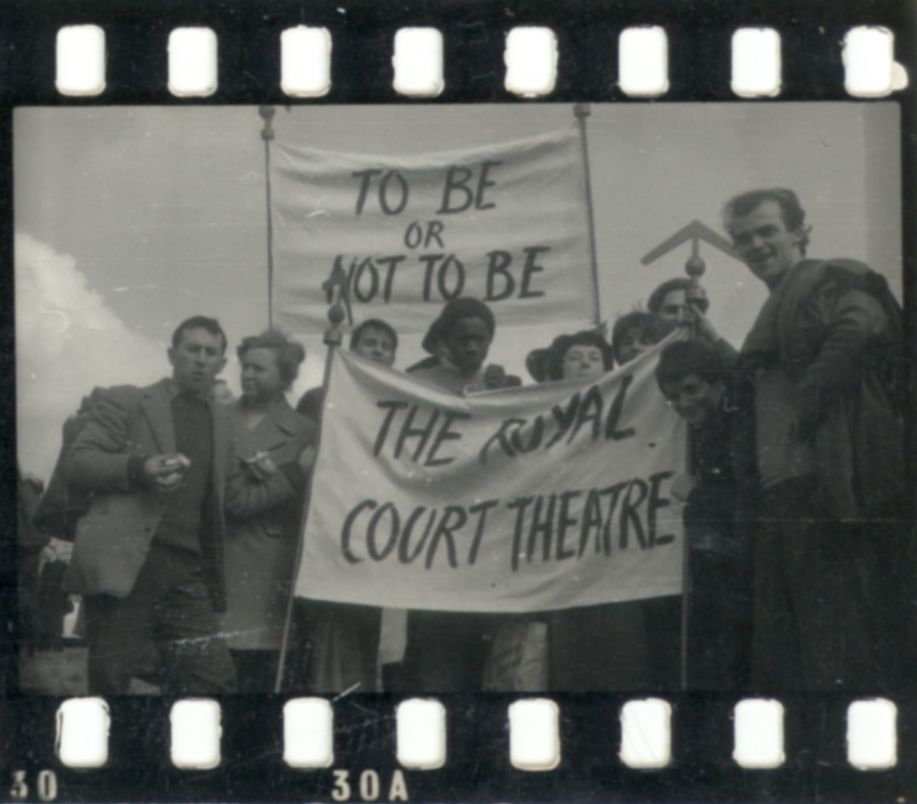
LA/6/2/2/32/1(6) Image from the march to Aldermaston, Easter 1958
© Lindsay Anderson Collection, University of Stirling Archives
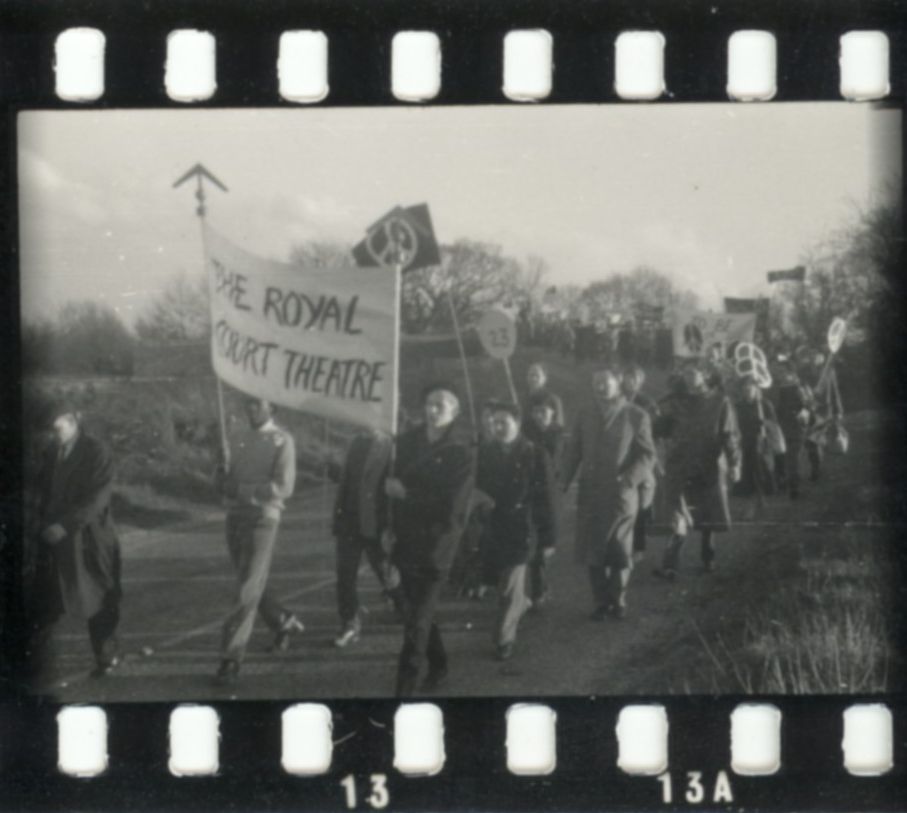
LA/6/2/2/30/3(2) Image from the march to Aldermaston, Easter 1958
© Lindsay Anderson Collection, University of Stirling Archives

Lindsay Anderson took part in this march and was also central to the creation of a film March to Aldermaston (1959).  The film was made by a committee of volunteers entitled the 'Film and Television Committee for Nuclear Disarmament'.  Along with Lindsay Anderson was Karel Reisz and a whole team of experienced film workers.  This included lab technicians who worked for free to process the footage and Contemporary Films, who handled the distribution of the film.  Although the film is credited to the entire committee it is widely acknowledged that Lindsay Anderson took over the film at the editing stage and shaped it into the film.  The narration of the film is by Richard Burton, who also narrated Lindsay Anderson and Guy Brenton's Thursday's Children (1954).  The commentary which Burton read was written by Christopher Logue (a poet and playwright and a friend of Anderson's).  The film itself seems as relevant to me today as it was then and indeed this made the film even more powerful in my mind - the fact that nothing much has changed.  Personally I find the support of nuclear weapons quite incomprehensible (of course, money and power are the main reasons but quite why these should outweigh the concern for human life is beyond me).  Whatever your political views though I think this film would be very interesting to watch as a document of the 1950s.  Like the films created by Anderson and others under the banner of Free Cinema this film documents the lives and concerns of ordinary working people.

The film is available as part of the boxset DVD on Free Cinema produced by the British Film Institute.  There is more information about the film on BFI Screenonline.  For more information about CND see their website

I like that the images show the periods of rest and fun in between the marching, for example the photo below of a girl having a rest.  There was musical accompaniment to the march, inlcuding folk music and jazz and there are a number of photos like the one second below which show the musicians taking part in the march. 
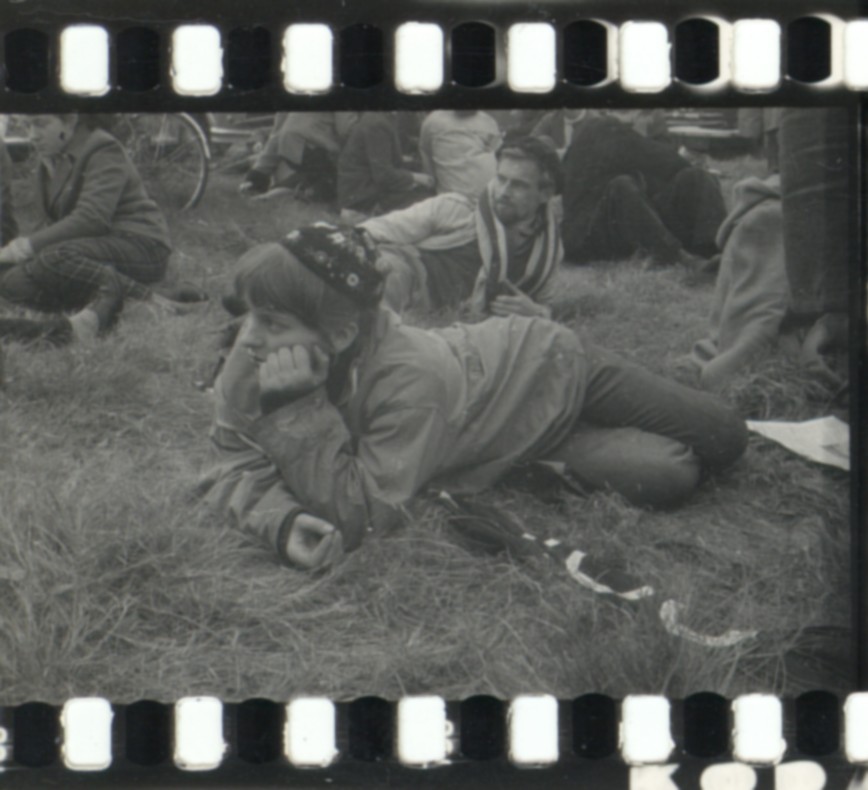
LA/6/2/2/29/4(1) Image from the march to Aldermaston, Easter 1958
© Lindsay Anderson Collection, University of Stirling Archives

LA/6/2/2/29/3(4) Image from the march to Aldermaston, Easter 1958
© Lindsay Anderson Collection, University of Stirling Archives

Monday, 19 July 2010

My posting has still been rather sporadic of late and I think it will continue that way for the next two months as it nears the end of our three-year project on 'The Cinema Authorship of Lindsay Anderson' with the deadlines looming large! I've now catalogued over 10,200 items in the archive which I find quite staggering to think about sometimes! The best things is I'm still enjoying the cataloguing as much now as I was at the beginning, indeed perhaps even more so. The reason for that being that the more you get to know about a collection and the individuals in it the more you get out of the cataloguing - well that's what I find anyway.

So, in the lack of anything more constructive to say right now whilst I continue to work my way through the named correspondence files I thought I would just share this Polish postcard I came across in a file on Friday. It's for a theatre production of Le Peche (according to Wikipedia this was written in 1908 and translates as History of Sin). The playwright, Stefan Zeromski(1864 - 1925) was a Polish writer, journalist and playwright and (once again taken from Wikipedia) he was apparently known as "the conscience of Polish literature."

LA/5/01/2/18/52, Lindsay Anderson Collection

Tuesday, 13 July 2010

The wonders of modern technology!

I am steadily making my way through the Lindsay Anderson named correspondence files.  I had a very pleasant day recently cataloguing the correspondence between Lindsay Anderson and Harry Carey Jr.  The son of Harry Carey, Harry Carey Jr. was, like his father, an actor in John Ford's Stock Company.  He starred in ten John Ford's films: 3 Godfathers (1948); She Wore a Yellow Ribbon (1949); Wagonmaster (1950); Rio Grande (1950); The Long Gray Line (1955); Mister Roberts (1955); The Searchers (1956); Two Rode Together (1961); Flashing Spikes (1962); Cheyenne Autumn (1964).  Harry Carey Jr. (also known as Dobe due to the colour of his hair)  wrote  a memoir of his time as an actor for John Ford Company of Heroes and this occupies a lot of the discussion in the correspondence between Anderson and Carey.  The correspondence starts in 1980 but we know they met earlier than this as there is an interview Anderson conducted with Carey in About John Ford in 1978.  

Insert sent to Anderson by Harry Carey Jr. with copy of Company of Heroes
© Lindsay Anderson Collection, University of Stirling Archives

About John Ford
© Lindsay Anderson Collection, University of Stirling Archives

The reason I said that this was a very pleasant way to spend the day is that Harry Carey Jr. just comes across as such a lovely man - the correspondence between them is warm, filled with reminiscences about John Ford and discussions of his films, but also some very vivid descriptions of Monument Valley and the surrounding areas which are great to read.

The first letter in the file from Anderson to Harry Carey Jr. is dated 6 February 1980 and in it Anderson discusses his latest purchase - a video recorder!  Anderson mentions this is correspondence with a number of people so it's apparent that he was very excited by this new ability to record films from the television and create his own film library.  Here he is filling Harry Carey Jr. in on his purchase:


"We've had YELLOW RIBBON here on TV recently , followed by LIBERTY VALANCE.  I indulged myself in a video-recorder before Christmas - so now I am building up a classic-film library.  So far, besides the aforementioned, I have MEET ME IN ST. LOUIS, THE MALTESE FALCON,  Renoir's LE GRAND ILLUSION, LITTLE CAESAR and PUBLIC ENEMY etc., etc.  Little did I think I would have copies of such pictures of my own, available at the press of a couple of switches.  Modern technology at last pays off!" LA/5/01/2/5/2

Ah, modern technology!  I was going to say it's easy to take this technology for granted but, not having a sky box or any similar thing for recording of the television, and being too lazy to try and tune my video recorder to the TV, I don't take this for granted anymore!  I have to hope that any programmes I miss are on BBC and will be repeated on the iPlayer, or that they are available for hire.  Of course, I could just get myself a sky box or similar technology but that would be too easy, I usually wait at last a few years before catching up with the latest technology.  I'll get an iPhone one of these days but only having got an iPod in the last few years, after years of a personal CD player when everyone else had a minidisc player, and before that years of a cassette player when everyone else had long moved on to CD's I guess I should just accept to being slightly behind the times with personal use of technology!

Wednesday, 23 June 2010

Cataloguing milestones

Well, that's me finally finished cataloguing all the A-Z correspondence files - it felt like a never ending task at times but at least the material I'm cataloguing has been very interesting.  The thing about being in an office on your own though is when you do reach a milestone like this there's no one to celebrate with!  It does feel like a pretty big achievement when you complete one section, especially one as big as this one was, with over 3800 items!  It was with great satisfaction that I scored all those files off my timetable!

Today I am not on my own as my room mate Isabelle is in so I'm doing a good job of distracting her from her dissertation with my interesting finds in the named correspondence files.  Yes, once again I'm back to 'A', well 'B' now to be more precise - cataloguing the correspondence between Lindsay Anderson and the artist Don Bachardy, from the named correspondence files.  Bachardy is an artist who paints the most beautiful portraits but is perhaps better known (well he was to me anyway) as the long-term partner of Christopher Isherwood.  Indeed the recent Tom Ford film A Single Man, based on the book by Isherwood, was inspired by a break-up between Bachardy and Isherwood, although in real life the break up was short lived and they were together until Christopher Isherwood died in 1986. 

I am only half way through their correspondence together and I found an interesting description by Anderson of why he felt Bachardy is such a talented artist "they manage to be both portraits and a collective self-portrait, which makes the whole collection a single work - as well as being a wonderfully perceptive and acute assembly of individual studies" [here Anderson is referring to a book of Bachardy's portraits which has just been published].  I thought this definition of Bachardy's talent could be transferred quite easily to film and seems to sum up Anderson's attitudes to his own creative work as a film director "no film can be too personal". 

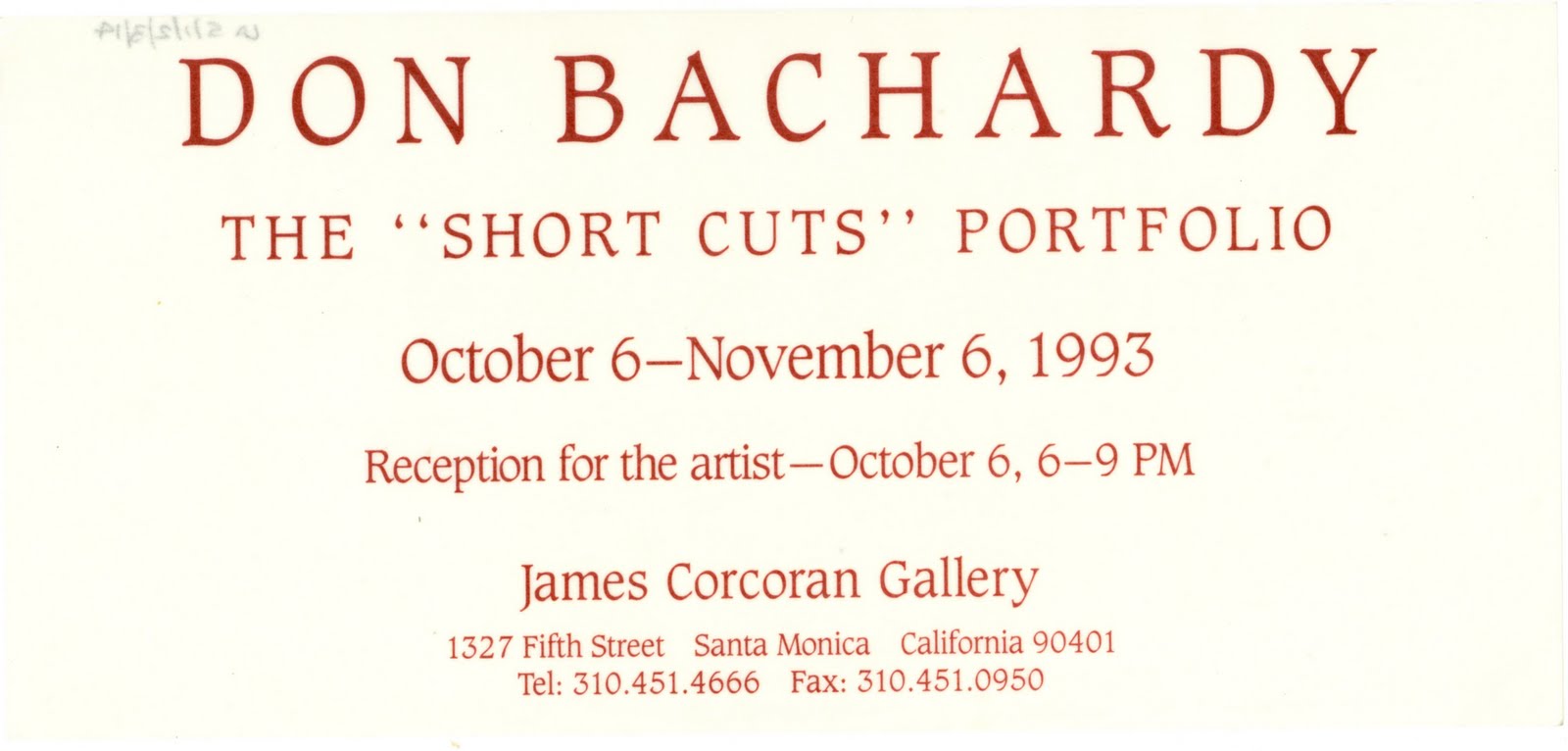
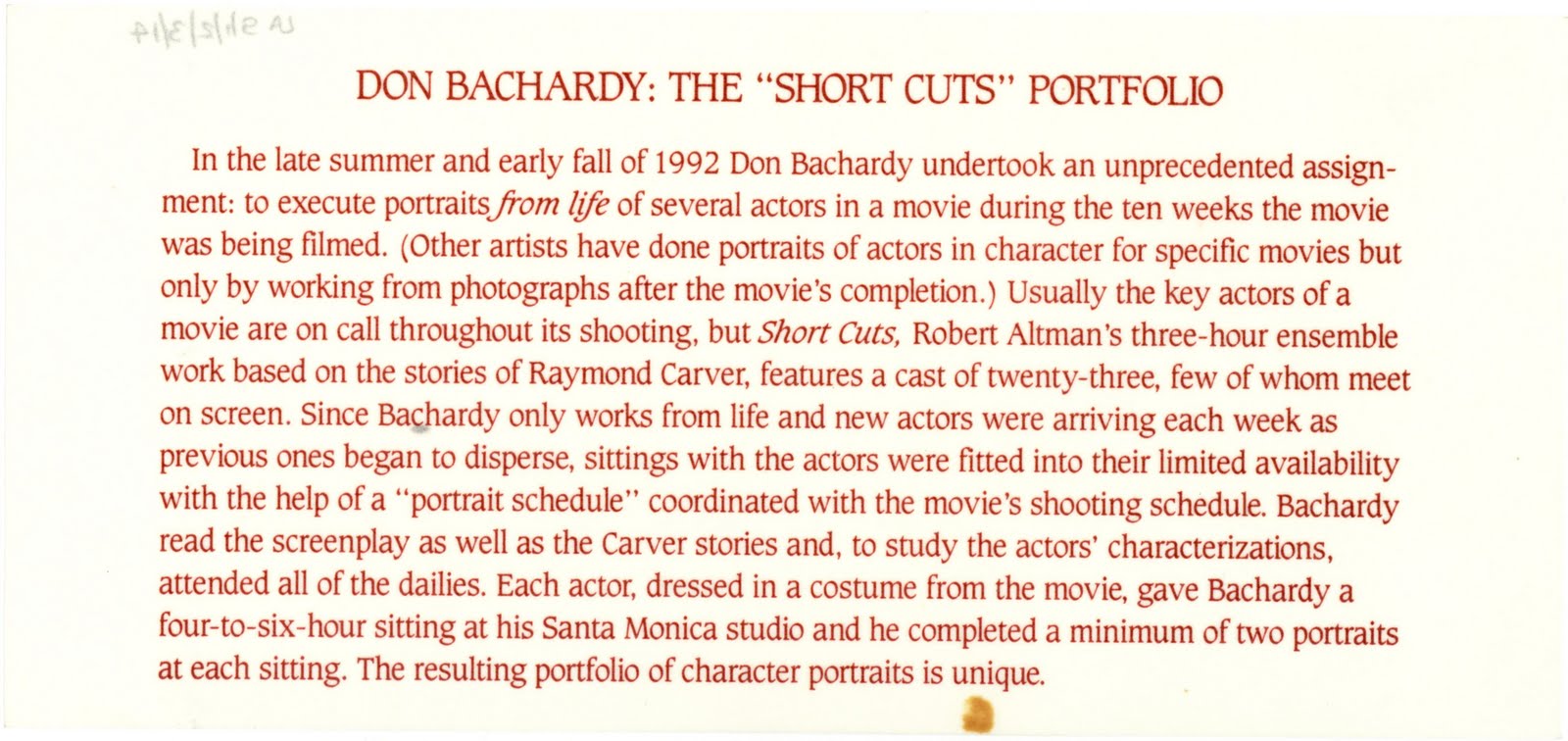
There are lots of fantastic photographs and colour images of Bachardy's paintings in the file but I would never want to use these without first seeking the permission of the artist.  Instead I thought I would show these images - an invitation to an exhibition of Bachardy's portraits of actors carried out during the shooting of Robert Altman's Short Cuts. 

Invitation to exhibition of The 'Short Cuts' portfolio by Don Bachardy, LA/5/1/2/3/14
© Lindsay Anderson Collection, University of Stirling Archives

Invitation to exhibition of The 'Short Cuts' portfolio by Don Bachardy, LA/5/1/2/3/14
© Lindsay Anderson Collection, University of Stirling Archives

I have just checked online and the Short Cuts portraits painted by Don Bachardy have been published with the script for Short Cuts.  You can see the front cover of the published script with some of Bachardy's work (though the quality of the image is poor) on Amazon.

Thursday, 10 June 2010

International Archives Day!

Happy (Belated) International Archives Day! I only found out it was International Archives Day yesterday through a link from archivesblog.com. Archives Outside is a blog based in New South Wales and they decided to celebrate International Archives Day by showcasing examples of archive collections from NSW. I thought I would appropriate this idea and pick some of my favourite archives in my home town of Glasgow, Scotland.

But first of all, I am wondering if any archives in the UK picked up on it being International Archives Day and did anything special for it? I didn't see anything on any of the listservs about it which I thought was a bit strange. Although it wasn't very well publicised at all this year, particularly in comparison with the World Day for Audiovisual Heritage in October last year. We certainly didn't know anything about it in time to do anything to celebrate - I'll need to keep a closer eye on potential awareness raising dates like this.

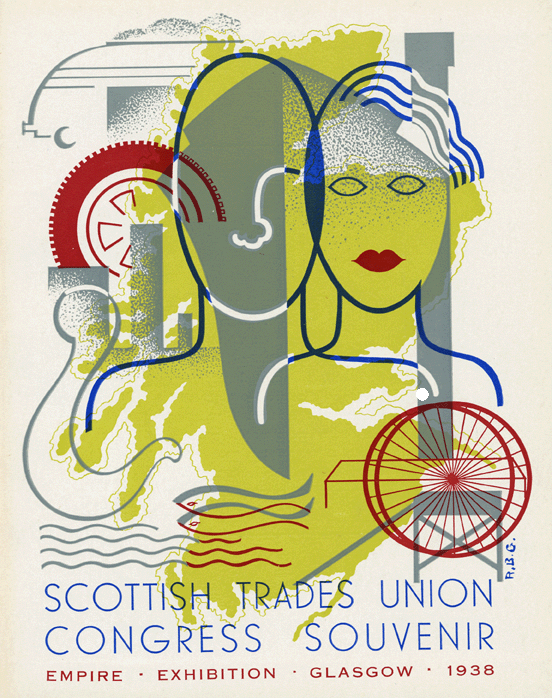
So, on to a couple of my favourite archives in Glasgow. I'll start with my first place of work after qualifying - Glasgow Caledonian University Archives. They have lots of interesting archives, for example, the Scottish Campaign for Nuclear Disarmament (CND) Archive and the anti-apartheid movement in Scotland Archive. I'll just give a bit more information though about one Archive they hold, the one which I worked on as a project archivist whilst I was there, the Scottish Trades Union Congress (STUC) Archive. This Archive contains documentation relating to the STUC and its business from 1897 onwards. I loved my work cataloguing part of this archive in the nine months that I was there and I remember being particularly interested by the minutes of some of the sub-committees, for example the Entertainment and Arts Sub Committee, the Women's Advisory Committee and of course, the letters of the various General Secretary's of the STUC (it's great to get paid to read other people's business!). There's full details of the contents of the archive here

Certificate of affiliation for Scottish Trades Union Congress membership
© Glasgow Caledonian University Archives


Scottish Trades Union Congress Souvenir 1938, p2
© Glasgow Caledonian University Archives


Also on my list of top archives to visit in Glasgow would be the Glasgow School of Art Archives and Collections. These are based in the beautiful Charles Rennie Mackintosh designed main art school building and I'd love to visit just for a browse through their archives. Going by the images they have on their Flickr site it looks like they've got some really interesting and inspiring stuff! I've attended some really interesting events at the Art School (more of that in later posts) but I've never just been in to look through their archives. Here's a few images from their Flickr pages that illustrate the variety of material in the archive.

Lucienne Day colour poster
© The Glasgow School of Art Archives and Collections


Glasgow School of Art degree show poster, 1988
© The Glasgow School of Art Archives and Collection

I could go on and on as there are lots more archives to visit in Glasgow, including Scottish Screen Archive, the University of Glasgow Archives (who gave me my first work experience and started me off on my chosen career path), Glasgow Women's Library and many more - but if I do that then this post will be more than the one day late it already is for International Archives Day!