Showing posts with label family photographs. Show all posts

Tuesday, 15 November 2011

Flickr and the future of photography - new exhibition

I'm just back from a great trip to Berlin (more of that in later posts!) and took lots of photos whilst I was there.  I was uploading them all to Flickr and it made me think about the nature of photographs and how much it has changed in the digital age.  So when I read about a new exhibition in Amsterdam 'What's next?' exploring the future of photography it caught my interest.

There's such a proliferation of photographs - from people we know and people we don't know.  I quite happily share my photos via Twitter and Flickr, and now on Instagram.  I guess most people are nosy anyway and digital photos have just made it a lot easier to indulge in the habit of peeking into people's lives.  I'm certainly not complaining as I love seeing where my friend's have been, catching up on what friend's who don't live nearby are doing, and also seeing new places through the photos I see from people I don't know on Twitter and blogs.

It made me think about the value of photographs.  Does the huge number of photographs mean that we value them less? does the fact that we only develop a small percentage of what we take, if any at all, automatically mean we value them less? or is that just me being retro and old-fashioned?

The exhibition features four 'guest curators' and the one that jumped out at me was Erik Kessels with his investigation in to 'Photography in abundance'

installation by Erik Kessells at Foam, Amsterdam image courtesy of Creative Review

"We're exposed to an overload of images nowadays," says Kessels. "This glut is in large part the result of image-sharing sites like Flickr, networking sites like Facebook, and picture-based search engines. Their content mingles public and private, with the very personal being openly and un-selfconsciously displayed. By printing all the images uploaded in a 24-hour period, I visualise the feeling of drowning in representations of other peoples' experiences." taken from the Creative Review website, 15/11/2011
There's no way I'd ever develop all the photos I've stuck up on Flickr, because to be honest I don't think a lot of them are good enough.  However when I used to use a film camera I'd take loads of poor quality photographs and they'd be developed without me knowing how they'd turned out until I went to pick the film up.  Although my lack of skill as a photographer did mean I never hold out any great expectations of what my photographs will be like - digital or film!  Just looking at these images of the vast quantity of photos taken and uploaded in one day has made me think that I should maybe try and exercise a bit more control, or 'curation' as the buzzword is, over which images I put up.  I already do this when I get digital photos developed, select my favourites or the ones that are most representative of the holiday.

Foam is the acronym for 'The Future of Photography Museum' and going by this exhibition it sounds like an interesting place to visit.

Monday, 7 March 2011

Where private and professional meet - or should do.

Yesterday I was reading Saturday's Guardian and was very happy to find an article The Rise and Rise of Family Photographs about the issues of personal archiving, appraisal, and digital obsolescence of family photographs.  However as I continued to read through the article I got this awful sinking feeling in my stomach, the knowledge that I might have done something which is bad as both a family member, and, as an archivist.  [takes a  deep breath]... I think when I was clearing out my mum's house I may have chucked out a whole paper bag full of family photos.  Now to qualify this slightly, they aren't my immediate family photos as in my Grandparents/Great Grandparents, they are photos which my mum got when she was helping to clear out the house of a Great Aunt.  None of the photos had any names, dates or places on them and my mum didn't know who most of the people were in them.  She did say a few times that she hoped to get round to trying to put names to at least some of them, but sadly she passed away before she could do this.  I did however keep a leather envelope which contains photos belonging to the same Great Aunt and, given that these were selected and kept in better storage, it suggests they were considered of more importance, or maybe just the best of the collection.  So, in retrospect maybe what I did, or may have done (as I haven't quite got round to going through everything that I packed up from my mum's house yet so am still unsure whether I merely packed the photos away) maybe it isn't so bad after all.  I've still got a selection of the photographs, which were considered important, and I wouldn't have been able to put names to any of the faces anyway.  


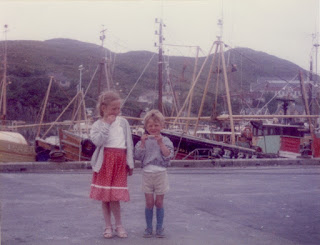
I've got two boxes full of me and my brother's family photographs with our parents and grandparents, the majority of which are in albums but very few of which have dates or places attached.  I think decisions have to be made, and to me, my immediate family photographs come first.  Me and my brother will need to sit down and go through these photos, probably with our dad, in order to remember where many of them were taken.   For example the photo below is me and my brother - but where? This could have been taken on a summer holiday, most likely Arisaig or Arran, though it doesn't look like Arran to me, or it could have been a day trip away, maybe Millport or Troon - in other words even these relatively recent photos are in desperate need of labelling if they are to stay relevant to our family.  


© Kathryn Hannan (nee. Mackenzie)
When I was going through the bags of our family photographs in my mum's house there were also loads of envelopes of photographs in addition to the albums - I made the decision that I wasn't just going to carry all these on with me - I was going to make like a good archivist and sort and appraise them!  I did this with my brother, which was a great experience in itself, reminiscing about childhood memories.  We decided to remove all duplication, we got rid of lots of photographs of scenery with no people in them keeping only the best shots of a place.  For example we went to the Isle of Skye many years in a row, each year taking similar photos of the Cuillins and the Old Man of Storr, so we picked the best ones and kept them, getting rid of the others.  We also narrowed it down by getting rid of photos that were very similar, for example photos of my 8th birthday - just how many photos do you need of me and my friends standing round the table laden down with cakes and treats - answer, not as many as immediate instinct would have you keep.  We then put all the loose photos in spaces in the photo albums - at this point my archival practices went a bit out the window to be honest.  I just wanted to get them all in albums so the didn't get bent and torn in transit so I still haven't tried to date or label any of them.  Reading the Guardian article has made me want to devote a day, with my brother, to going through and doing that - not only would it be useful, but it would be fun too!


I tweeted about the Guardian article last night then today when I checked the blogs I follow I found a really interesting post by Melissa Manon at ArchivesInfo 'Culling Family Photographs'.  In her article she makes the very important point 
 "We really do not need to keep everything. We do not need to be afraid to determine what is unnecessary. We do not need to leave the "dirty work" for our descendants. If we do, eventually someone is likely to get frustrated and just throw the whole kit-and-kaboodle into the trash. Handing down a well-managed collection of personal papers and photographs to loved ones encourages them to treasure the items, keep up their maintenance, AND to value the family history that they embody."


These personal examples I've given really resonated with another point in 'Culling Family Photographs' - 
"Label, label, label. If a photo is worth keeping, you should provide its back-story. Use a photo safe pen or pencil to record the name of the person, place, and/or event depicted. If there is a "story" to the image, supply as much as you can of that too." (ArchivesInfo, Culling Family Photographs, March 5 2011).
Her article is full of useful advice about the issues of archiving family photographs, including the very important issue of appraisal i.e. do you keep it or not.  


From personal experience I, like Melissa, do take exception to the point made in the Guardian article by Michael Hewitt that in regards to uncertainties over whether something will be of value to future generations "The only answer, therefore, is to hang on to all of it, and let our descendents do the sifting."  Having been put in this position I am determined that I am not going to repeat it!  


Another thread running through the Guardian article was the issue of digital obsolescence.  Michael Hewitt makes the point that - 
"we all seem to need something approaching an information technology degree. It's a problem that will become increasingly common as we gradually entrust all our photos and home movies to digital media. Not just because of disk crashes. Format obsolescence won't help either... American Scientist recently dubbed this potential loss of generations' worth of photos and home movies the "digital dark age". We should, it says, all make an effort now to preserve them before it's too late."
There are so many issues encased in the worries over digital obsolescence, not least the fact that it is something which most people don't think about until they have a problem, for example their computer crashes and the files weren't backed up, or the files were only on the memory drive in the camera and the camera was stolen.  Also in terms of labelling - ok you might give the photo a title but where do you put the additional information - generally this would be on Facebook, Flickr, Twitpic or whatever other platform is used to share the photographs.  This means that the information about the photographs is detached from the photograph files themselves, and even if the files are backed up elsewhere is this metadata about them carried over with them?  I know that personally I didn't, until now, think of what happens to all the cataloguing I add to photographs on Flickr - not just places, dates, etc but the URL's that I'll add in to photographs of exhibitions, as just one example.  Then there are all the family photographs I haven't put up on Flickr that are just on my laptop and my camera - I should clearly have these backed up somewhere, but how do I add metadata to the photos? I don't know how to do that, I'm sure I could ask an archivist/IT friend but will I ever get round to it - I doubt it.  My option is still to print off the most important photos and put them in envelopes.  I have albums but as yet still haven't got round to putting any of the photos in them. 


It really gave me a warm glow to read this article in the Guardian though - to hear the terms archiving and digital obsolescence, and the concepts of cataloguing and tagging, discussed in such a thoughtful way.  Although I know I have a long way to go in terms of properly labelling and preserving my family photographs at least I feel aware of all the issues involved - now all I have to do is act on it and use my professional archiving skills for the benefit of my personal and family life!