Showing posts with label London. Show all posts

Friday, 11 May 2012

Visit to the Cinema Museum, London

This is a post I originally wrote as a piece for the newsletter of the London Region Archives and Records Association (I still have to concentrate not to say Society of Archivists!).  I've altered it slightly since and included a few more photographs. The newsletter is available here.

London Metropolitan Archives (LMA) have a monthly film club: a free drop-in event with ‘screenings of archive films from LMA and other organisations, occasional guest speakers and plenty of opportunity for discussion'.  Sounded perfect - two of my favourite things, film and archives - together! When I saw the March film club was a visit to the Cinema Museum in Elephant and Castle I was even more excited as I'd been meaning to visit for years.  Emily, the organiser of the Film Club, was very friendly and arranged to meet everyone outside.  She had arranged for us to have a tour and a film screening.

Exterior of the Cinema Museum, photo by me
Ronald Grant was our host for the evening and he told us the story of the development of the film museum, the history of the building (it was previously a workhouse where a young Charlie Chaplin spent time), and a great history of film itself.  Ronald started working as an apprentice projectionist with Aberdeen Picture Palaces Ltd at the age of 15.  On moving to London he worked for the BFI and the Brixton Ritzy.  A trip back to Aberdeen led to a chance encounter with his old employer who showed him warehouses full of artefacts from the cinema chain he had worked with.  In order to save these from being destroyed he returned to London with a large quantity of artifacts and film equipment which formed the basis of the museum (there more on the history of the museum on their website.

Category Board featuring 'H' for Horrific!, photo by me
The collection has continued to grow since then and covers everything you could think of from the doors and display boards of the cinema to the interior fixtures, film projectors and the films themselves (over 17 million feet of film), film journals, books and magazines, uniforms of staff from the cinemas, posters and original artwork, publicity stills and photographs of cinemas, and I’m sure lots more that I’ve missed out!

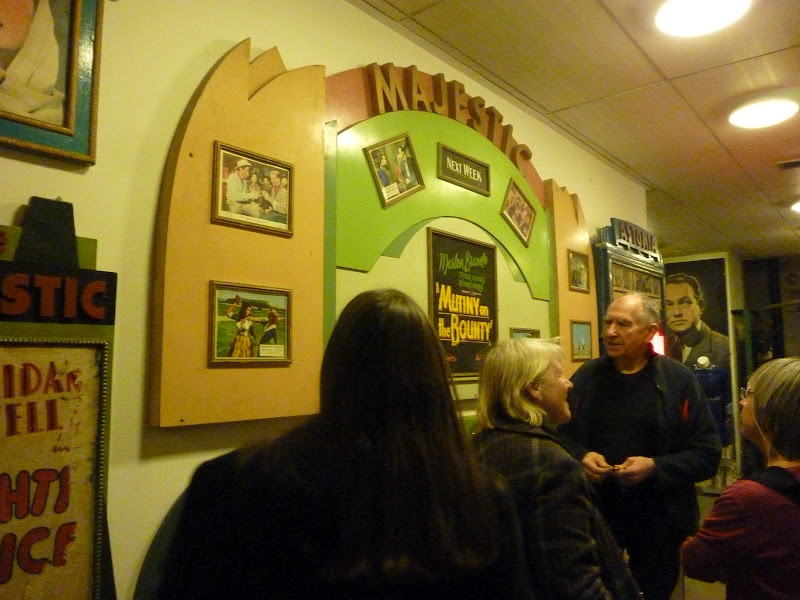
I really liked this carved poster frame with Mutiny in the Bounty (which starred Richard Harris) in the centre, photo by me
Ronald was a fantastic tour guide, weaving his personal history in and around all the objects and artefacts in the museum. He also showed us the space they use for doing events including film screenings and sessions with film makers and actors – I’ll definitely be going back!

The evening ended with an archive film screening of a selection of films including some a film made about the last tram in London ( 1952) and, to my delight, a film by the New Zealand film-maker Len Lye which I think (I knew I should have written this up when I got home that night!) was A colour box (1935). I would highly recommend a visit to anyone interesting in film, film archives and film history.

Unfortunately I couldn’t make it to the April meeting of the film club so I can’t report on how that went but I’m looking forward to the May Film Club on Wednesday 23rd May.  Information on the dates of the upcoming film clubs are available here.

Tuesday, 24 January 2012

Evangelist of Happiness

'Evangelist of Happiness' - this phrase was used to describe Pipilotti Rist by the New Yorker critic Peter Schjeldahl, I saw this written in a review of her recent London show at the Hayward Gallery and couldn't think of a better or more apt description for 'Eyeball Massage' - her recently-finished show at the Hayward Gallery.

[photo by me]
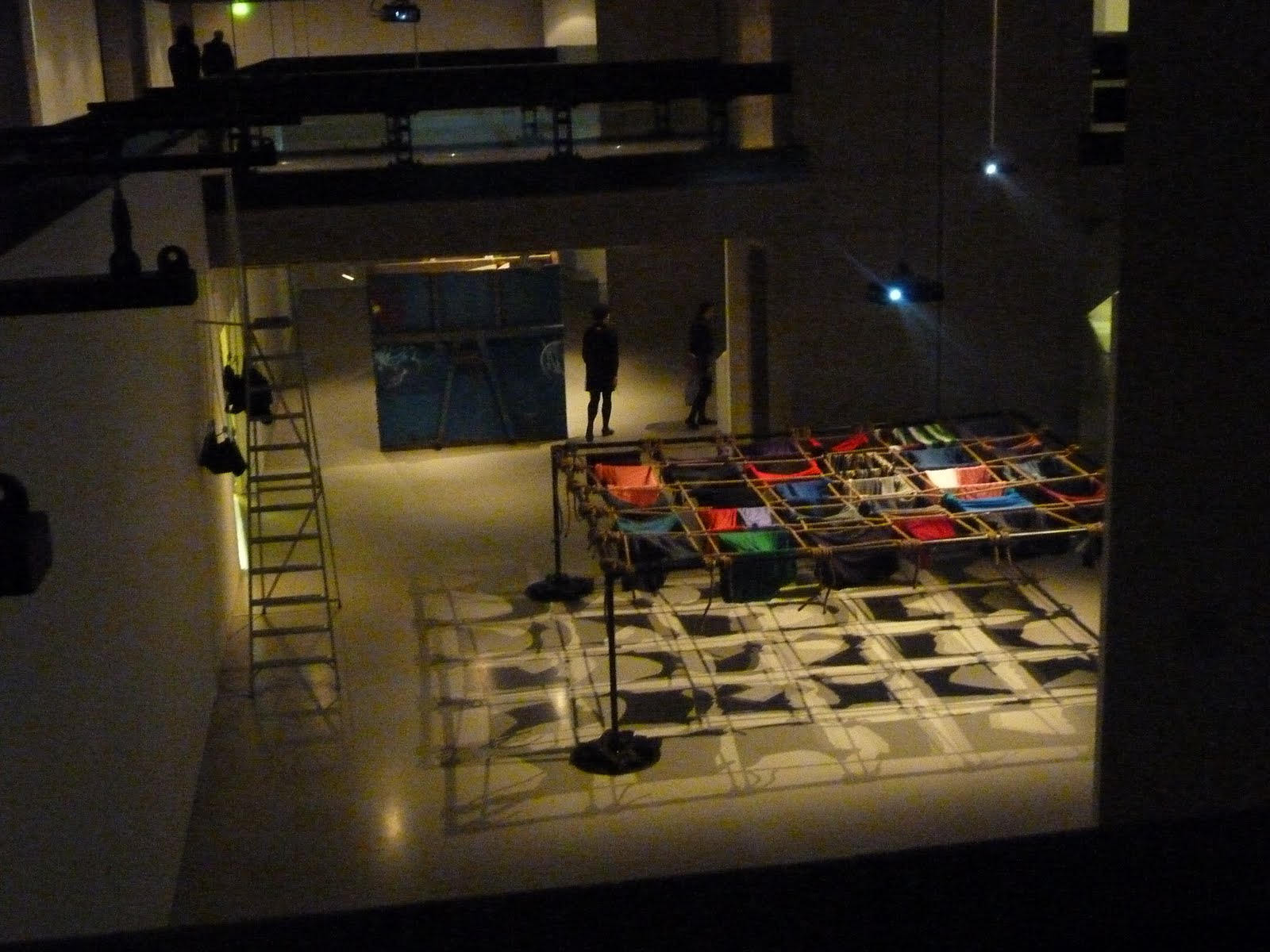
The first thing you see when you go in to the exhibition is Massachusetts Chandelier -  a light-hearted start to the show and a nice way to begin.  The underwear was donated from her family and friends and in the booklet accompanying the exhibition she refers to underpants as 'the temple of our abdomen' and goes on to say 'this part of the body is very sacred, as it is the site of our entrance into the world, the centre of sexual pleasure and the location of the exits for the body's garbage'.  So straight away you get one of the main themes of the exhibition - the celebration of the human body.

My photos are, to put it bluntly, crap! However the video review at the bottom was filmed in the exhibition so watch that if you want to see more of the films.  The photo I've included here (below) is of 'I'm not the girl who misses much', made whilst Rist was a student.  It shows her singing the words of the title (a line from the Beatles song Happiness is a Warm Gun') while dancing around topless.  This was really weird as you had to stick your head up through holes in a wooden board in order to see the film - it felt like watching a peep show, but with other people as there were quite a few holes - even weirder!  Both image and sound were at varying speeds and there was a definite air of hysteria to it, but still a real element of fun as well.  There were lots of films shown on the floor, in the floor, in seashells, in handbags - so innovative!  My absolute favourite, and the one I could have spent all day in was 'Lobe of the Lung'.  This was projects on three screens, a slightly different film on each one, with lots of cushions for folk to sit and watch it on.  It was like a cocoon, with hypnotic music as well.  When we were in there were children in, dancing about and enjoying it and lots of people lying about on the cushions.  The colours in this film were totally saturated - I remember lots of shots of rotting fruit, water lillies, a girl underwater, a wild pig eating grass shown at the same time as the girl eating an apple. 


[photo by me]

In his audio review Peter Schjeldahl says “She resolves no critical problems of contemporary art. She just makes you forget that there are any”.  This isn't meant as a criticism at all as he begins by saying she is one of his favourite artists.  I don't know much about the critical problems of contemporary art but this exhibition didn't make me forget issues in contemporary art and art history which I think are important.  This show really made me think about the way that women are often portrayed in art, of the absence of women throughout the history of art (not a complete absence just a distinct lack of).  I would also say that in the positive depiction of sensuality and of the human body in all it's shapes and sizes, the theme of reconnecting us with nature, with animal instincts, makes it in a sense very political.  And, as Schjeldahl said, 'it made being a member of society seem like a great idea'.

Another description of the show, which sums up how I felt when I walked out - happy, dazed, calm, on a bit of a high, in love with the world - comes from Adrian Searle in the video shown below.  His description? 'You come out and the world feels better'. Thank you Pipilotti Rist for making my world a better place on Saturday January 7th.


Thursday, 21 April 2011

New York Downtown Scene 1970s - exhibition at the Barbican, London

I realised I tantalisingly mentioned the Barbican exhibition at the end of my post of my new job, then got so excited about the Researcher's Tales at the BFI that I forgot about the Barbican.  However, it definitely was only temporarily forgotten as it was such a breathtaking exhibition that I'm actually hoping I've got time to go back!

View of 'Floor of the Forest', Barbican

'Laurie Anderson, Trisha Brown and Gordon Matta-Clark - Pioneers of the Downtown Scene, New York, 1970s' is on until 22 May and I would recommend it to anyone in or visiting London.  It was the last exhibition I went to see with a friend who's since moved back to Israel (if you're reading this, I hope you make it back to London soon!) and what a lovely day we had.  It was lovely and sunny, we saw this exhibition, wandered around the Barbican complex, saw part of the original wall of London, then went to meet other friends in 'The Book Club' pub in Shoreditch - a packed and fun day!

I've read so much about New York in the 1970's, in Tim Lawrence's fantastic biography of Arthur Russell Hold On To Your Dreams, in Patti Smith's Just Kids, and most recently in City Boy by Edmund White.  So I'd heard of Laurie Anderson, Trisha Brown and Gordon Matta-Clark without ever having seen or experienced their work.  As the title states the exhibition is about their work in New York in the 1970s and it covers dance, performance art, photography, film - but none of them in quite such a straightforward way as that makes them sound.  For example Gordon Matta-Clark's cut outs of buildings - at first I thought, yes interesting, replica's of sections of dilapidated buildings, however... they weren't replicas, it was actual sections of buildings!  He had taken photographs of the cut-outs and it was just such a painstaking looking process and so clever, I loved it! I read a good post about him here, which is also where I got the image below from.
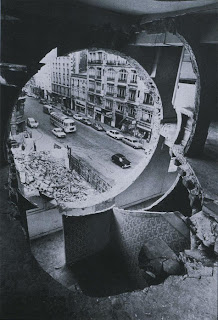
Interior view of conical intersect
We were lucky to arrive just in time for 'Walking on the Wall' a performance piece by Trisha Brown.  This really played with your sense of perspective and space and was spell-binding and fun to watch.  The performances are on every day - if I go back I'd love to see Floor of the Forest! Laurie Anderson's performance pieces which she had photographed were so much fun as well, for example there was one series of photographs of her lying in various places, on a bench, in a train station, on a beach.  The premise was to see if sleeping in different places altered her dreams.

There were a large number of film pieces by Gordon Matta-Clark and Trisha Brown and whilst I really enjoyed all of them they also brought out my archivist side as the quality of some of them was great, they'd obviously been preserved, there were others which were really very grainy and quite difficult to make everything out clearly.  That made me very sad as anyone who sees these works could see how deserving of preservation and care they are.  Though I guess at the time if the artist just kept a print themselves, maybe in a loft or cupboard then the chances of it being well preserved are less.  It was just so much fun to see them all though that the quality was really of minor importance to the effect and the experience!

Having read so much about the music scene in New York it was great to see another side to the New York of the 1970s - I know at the time it would have been edgy, no doubt dangerous, and pretty poor too - but I'd still have loved to have experienced it!

Tree in blossom outside the Barbican

Thursday, 10 March 2011

John Stezaker at the Whitechapel Gallery - collage work using archive images

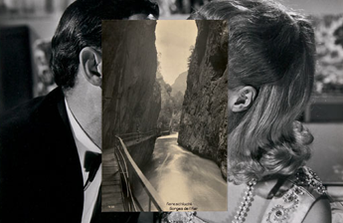
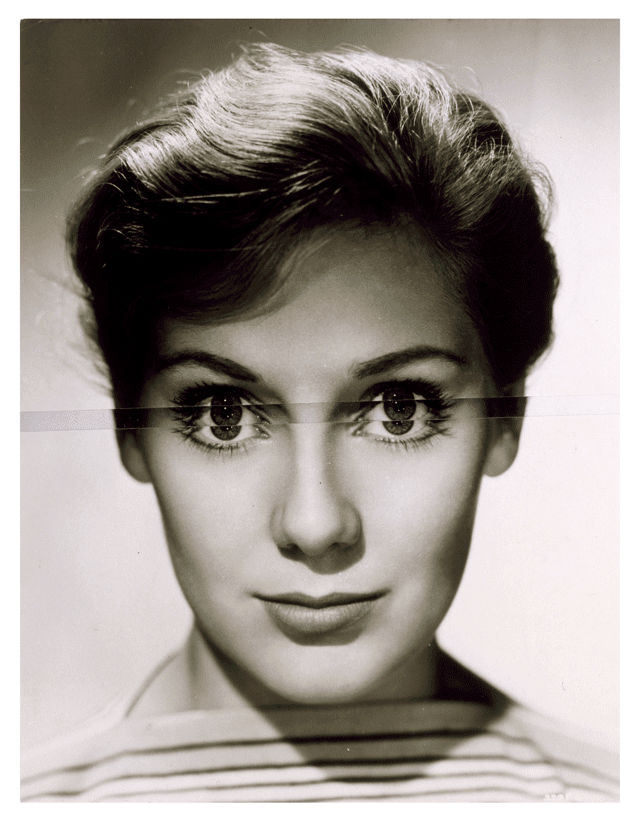
Last weekend- after a Friday and Saturday night at home I decided I had to get out and about on Sunday and do something, but, with so much choice in London what to do!  I chose to go to the Whitechapel Art Gallery which I love anyway, but which also has an exhibition on which I'd been wanting to see for a while.  The work of John Stezaker is collages which he creates from classic movie stills, old postcards and book and magazine illustrations and clippings.  He puts these together in such a way that although you know instinctively that the image is wrong, in the sense that it's been altered, there is something about them that's so right.  Often the images are lined up, for example in the image below he lines the faces in the movie still up with the edges of the cliff from the vintage postcard.  I found this whole exhibition incredibly pleasing! It made me smile as I walked around it, which is always nice on a Sunday afternoon, and you could read so much into the images, but you could also just enjoy the act of looking, the new meanings and contexts created by mixing together these old images.


It's only on for one more week, finishing on Friday 18th March and I would highly recommend this to anyone who gets a chance to visit before it finishes.  If I lived in the area it's something I would probably have gone back to more than once, in fact if I wasn't going away this weekend I think I'd be going back! 

Saturday, 11 September 2010

A Lucky Find

I'm just back from a week's holiday in Crete where we had a lovely time enjoying the beautiful scenery and lovely hot weather, eating tasty local food (including lots of fresh fish), and basically relaxing after the recent hectic time of the end of my post at Stirling University and celebrating my husband's new job and our imminent move to London - yay!

So on our return from Crete we're spending a few days in London exploring some of the areas we're thinking we might move to.    Yesterday we were in Stoke Newington first which we both really liked but which is maybe not going to be feasible re commuting.  Anyway we had fun exploring and of course doing a wee bit of shopping.  On our wander we came across a lovely shop on Church Street which drew me in with the lovely array of vintage tea pots I could see through the window.  They also had a great selection of prints, including reproductions of Cuban film posters.  I wasn't planning to buy anything but when I came across this poster for Lindsay Anderson's O Lucky Man! (1973) I just had to buy it!  The artist is Antonio Fernandez Reboiro and the poster is from 1977.  I didn't want to take the poster out it's plastic until I get home so apologies for the poor quality of the image but the quality of the art work shines through I think. 


I don't know much about Cuban movie posters but found a few interesting blogs that will start me off on a bit more reading when I get back to Glasgow - for now we're off to Borough Market for some tasty food!

Here are the blogs I came across:

Tales of a Cinesthete

Cuban Posters

Thursday, 18 February 2010

Dieter Rams retrospective at the Design Museum, London

On a recent trip to London I visited the Design Museum for the first time to see the Dieter Rams retrospective 'Less and More - the Design Ethos of Dieter Rams' and it was such a visual treat - the building itself is striking, the area the museum is in is one I hadn't spent much time in before so I enjoyed the views of and from Tower Bridge, and all the designs Rams created for Braun were amazing to see. Lots of beautifully designed record players and film cameras that would not look out of date today.


I came away from the exhibition struck by the 10 elements of Dieter Rams' design philosophy:
  1. Good design is innovative.
  2. Good design makes a product useful.
  3. Good design is aesthetic.
  4. Good design makes a product understandable.
  5. Good design is honest.
  6. Good design is unobtrusive.
  7. Good design is long-lasting.
  8. Good design is thorough down to the last detail.
  9. Good design is environmentally friendly.
  10. Good design is as little design as possible.
It seems like Rams was a victim of his own philosophy as his designs have become so imitated and inspiring to others that it has become a 'style' in itself, something that seems against his philosophy as quoted on the Guardian "I believe designers should eliminate the unnecessary... That means eliminating everything that is modish because this kind of thing is only short-lived."


I just loved all the old record players and home movie cameras - they're so beautifully made and the designs seem so simple and pure, there's nothing that isn't necessary. I spent ages looking at all the record players as it is still most definitely my favourite medium for listening to music. As I write this today I am enjoying listening to 'Have one on me' the new album by Joanna Newsom which came on triple vinyl in a lovely box - so not only is it a wonderful listening experience, it's also a beautiful object to look at. I am a relatively recent convert to the ipod but I think even without the information given at the exhibition I would have figured that the designer behind a lot of Apple's designs was influenced by Rams.