Monday, 21 March 2011

Louis Vuitton & Paris

As a Christmas present my husband surprised me with a trip to Paris which we went on at the end of February.  I've only been to Paris once before, it was January and freezing, and I didn't have much of a plan really, except to go to the Eiffel Tower and the Louvre.  So this time we made lots of plans!  I am guilty of always overestimating how much can be done in a day and then trying to fit it all in anyway so this time I tried to be more realistic.

The l'Orangerie had come highly recommended by a number of friends, including Zoe at McGill Duncan Gallery so that was high on my list, as was the Rodin Museum, recommended by my Gran as a highlight of her visit twenty or so years ago!  Surprisingly, the other place at the top of my list was an exhibition about Louis Vuitton, I say surprisingly as I'm not exactly a high fashion devotee.  I found out about the exhibition here.  All I knew about Louis Vuitton was that lots of people seem to have Louis Vuitton embossed handbags which say nothing to me about fashion and everything about how much money they want people to think they've spent on said bag.  Oh, and at the other extreme, the beautiful luggage seen in Wes Anderson's The Darjeeling Unlimited (one of the highlights of a disappointing film).

Photograph my own. 

However this exhibition, at the Musee Carnavalet, has completely changed my perceptions of the company and brand.  The company began in 1834 in Paris with the first store opening in 1854.  The exhibition goes deeply into the history of the company and the aims and beliefs of the Vuitton family who set up and ran the business.  Interestingly even from the beginning there was a real awareness of history, of archiving their own history and looking further back into history, as tools for marketing and promotion.  I think it was his son who researched and wrote a history of luggage through the ages and in addition to items deigned by Vuitton the exhibition also included examples of sources for inspiration for some of the designs.  There were so many stunning examples of suitcases, vanity cases, tea cabinets, travel wardrobes etc but unfortunately you couldn't take photographs - which, given my complete lack of photography skills is no huge loss - instead I will share with you this promotional video for the exhibition.  One of my favourites was a suitcase filled with hairbrushes, all of which fitted exactly into their own slots to stop them becoming dislodged in travel, and even better... when you looked at it upside down all the handles of the brushes made up a Manhattan skyline - genius!  The exhibition was laid out beautifully as you can see in the video and I suppose it all works as very effective promotion for the company but heck, what's wrong with promotion when it's so enjoyable!

Tuesday, 15 March 2011

'Tweeter's' help in identifying building

Last week I was cataloguing a film (AV260/30) by Alan E Turner, an amateur filmmaker from Romsey.  The film was called 'West Country Holiday' and having a title is always useful, especially when it identifies the area shown in the film.  Inter-titles are even more useful and luckily for us Mr Turner included inter-titles in most of his films.  These are titles which appear throughout the film, usually indicating a change of location.  In this particular film there was an inter-title Ilfracombe, followed by some footage of the seaside resort of Ilfracombe in the 1930s.  The footage is lovely, showing lots of beautiful buildings, some great footage of the Lynton to Lynmouth Cliff Railway, and including this building shown in the image below.  I tried with Google Maps, walking about the streets of Ilfracombe in Google street view, looking at tourist websites for Ilfracombe but I just could not identify this building.

© Wessex Film and Sound Archive, AV966/30 - the Victoria Pavilion, Ilfracombe 
I decided to try Twitter as this has been successful before in identifying buildings, particularly when we have the name of the town to help.  This time I didn't even need to send messages to local tourist websites, I just posted the image on Twit Pic with a message on Twitter asking if anyone knew what this building was - you can see the response in the second image.  People are so helpful - I posted the request for information on the 10th of March and the replies from two individuals both came in the same day!


It turns out the building is the Victoria Pavilion.  It was built in the 1920s but in 1994 the decision was made that the costs to continue repairing it were too high and the building was demolished and replaced with the Landmark Theatre.  I used various online sources to verify the identification of the building and gather information on it but I would never have found any of this without the help from our followers on Twitter.  Or I should correct that, I might have found it, if I had been able to track down a book of old photographs of Ilfracombe but there just isn't that kind of time to devote to identifying one building so the use of social media such as Twitter are invaluable in this respect.

Friday, 11 March 2011

My thoughts on the UK Archives Discovery Network (UKAD) Forum on Wednesday 3rd March 2011

My first visit to the National Archives – after getting slightly disorientated when I came out the station I eventually got on the right road and made my way to the National Archives.  I wasn’t quite sure what to expect of the day – would it all be too ‘techy’ and over my head, would it be practical or theoretical, what would I be able to take away and apply to my work? One thing I certainly had not expected was the high attendance of the conference, I was expecting maybe 30 or 40 people not the 100 or so people that attended.  There was a real buzz on arrival of expectation and enthusiasm which was just great.  I felt slightly overwhelmed at first as it’s the first archive meeting I’ve been to since moving down to London and although the archives world is still relatively small it is of course a lot smaller in Scotland, so not so many familiar faces for me.  However this was great as it was an opportunity to meet and chat to archivists and information professionals from all over, Scotland included.  

The event was the first event organised by the UK Archives Discovery Network (UKAD) who describe themselves as “a network of like-minded archivists and other professionals working towards opening up archival data in order to promote the use of archives.”  I liked the sound of this, had a look at the planned agenda for the day, and decided to sign up, and, the event was free – even better!

The day began.. with tea and biscuits of course! As anyone who knows me can attest I don’t function well until I’ve had my obligatory morning caffeine kick.  The day proper began with two keynote speakers in the plenary session, John Sheridan (The National Archives) and Richard Wallis (Talis).  Both these speakers talked about open data and linked data.  The definition given of linked data, as I remember it, was information that is known about the information you have, and how to exploit this using the web.  So basically how do we create the links between the information we have and other information about our information on the web.  So far so straightforward.  At least two speakers references Tim Berners-Lee’s  ‘Five Stars of publishing data’ which i really like as a brief guide of 'what to do'.
* putting on web
** make it available as structured data
*** standardized format
**** URL’s to identify things
***** link data to other data, context

So, what I have taken away from the day? First off, as a side product of the actual presentations and workshops, I came away with a reaffirmed belief in the friendliness and enthusiasm of my colleagues in the profession because of the energy and enthusiasm of the day.  I’m always banging on about how much I love being an archivist, well this day just reinforced many of the reasons why.

I also came away with some specific tips for increasing the profile of an institution, for example using Google Analytics; using URL’s which make sense & are relevant, & not using acronyms in URL’s; checking to see if there’s a Wikipedia entry for institution, if not, why not, and can we create one?

Importantly I feel I gained a deeper awareness of the importance of thinking about what we want to achieve with the use of social media.  Do we want to attract the same users as would come through the door, are we targeting specific user groups at all or do we just want to promote generally?  Is it about promotion or interaction, or both?  Generally thinking of the use  of social media in the same way you would any other activity i.e. formulating plans and aims beforehand.

The day ended with a great session by Teresa Docherty from the Women’s Library about the relaunch of Genesis.  Genesis is a project which works as a portal allowing people to search across women’s studies resources in a huge number of locations – archives, libraries and museums across the UK.  Teresa finished her talk with the sentiment that ‘lets get out data out and let people play with it.  It’s time to have some fun!’ (paraphrased).  I love this attitude as I think it’s too easy to get stuck in the trap that our Archive, or a particular set of records in our archive, would only be of interest to one set of users.  One example I can think of from my own experience so far is artists coming in and doing projects in the archive and producing outstanding new work based on the archives.  This ties into a point made earlier in the day by Alexandra Eveleigh that we are maybe too accustomed to thinking only of study and research in terms of use of our archive and we need to think of archives outside of this narrow definition for example the use of apps and gaming devices by museums.  There were of course mountain of other topics discussed and areas covered, and far more eloquently than I could summarise, so here is a link to Slideshare where some of the speakers have uploaded their presentations:


Teresa Docherty – Genesis Relaunch

Richard Wallis – Linked Data


There are also some blog posts I've come across about the day - a great post by Bethan Ruddock at the Archives Hub and another on the SALDA blog.

So, the task now is to apply what has been learned, continue to be open and receptive to new ideas, and keep up the enthusiasm!

Thursday, 10 March 2011

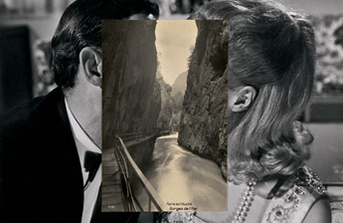
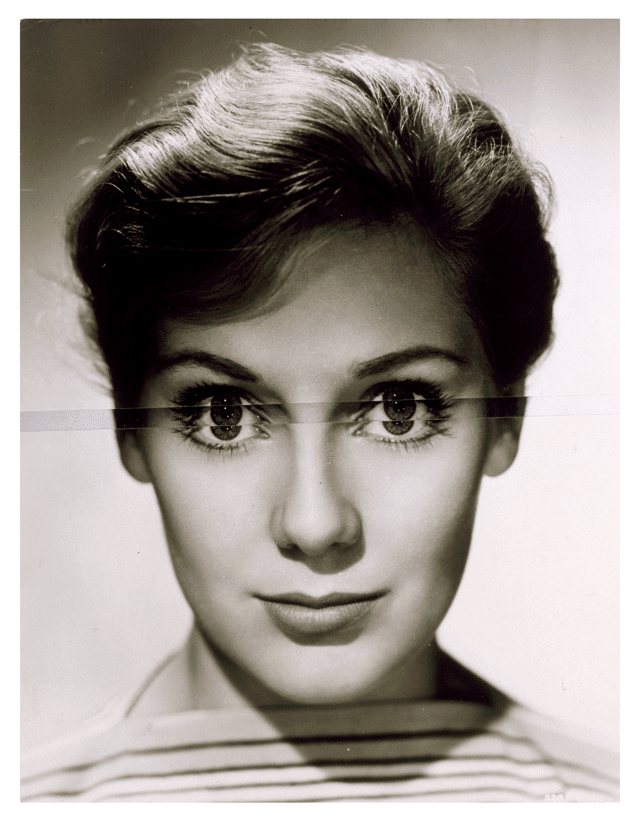
John Stezaker at the Whitechapel Gallery - collage work using archive images

Last weekend- after a Friday and Saturday night at home I decided I had to get out and about on Sunday and do something, but, with so much choice in London what to do!  I chose to go to the Whitechapel Art Gallery which I love anyway, but which also has an exhibition on which I'd been wanting to see for a while.  The work of John Stezaker is collages which he creates from classic movie stills, old postcards and book and magazine illustrations and clippings.  He puts these together in such a way that although you know instinctively that the image is wrong, in the sense that it's been altered, there is something about them that's so right.  Often the images are lined up, for example in the image below he lines the faces in the movie still up with the edges of the cliff from the vintage postcard.  I found this whole exhibition incredibly pleasing! It made me smile as I walked around it, which is always nice on a Sunday afternoon, and you could read so much into the images, but you could also just enjoy the act of looking, the new meanings and contexts created by mixing together these old images.


It's only on for one more week, finishing on Friday 18th March and I would highly recommend this to anyone who gets a chance to visit before it finishes.  If I lived in the area it's something I would probably have gone back to more than once, in fact if I wasn't going away this weekend I think I'd be going back! 

Tuesday, 8 March 2011

The most Inspirational Woman in my life - my Mother

I've just realised that tonight - on International Women's Day - I spent my time doing things inspired by the most inspirational woman in my life, my mum, Christine Mackenzie.  I finally finished a draft excluder I started making in January on the sewing machine which belonged to her.  I think it looks pretty good - as long as you don't look too closely at the bad stitching on the finish.  I used instructions I found on the Guardian website here.  The main mistake I made was not sticking so closely to the instructions given about the width - I used up at least four large bags of rice to fill it, maybe necessary if you live in a cave but slightly excessive for a small under-door draft!  I also think I should have picked a material with a smaller, more repetitive pattern, but that's purely aesthetic and to be honest given the cold weather this winter it's the function I'm more bothered about.  It took me a while to work out which needle head to use on the sewing machine but luckily I still had the instruction manual so managed to work it out with the help of that.

I was amazed that I remembered how to thread it all up, having been shown on many occasions as a young girl by my mum.  As a teenager I was always starting up art projects which my mum always encouraged - although invariably, any ones involving the sewing machine, she ended up finishing off for me.  It is very comforting for me to use her sewing machine as it brings back so many happy memories, even the noise of the foot pedal bring back memories of sitting reading a book or watching TV in the living room, hearing my mum being creative in the other room - she was never one for sitting in front of the TV, always preferring to do something creative (maybe more than preferring actually, it was like an imperative, it was essential to who she was I think). 

my draft excluder
I'll never live up to my mum's inspirational and creative work on the sewing machine but it's going to be nice to use the same machine to (hopefully!) make clothes that my mum used to make such beautiful art work - such as the first image here, an early work of a farm just across the fields from the house we grew up in in Eaglesham.  Believe it or not this is just a scanned image of a photo of the work - the texture has come through so well!  This photo of the piece, mounted on board and with explanations would have been done for the classes she taught.  This archive of my mum's work, the samples she did, the explanations she gave, is something I want to collect, along with photos of her finished art works, on a website - a project for this year I think.

© Christine Mackenzie
The mermaid is a more recent work and I absolutely love it - the colours, the skill and detail in the stitching, the romance and mythology of the boat on the water and the Gaelic text (which I know I have a translation of but can't find right now).

© Christine Mackenzie
After that I made pancakes - large crepe style ones rather than scotch ones.  It brought back lots of happy memories of making them with my mum and for my mum.  I remember on pancake day when we were younger and both me and my mum were vegetarians, and my brother just fussy, that we would make 'savory' pancakes - filling the with grated cheese - followed by sweet pancakes - filled with Golden Syrup and maybe a bit of cream.  Tonight though I stuck to the traditional lemon and sugar for me and Oliver.

The recipe for the pancakes I made tonight came from the Glasgow Cookery Book, Centenary Edition.  But the history of the Glasgow Cookery Book and the inspirational women behind it is definitely a story for another blog post!  if you can't wait for that and want more information then you can find out more about the history of the book at Glasgow Caledonian University Archives and about the centenary edition here.


I hope everyone else has had some positive thoughts, actions and memories on International Women's Day.