Monday, 7 March 2011

Where private and professional meet - or should do.

Yesterday I was reading Saturday's Guardian and was very happy to find an article The Rise and Rise of Family Photographs about the issues of personal archiving, appraisal, and digital obsolescence of family photographs.  However as I continued to read through the article I got this awful sinking feeling in my stomach, the knowledge that I might have done something which is bad as both a family member, and, as an archivist.  [takes a  deep breath]... I think when I was clearing out my mum's house I may have chucked out a whole paper bag full of family photos.  Now to qualify this slightly, they aren't my immediate family photos as in my Grandparents/Great Grandparents, they are photos which my mum got when she was helping to clear out the house of a Great Aunt.  None of the photos had any names, dates or places on them and my mum didn't know who most of the people were in them.  She did say a few times that she hoped to get round to trying to put names to at least some of them, but sadly she passed away before she could do this.  I did however keep a leather envelope which contains photos belonging to the same Great Aunt and, given that these were selected and kept in better storage, it suggests they were considered of more importance, or maybe just the best of the collection.  So, in retrospect maybe what I did, or may have done (as I haven't quite got round to going through everything that I packed up from my mum's house yet so am still unsure whether I merely packed the photos away) maybe it isn't so bad after all.  I've still got a selection of the photographs, which were considered important, and I wouldn't have been able to put names to any of the faces anyway.  


I've got two boxes full of me and my brother's family photographs with our parents and grandparents, the majority of which are in albums but very few of which have dates or places attached.  I think decisions have to be made, and to me, my immediate family photographs come first.  Me and my brother will need to sit down and go through these photos, probably with our dad, in order to remember where many of them were taken.   For example the photo below is me and my brother - but where? This could have been taken on a summer holiday, most likely Arisaig or Arran, though it doesn't look like Arran to me, or it could have been a day trip away, maybe Millport or Troon - in other words even these relatively recent photos are in desperate need of labelling if they are to stay relevant to our family.  
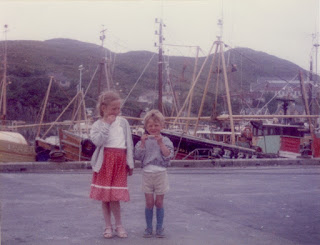

© Kathryn Hannan (nee. Mackenzie)
When I was going through the bags of our family photographs in my mum's house there were also loads of envelopes of photographs in addition to the albums - I made the decision that I wasn't just going to carry all these on with me - I was going to make like a good archivist and sort and appraise them!  I did this with my brother, which was a great experience in itself, reminiscing about childhood memories.  We decided to remove all duplication, we got rid of lots of photographs of scenery with no people in them keeping only the best shots of a place.  For example we went to the Isle of Skye many years in a row, each year taking similar photos of the Cuillins and the Old Man of Storr, so we picked the best ones and kept them, getting rid of the others.  We also narrowed it down by getting rid of photos that were very similar, for example photos of my 8th birthday - just how many photos do you need of me and my friends standing round the table laden down with cakes and treats - answer, not as many as immediate instinct would have you keep.  We then put all the loose photos in spaces in the photo albums - at this point my archival practices went a bit out the window to be honest.  I just wanted to get them all in albums so the didn't get bent and torn in transit so I still haven't tried to date or label any of them.  Reading the Guardian article has made me want to devote a day, with my brother, to going through and doing that - not only would it be useful, but it would be fun too!


I tweeted about the Guardian article last night then today when I checked the blogs I follow I found a really interesting post by Melissa Manon at ArchivesInfo 'Culling Family Photographs'.  In her article she makes the very important point 
 "We really do not need to keep everything. We do not need to be afraid to determine what is unnecessary. We do not need to leave the "dirty work" for our descendants. If we do, eventually someone is likely to get frustrated and just throw the whole kit-and-kaboodle into the trash. Handing down a well-managed collection of personal papers and photographs to loved ones encourages them to treasure the items, keep up their maintenance, AND to value the family history that they embody."


These personal examples I've given really resonated with another point in 'Culling Family Photographs' - 
"Label, label, label. If a photo is worth keeping, you should provide its back-story. Use a photo safe pen or pencil to record the name of the person, place, and/or event depicted. If there is a "story" to the image, supply as much as you can of that too." (ArchivesInfo, Culling Family Photographs, March 5 2011).
Her article is full of useful advice about the issues of archiving family photographs, including the very important issue of appraisal i.e. do you keep it or not.  


From personal experience I, like Melissa, do take exception to the point made in the Guardian article by Michael Hewitt that in regards to uncertainties over whether something will be of value to future generations "The only answer, therefore, is to hang on to all of it, and let our descendents do the sifting."  Having been put in this position I am determined that I am not going to repeat it!  


Another thread running through the Guardian article was the issue of digital obsolescence.  Michael Hewitt makes the point that - 
"we all seem to need something approaching an information technology degree. It's a problem that will become increasingly common as we gradually entrust all our photos and home movies to digital media. Not just because of disk crashes. Format obsolescence won't help either... American Scientist recently dubbed this potential loss of generations' worth of photos and home movies the "digital dark age". We should, it says, all make an effort now to preserve them before it's too late."
There are so many issues encased in the worries over digital obsolescence, not least the fact that it is something which most people don't think about until they have a problem, for example their computer crashes and the files weren't backed up, or the files were only on the memory drive in the camera and the camera was stolen.  Also in terms of labelling - ok you might give the photo a title but where do you put the additional information - generally this would be on Facebook, Flickr, Twitpic or whatever other platform is used to share the photographs.  This means that the information about the photographs is detached from the photograph files themselves, and even if the files are backed up elsewhere is this metadata about them carried over with them?  I know that personally I didn't, until now, think of what happens to all the cataloguing I add to photographs on Flickr - not just places, dates, etc but the URL's that I'll add in to photographs of exhibitions, as just one example.  Then there are all the family photographs I haven't put up on Flickr that are just on my laptop and my camera - I should clearly have these backed up somewhere, but how do I add metadata to the photos? I don't know how to do that, I'm sure I could ask an archivist/IT friend but will I ever get round to it - I doubt it.  My option is still to print off the most important photos and put them in envelopes.  I have albums but as yet still haven't got round to putting any of the photos in them. 


It really gave me a warm glow to read this article in the Guardian though - to hear the terms archiving and digital obsolescence, and the concepts of cataloguing and tagging, discussed in such a thoughtful way.  Although I know I have a long way to go in terms of properly labelling and preserving my family photographs at least I feel aware of all the issues involved - now all I have to do is act on it and use my professional archiving skills for the benefit of my personal and family life!  

Tuesday, 1 March 2011

An Oscar in the Archive

This was something I wrote when I worked at Stirling University Archives - I thought with the Oscars being topical right now I would finally get round to putting it up!

'An Oscar in the Archive', Kathryn Mackenzie, Archivist/Research Assistant, Lindsay Anderson Collection, University Archives, University of Stirling

One of the more unusual items found when the Lindsay Anderson Collection arrived at the University of Stirling was an Oscar statuette.  The ‘Oscar’ was found in the Collection when it was being unpacked by the University Archivist, Karl Magee.  The initial excitement at having found an Oscar gave way to a realisation that, going by the weight and material of the statue, it was highly unlikely it was an original!  The Lindsay Anderson Collection now contained a fake Oscar rather than the real thing, but it is precisely this fact that makes the story so interesting.


Lindsay Anderson's 'Oscar'
© Lindsay Anderson Collection, University of Stirling Archives

We knew from research into Lindsay Anderson’s films that he had won an Oscar, in 1954, for a film he co-directed with Guy Brenton entitled Thursday’s Children.  Set in the Royal School for the Deaf in Margate this 25 minute film shows a group of deaf children in their classroom.  The film is narrated by Richard Burton who describes the stories of the individual children and the learning process they go through to enable them to communicate.   Thursday’s Children won the Academy Award for Best Documentary Short in 1954.  So, the question we faced now was, given that Anderson had won an Oscar, why was the one in the Archive a fake?!


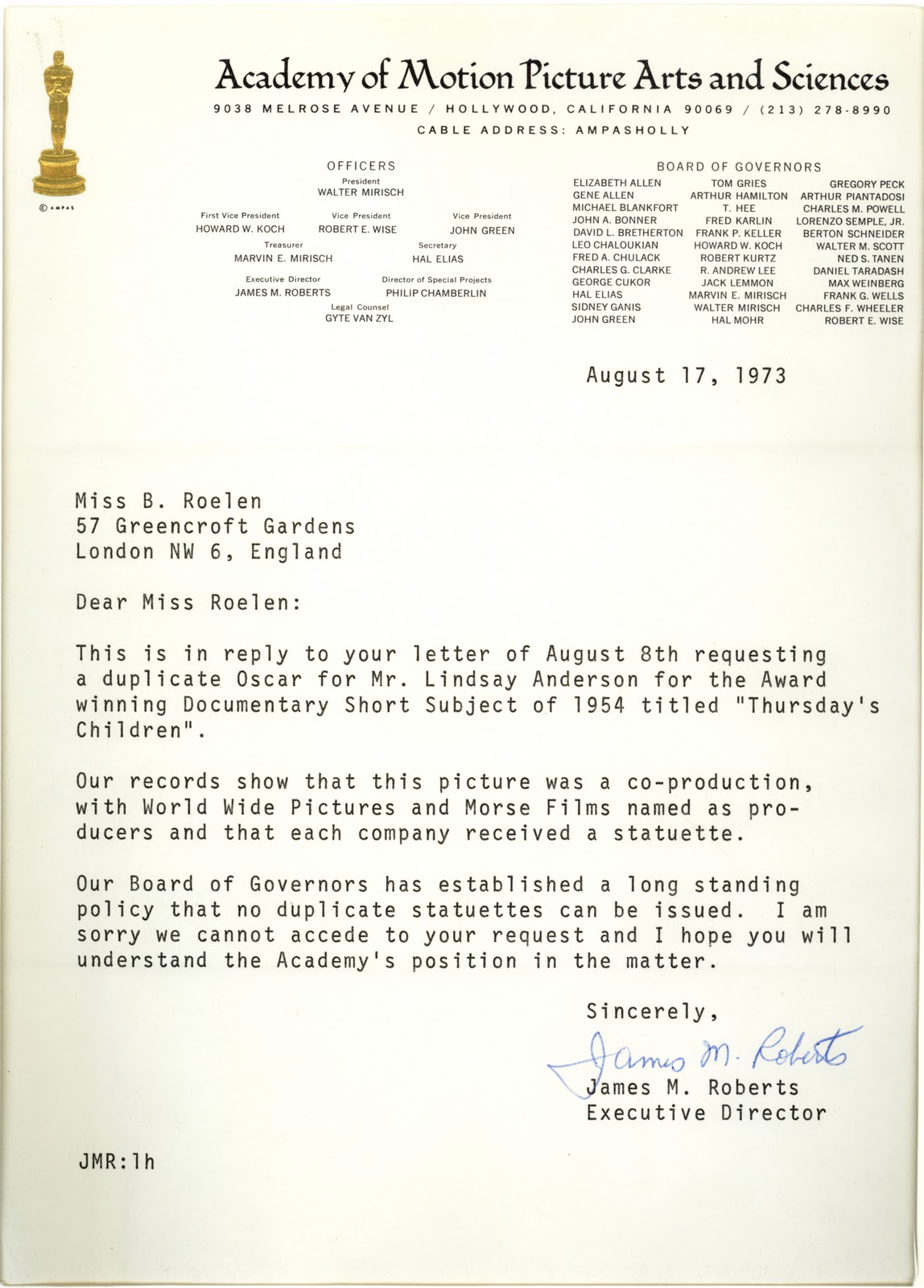
LA/5/01/1/1/4 Letter from the Academy of Motion Picture Arts and Sciences to Brigitte Roelen (Lindsay Anderson's secretary), 17/08/1973
© Lindsay Anderson Collection, University of Stirling Archives

It wasn’t until a few months later, whilst going through the correspondence, that this puzzle was solved.  A letter from Lindsay Anderson’s secretary to the Academy of Motion Picture Arts and Sciences, dated 8 August 1973, was the first step in uncovering the story of the Oscar.  She explains that the Award for Thursday’s Children was collected by Anderson’s co-director as Anderson was unable to attend.  The letter is to enquire if it is possible for Anderson to receive a replica of the Oscar statue.  The Executive Director of the Academy replied only a week later on 17 August 1973.  He explained that “Our Board of Governors has established a long standing policy that no duplicate statuettes can be issued”.  Well, this must have disappointed Anderson greatly, enough in fact that he discussed it with his friends.  How do we know this?  Because at a meeting of the Lindsay Anderson Memorial Foundation’ we found out it was friends of his who bought him a replica Oscar to fill the gap on his mantelpiece where the statuette should have stood!  So we now knew the story behind the Oscar in our collection and, although a real Oscar would have been a wonderful addition to the Collection, I think the story the fake Oscar tells is far more interesting.  


'Oscar' on display in the James Hockey Gallery, University College for the Creative Arts, Farnham
© Lindsay Anderson Collection, University of Stirling Archives

The ‘Oscar’ and the letters to and from the Academy are now regular features in an exhibition ‘Is That All There Is? An exhibition of archive material from the Lindsay Anderson Collection’.  This exhibition has been on display at the Changing Room Gallery in Stirling, The MacRobert Arts Centre at the University of Stirling and the James Hockey Gallery at the University College for the Creative Arts, Farnham.

(Originally written 14/08/2010)

Post Script:
The Oscar is now part of a new exhibition display Treasure from our Collections at the newly refurbished University of Stirling Archives and Special Collection

Wednesday, 23 February 2011

Fun with statistics

Now, if you'd asked me any time up until this if I could have fun with statistics the answer would have been a very quick and very clear No!  However I've since rediscovered the StatCounter account I set up when I started Archives and Auteurs and I am amazed to find myself idly browsing my blog's statistics.   The reason I remembered about the account was thinking about the work Flickr I recently set up with Zoe Viney for the Wessex Film and Sound Archive.  We couldn't find any way for collecting statistical information through Flickr beyond the basic page views information.  I remembered about StatCounter and surprised myself by remembering my user name and password as well.  It had still been running even though I haven't been logging in but as I hadn't added my new IP addresses (work and home) to the list of addresses not to count then I think my results might be slightly skewed.  So, if anyone else is setting up StatCounter or any similar statistical service then it is always best to block your own computer's IP address so your figures are more accurate, unless your memory is really bad and you want to keep count of your own views of course.


The images I've included below show the breakdown by country of visitors to my blog over the course of last week, then the second one lists in more detail every country that views have come from.  you can narrow this down to city as well.  Other useful things you can check are which pages are the most popular, which websites people are directed to your site from, how long they stay (this can sometimes be a bit painful), and lots of other useful, or useless, information depending on your point of view/general inclination to nosiness.


What I found most useful was information on how people had found my blog - what terms they had searched for or what website they had come from.  This made me think more about the tagging I use on my posts and I have resolved to try and be a bit more thorough in my tagging - treating it more like my actual cataloguing work than I have done in the past.  

I haven't started using it yet for the WFSA Flickr account for two reasons, the first being I thought I would try it first with my Flickr account to see if it worked.  With StatCounter, and I assume it is similar whatever software you use, you have to input the HTML code in to your profile on Flickr then add the web pages to your statistic software account.  I'm find doing this with my own account but I was a bit unsure with the work one - does this give them access to other information on your Flickr account, do they have rights over the statistical data as it is displayed on their account?  These questions are things I would rather investigate more fully before using it for workplace statistics - but for now I'll keep enjoying using it for my own web pages.

Tuesday, 22 February 2011

on Marginalia

Thanks to a few links on Twitter I just got directed to an article in the New York Times 'Book Lovers Fear Dim Future for Notes in the Margins' (20/02/2011).  The article doesn't discuss the issue of writing in the margins on digital books, except to quote G. Thomas Tanselle, a former vice president of the Kohn Simon Guggenheim Memorial Foundation and an adjunct professor of English at Columbia University “People will always find a way to annotate electronically... But there is the question of how it is going to be preserved. And that is a problem now facing collections libraries.” I don't own a Kindle or other digital book so don't know if it is possible to write in the margins so to speak - does anyone else know, has anyone tried to do it? 

What it does discuss is the history of marginalia, or writing in the margins of books.  It gives various examples including a book The Pen and the Book about making a profit in publishing.  the book in itself is not particularly valuable for it's original content, instead it is the notes in the margins that qualify it to be held in an Archive.  The notes were written by Mark Twain and they include very scathing comments about the author, Walter Besant.  Twain noted in pencil that "nothing could be stupider" in regards to Besant's argument that advertising could be used to sell books.

The Lindsay Anderson Archive holds Anderson's personal book collection and how I wish now that I'd spent a few evenings going through all the books in it more thoroughly for annotations as the ones I did find were great! The one I most remember is one that has been used by me and by Karl Magee (the University Archivist at Stirling).  The book in question is Hollywood England: the British Film Industry in the Sixties, Alexander Walker, 1974.  In one section Walker talks about the failings of British cinema to produce Auteurs 'Where in the period under review does one look for the British equivalent of Bergman, or Forman, or Rohmer, or Antonioni, or Truffaut of even Godard? The answer is, nowhere.'.  In his characteristic red pen Lindsay Anderson has boldly underlined this and written in the margins in large red letters 'Thanks!'  I'm sure there must be many more examples of marginalia in the book collection that I just didn't get to - one of the pitfalls of fixed-term contract work I suppose!

Thoughts on using Flickr for Archives

Since last Friday me and fellow cataloguer Zoe Viney have been avidly following our Flickr statistics (really not as boring as it sounds!) and the publicity we did has had a huge impact on viewing figures.  Just using mailing lists such as the Archives NRA list, Hampshire County Council lists, and our Twitter we had over 300 views by the end of the first day (last Friday, 18th February 2011) and as of five minutes ago we have 495 views - pretty good going for five days I would say!  Even though I use Twitter every day, check my mailing lists every day and so on, I was still surprised by the high response rate to our postings.  I think this illustrates the high value which such social networking tools as Twitter, Facebook and Flickr can have for an archive, especially in these difficult times of cuts and closures.

Our original aim was to create an online exhibition which would promote the project we are working on specifically and the Wessex Film and Sound Archive more generally.  This was an additional outcome to the project rather than a core part of it so we had to do it for free, and without using up our cataloguing time.  I had used Flickr before when I worked at Stirling University (see their Flickr here) so I knew how easy it was to set up and to upload images to.  I had never used it to upload videos before but this isn't any different to uploading photos so doesn't take long at all.  What I had thought would take longer was actually making clips from the digital copies of the films.  However this was surprisingly straightforward using Quicktime to select then extract a short section of a film.  The quality of the images varied hugely depending on whether we were doing screenshots from Quicktime files, DVD copies, or taking photographs of a screen showing a VHS copy with the Quicktime files giving the best quality still shots.

The exhibition is 'A Sense of Place' - let me know what you think of it and feel free to add any additional information or comments to the Flickr site.  It is very easy to use Flickr and by using some free publicity, very easy to direct people to your site.  However what seems to be a lot harder, well at least I've found it harder, is encouraging people to interact and communicate with the archives through Flickr.  Our aim now should be to try to generate more user interaction, maybe by posting stills of places or people we can't identify - that's the next project to get started on!

Another thing - trying to set up an exhibition within Flickr, (we don't have Flickr Pro so can't use Collections, only Sets)  was tricky.  It was only due to Zoe's persistence with sorting out the links that it works (well, we think it works, let us know what you think).  it took a lot of tweaking to get it so that we could create themes then link to a set of images from a particular film.  Flickr Pro would help with this as you could create Collections, then Sets within the Collections - if the exhibition and our general use of Flickr proves to be a success then we hope that Flickr Pro is something the Record Office would consider investing in (not that it's a huge investment really, just $25).

I think this clip below shows just how much you can get out of a 1 minute 30 second clip - there is just so much going on at this market and fair!  The film is titled 1939 - 1963 Then and Now as the filmmaker Eda Moore spliced together footage of Salisbury (her hometown) across this date range to show what had changed, and what had stayed the same.


AV509/3 - Eda Moore 1939 - 1963 Then and Now